For: PTE Academic learners who need a calm, repeatable way to plan and write a focused argumentative essay in 20 minutes
What PTE Write Essay practice needs to train
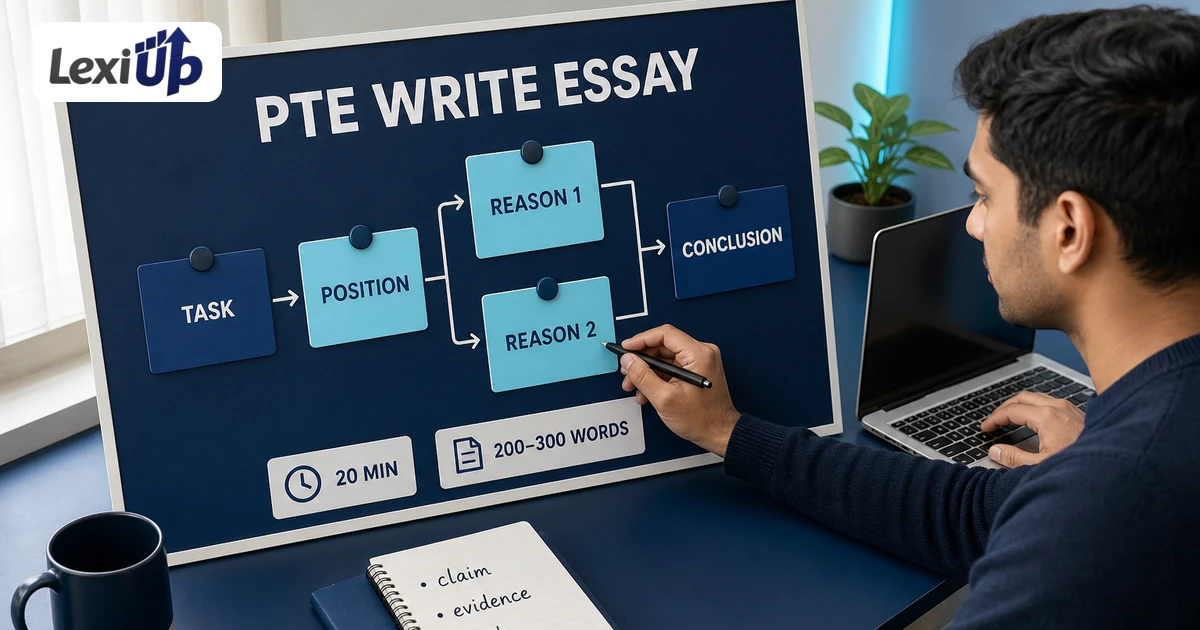
PTE Write Essay practice should train more than fast typing. Pearson currently asks you to write a 200–300 word argumentative essay in 20 minutes. The prompt is short, but your response must identify the task, take a clear position, develop relevant ideas, organise them logically, and control written English at the same time.
A useful routine therefore begins with decisions, not sentences.
The task assesses Writing. Pearson lists seven scored traits: Content, Form, Development, Structure and Coherence, Grammar, General Linguistic Range, Vocabulary, and Spelling. These traits are related, but they are not identical.
A grammatically accurate essay can still be weak if it answers only part of the prompt, while a relevant argument can become hard to follow if its paragraphs do not have clear roles.
This guide uses an original planning method and does not reproduce protected assessment prompts or model answers. It is specifically for PTE Academic. PTE Core does not currently include Write Essay, so keep Academic and Core materials separate and confirm the current official format before test day.
LexiUp PTE is independent preparation support and does not issue or guarantee an official Pearson score.
Know the official Write Essay task before practising
Pearson describes the prompt as two or three sentences and gives 20 minutes for one response. The task asks for an argumentative essay on the stated topic, not a general article about a related theme. Read every instruction word carefully.
A request to agree or disagree, discuss two views, explain advantages and disadvantages, or consider a proposed action creates a different job for the essay.
The response should contain 200–300 words. The test screen provides a word counter and cut, copy, and paste controls. Use those tools to check and revise, but do not let them replace a plan.
The safest target is not the maximum number of words; it is a complete answer inside the official range with enough time left to review content and language.
Pearson advises analysing the task before writing and explains that strong responses address the topic, support a position with details or explanations, use multiple paragraphs, and maintain a clear introduction, body, and conclusion.
That guidance supports a simple process: decode the prompt, decide the position, map the reasons, write each paragraph for one purpose, and review each scored trait separately.
| Feature | Official task information | Practice decision |
|---|---|---|
| Prompt | Two or three sentences on a topic | Underline the topic, instruction, and any required viewpoints |
| Response | Argumentative essay | Take a position and support it rather than listing unrelated facts |
| Time | 20 minutes | Protect planning and review time before drafting expands |
| Length | 200–300 words | Use the counter and stay safely inside the stated range |
| Skill | Writing | Practise argument, organisation, grammar, vocabulary, and spelling together |
| Scoring | Seven separate traits | Review the essay through seven focused questions |
Step 1: decode the complete essay task
Begin by separating the prompt into three parts: the topic, the instruction, and the scope. The topic names the issue. The instruction tells you what thinking to show. The scope places boundaries around the answer, such as a particular group, context, consequence, or set of viewpoints.
Missing any one of these parts can turn a fluent essay into an incomplete response.
Circle or note command phrases in plain language. “To what extent do you agree?” requires a position and a degree of agreement. “Discuss both views” requires fair treatment of both positions before your own conclusion. “What are the advantages and disadvantages?” requires a balanced comparison.
Do not answer the task you hoped to see; answer the exact task on the screen.
Rewrite the job in one short question before planning. For example: “Should universities require this change, and why?” This private note is not part of the essay. It acts as a checkpoint for every paragraph. If a planned idea does not help answer that question, remove it or connect it more clearly to the required issue.
- Name the central topic in a few words.
- Mark the instruction or command phrase.
- Identify every viewpoint, group, or condition that must be covered.
- Rewrite the task as one direct question.
- Check that the question still reflects the original scope.
Step 2: choose a clear position with useful boundaries
A position should be clear enough to guide the whole essay. You do not need an extreme opinion. A qualified position can be strong when its boundary is easy to explain: you may agree with a policy in one context but reject it as a universal rule, or accept an advantage while showing why a condition is necessary.
The important point is consistency.
Write a one-sentence position that directly answers your private task question. Then test it against two standards. First, can you explain it with at least two distinct reasons? Second, can every body paragraph connect back to it without changing the meaning? If the answer is no, narrow or simplify the position before you begin drafting.
Avoid choosing a position only because it sounds sophisticated. A complicated claim can demand evidence and language you cannot control in 20 minutes. Prefer a precise argument you can develop over a dramatic claim supported by vague statements.
The score is not improved by pretending certainty where the issue is conditional or by adding an unrelated “balanced” sentence at the end.
| Check | Useful question | Warning sign |
|---|---|---|
| Relevance | Does this sentence answer the exact instruction? | It discusses the topic but avoids the task |
| Clarity | Could a reader state my position in one line? | The stance changes between clauses |
| Support | Can I develop two different reasons? | Both reasons repeat the same idea |
| Scope | Have I kept every required group or condition? | One part of the prompt disappears |
| Control | Can I explain this accurately in 20 minutes? | The claim needs specialist facts I do not have |
Step 3: build a four-part essay map
Turn the position into a route before writing full sentences. A practical four-part map is introduction, reason one, reason two, and conclusion. Each part receives one job. The introduction frames the issue and states the position. Each body paragraph develops one reason. The conclusion returns to the position after the support has been shown.
For each body paragraph, write four short notes: claim, explanation, evidence or example, and link. The claim states the paragraph’s reason. The explanation shows why it matters. The evidence can be a plausible general example or logical consequence; it should not be an invented statistic, named study, or personal story presented as universal proof.
The link connects the paragraph back to the task.
Check that the two reasons are genuinely different. “It saves time” and “it is faster” are one idea. A stronger pair may separate access from quality, short-term effects from long-term effects, or individual impact from institutional impact. Distinct reasons give the essay development and stop the body from becoming one repeated paragraph with different vocabulary.
- Introduction: topic context plus direct position.
- Body 1: first reason, explanation, example, and link.
- Body 2: second reason, explanation, example, and link.
- Conclusion: restate the answer and its main boundary.
Step 4: develop reasons instead of listing claims
Development means carrying an idea beyond its first sentence. After stating a reason, answer “why?”, “how?”, or “with what consequence?”. Then add a concrete illustration that fits the claim. The illustration can describe a realistic situation, process, or comparison. It does not need a fabricated percentage or an authority you cannot verify.
Keep the reasoning chain visible. A useful pattern is claim → explanation → example → significance. Suppose your claim is that flexible learning can widen access. Explain which barrier becomes smaller, illustrate how a learner with work commitments might benefit, and show why that supports the position.
Each sentence adds a new function instead of repeating the same wording.
Do not let an example become a second topic. If the paragraph begins with public transport policy and the example turns into a long story about one city, the task may disappear. Use enough detail to make the reason credible, then return to the essay question.
The link can be brief, but it should show why the paragraph changes the reader’s judgement.
| Part | Purpose | Self-check |
|---|---|---|
| Claim | State one reason that supports the position | Is it different from the other body paragraph? |
| Explanation | Show how or why the reason works | Have I moved beyond a label? |
| Example | Make the explanation concrete | Is it plausible and free of invented evidence? |
| Significance | Connect the reason to the task | Does the paragraph support my actual position? |
Step 5: give every paragraph one clear role
The introduction should orient the reader without using most of the word budget. Paraphrase the issue accurately, then state the position. Avoid opening with a universal claim such as “Since the beginning of time” or a memorised sentence that could fit any topic. A direct introduction makes the body easier to follow and protects relevance.
Start each body paragraph with its controlling idea. Arrange the remaining sentences so that the explanation and example support that idea in order. Use transitions when they express a real relationship, not as decoration. “However” signals contrast; “therefore” signals result; “for example” introduces an illustration. A connector cannot repair two sentences whose meanings do not connect.
The conclusion should answer the task after the evidence, not introduce a new argument. Restate the position in fresh, accurate wording and summarise the main basis for it. If your argument was qualified, keep the qualification. A sudden absolute conclusion can contradict an otherwise careful essay and weaken coherence.
- Introduction: frame the exact issue and state the position.
- Body paragraph one: develop the first independent reason.
- Body paragraph two: develop the second independent reason.
- Conclusion: return to the position without adding new evidence.
Step 6: control grammar and vocabulary under time pressure
General Linguistic Range does not require every sentence to be long. Use a controlled mix of simple, compound, and complex structures. A clear main clause can carry the central claim, while a subordinate clause can add a condition, reason, or contrast. Vary structure only when you can keep agreement, reference, and punctuation accurate.
Choose vocabulary for precision and context. Academic writing benefits from specific verbs and nouns, but an unusual synonym is not automatically better. Keep technical terms that have no safe replacement, and avoid changing a prompt word into something with a different strength. Check common word partnerships, word form, and whether each pronoun has a clear reference.
Leave time for spelling because familiarity hides errors. Read slowly from the final paragraph backwards or scan one line at a time. Look for repeated mistakes in endings, articles, subject–verb agreement, and words you typed quickly. Correct an error you can see; do not rewrite a complete sentence in the final minute unless its meaning is genuinely unclear.
- Prefer accurate sentences over uncontrolled length.
- Use connectors only for relationships that are actually present.
- Keep word choice natural, relevant, and appropriate for an academic essay.
- Check spelling, word form, agreement, articles, and punctuation separately.
Step 7: review all seven scored traits
A general reread often notices only the sentences you already like. Use seven short questions instead. Begin with Content: did you answer every part of the prompt and support the position? Then check Form: is the response an essay in the required 200–300 word range? These two questions protect the basic task before you polish individual words.
Next review development and organisation. Does each paragraph have one role, and does each reason receive an explanation and relevant support? Can a reader follow the position from introduction to conclusion? Then inspect Grammar and General Linguistic Range. Check the accuracy of sentence boundaries and the controlled variety of structures across the whole response.
Finish with Vocabulary and Spelling. Replace a vague or inaccurate word only when you know a clearer option. Scan for repeated terms, but do not force synonyms that change the meaning. Confirm spelling in the words that carry the topic and argument. The final check should make the essay more accurate, not merely more decorative.
| Trait | Final question |
|---|---|
| Content | Did I answer every required part with relevant support? |
| Form | Is this an essay of 200–300 words? |
| Development, Structure and Coherence | Do the paragraphs develop distinct reasons in a logical route? |
| Grammar | Are sentence boundaries, agreement, and punctuation accurate? |
| General Linguistic Range | Did I use enough controlled structural variety to express the argument? |
| Vocabulary | Are word choices precise, natural, and appropriate? |
| Spelling | Have I checked the words most likely to contain typing errors? |
Use a practical 20-minute essay workflow
The timing below is a practice framework, not an extra Pearson rule. It reserves four minutes for analysis and planning, thirteen minutes for writing, and three minutes for review. Adjust the split after several timed attempts, but keep all three stages.
A learner who begins drafting immediately may gain a minute at the start and lose several minutes reorganising later.
During planning, write only keywords. Confirm the task, position, and two reasons. During drafting, follow the map and watch the word counter at paragraph boundaries instead of after every sentence. If one paragraph grows too long, finish its current reasoning chain and shorten low-value framing before removing the evidence that makes the reason clear.
During review, follow the seven-trait order. Do not spend all three minutes replacing vocabulary. Relevance, task completion, and paragraph logic come first. Then correct grammar, wording, and spelling. Submit when the essay is complete and accurate inside the official range, even if one sentence could be made more elegant with unlimited time.
| Time | Action | Output |
|---|---|---|
| 0–2 minutes | Decode topic, instruction, and scope | One direct task question |
| 2–4 minutes | Choose position and map two reasons | Four-part essay route |
| 4–6 minutes | Write the introduction | Issue plus clear position |
| 6–11 minutes | Develop body paragraph one | Claim, explanation, example, link |
| 11–16 minutes | Develop body paragraph two | A distinct second reasoning chain |
| 16–17 minutes | Write the conclusion | Restated position and boundary |
| 17–20 minutes | Review all seven traits | Relevant, controlled final response |
Build a focused PTE Write Essay practice review loop
Improvement becomes clearer when each attempt produces one reusable lesson. After writing, keep the original response and mark the first point where the argument weakened. It may be a missed instruction, repeated reason, unsupported claim, unclear paragraph link, grammar pattern, vague word, or spelling habit. Choose the issue with the largest effect on meaning or organisation.
Revise only the relevant part, then test the same decision on a different original topic. If you missed the task instruction, decode three new prompts without writing full essays. If the body lacked development, plan claim–explanation–example–significance chains for two new issues.
If grammar caused the problem, rewrite the affected sentence pattern with new content instead of memorising one corrected sentence.
Return one or two days later and complete a fresh plan without looking at the correction. This delayed check shows whether the decision is available from memory. Use authorised practice material and current Pearson guidance as periodic format checkpoints. Do not copy protected questions, and do not treat an AI or teacher-style review as an official score report.
- Save the original essay and word count.
- Identify the first high-impact problem.
- Name the scored trait most closely connected to it.
- Correct one paragraph or sentence pattern.
- Apply the correction to a different original topic.
- Repeat the decision after a one- or two-day delay.
- Use the evidence log to choose the next practice focus.
Frequently asked questions
Is Write Essay in PTE Academic or PTE Core?
Write Essay is currently a PTE Academic task. Pearson does not list it in the current PTE Core format, so use Academic instructions and materials for this routine.
How long do I have for PTE Write Essay?
Pearson currently gives 20 minutes to write one argumentative essay. Use part of that time to analyse and plan, and protect a final review window.
How many words should the essay contain?
The official task requires 200–300 words. Use the on-screen counter and aim for a complete response safely inside that range rather than treating 300 as a target.
What traits are scored?
Pearson lists Content, Form, Development, Structure and Coherence, Grammar, General Linguistic Range, Vocabulary, and Spelling.
Should I memorise one essay template?
A fixed template can pull the response away from the actual prompt. Practise a flexible decision route—task, position, reasons, paragraph roles, and seven-trait review—then write language that fits the topic.
Does LexiUp provide an official essay score?
No. LexiUp PTE provides independent preparation support. Its guidance is not a Pearson score report and cannot guarantee an official result.
Sources and review note
This guide was reviewed against the sources below. LexiUp remains independent of the exam owners.