For: PTE Academic and PTE Core learners who want a calm, accurate method for answering short recorded questions
What PTE Answer Short Question practice should train
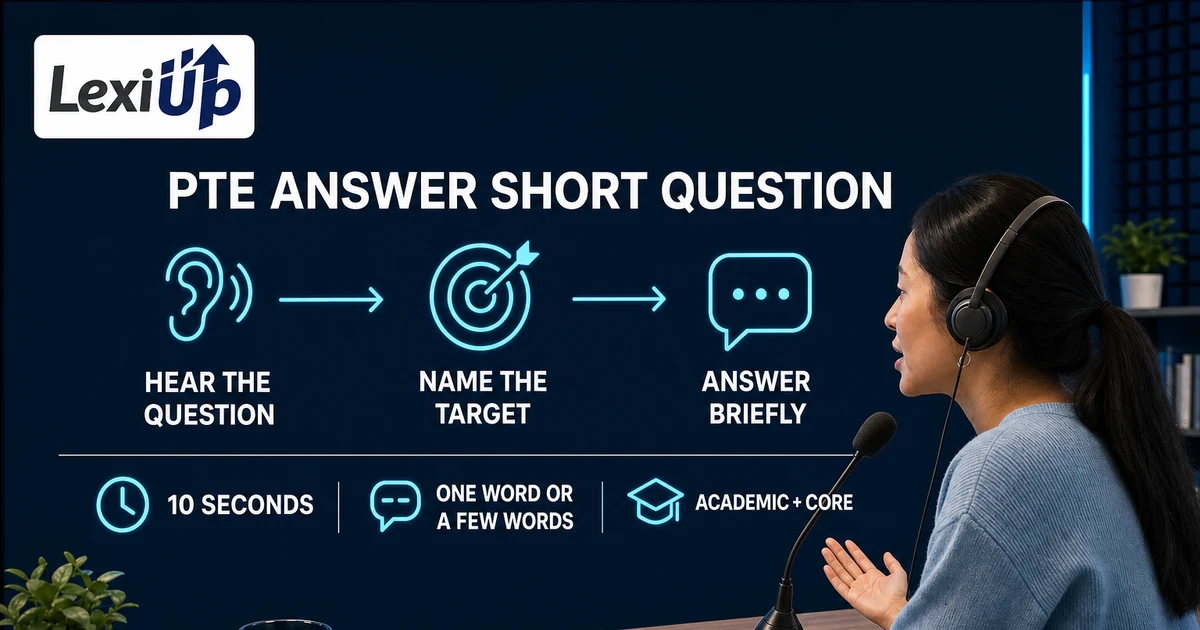
PTE Answer Short Question practice should train a small but complete listening decision. You hear a recorded question, identify exactly what information it requests, retrieve one accurate term, and say that answer clearly. Pearson says one word or a few words is enough. A longer explanation earns no extra marks and can make a simple response less controlled.
Pearson currently includes Answer Short Question in both PTE Academic and PTE Core. In each test, the prompt lasts 3–9 seconds, the microphone opens after the recording, and you have 10 seconds to answer. There is no short tone before recording begins, so you need to be ready to speak as soon as the status changes to Recording.
The scoring contribution is not identical across the two tests. Pearson lists the PTE Academic task as affecting Listening, while the PTE Core task affects Listening, Speaking, and Vocabulary. Both versions judge whether the words in the response are appropriate; an incorrect response or no response receives no credit.
Keep the version you booked visible in your practice notes so you do not merge their scoring descriptions.
- Compare the current PTE Academic test format →
- Check whether PTE Academic or PTE Core fits your goal →
| Feature | PTE Academic | PTE Core |
|---|---|---|
| Prompt | Recorded question, sometimes with an image | Recorded question, sometimes with an image |
| Prompt length | 3–9 seconds | 3–9 seconds |
| Answer time | 10 seconds | 10 seconds |
| Response | One word or a few words | One word or a few words |
| Scoring contribution | Listening | Listening, Speaking, and Vocabulary |
| Credit | Correct or incorrect | Correct or incorrect |
Step 1: settle before the recording starts
Use the moment before the audio to stop reading the previous item and reset your attention. Confirm that the next task is Answer Short Question. Your job is not to repeat the recording or build a full explanation. You need to understand the question and supply its missing piece of information.
Keep your posture steady and your mouth at a consistent distance from the microphone. Avoid touching the headset or moving the microphone once the recording is about to start. A comfortable position reduces the chance that you will delay the answer while adjusting equipment.
If an image appears, take in its broad subject without guessing the answer before the question. The recording decides what is being asked. The same picture could support a question about a place, object, action, quantity, or relationship, so let the spoken wording direct your attention.
Step 2: hear the question word and the main noun
Listen first for the question word or question frame. Who asks for a person, where for a place, when for a time, why for a reason, and how many for a number. What and which need more help from the rest of the sentence, so hold the main noun and verb as well.
Reduce the question to a small target while you listen. “What do we call a person who designs buildings?” becomes PERSON + DESIGNS BUILDINGS. “Where are historical objects displayed?” becomes PLACE + HISTORICAL OBJECTS. The target is easier to retrieve than the complete wording of the recording.
Do not chase every function word. Articles, auxiliaries, and polite framing can help grammar, but the answer usually depends on a few content words. Protect the question word, the category being requested, and the strongest clue. That small set is your retrieval route.
| Question signal | Likely answer type | Target to hold |
|---|---|---|
| Who / what person | Person or role | Role + defining action |
| Where / what place | Place | Place + purpose |
| When | Time or period | Event + timing clue |
| How many / how much | Number or quantity | Item + unit |
| What is used for | Object or tool | Function + context |
| Why | Brief reason | Cause or purpose |
Step 3: name the answer category before the word
If the answer does not arrive immediately, name its category first. Decide whether you need a person, place, object, process, unit, subject, or short reason. Category retrieval narrows the search and prevents a related but grammatically wrong word from taking control.
Use the definition inside the question. A prompt may describe an object by its purpose, a profession by its work, or a place by what happens there. Keep the defining relationship intact. If the question asks for the place where books are borrowed, “reading” is related to the topic but does not name the requested place.
When an image is present, use it to confirm the category, not to replace listening. A picture of a laboratory may contain a scientist, microscope, glassware, and safety equipment. The question word and verb tell you which of those visible ideas matters.
Step 4: retrieve the shortest complete answer
Choose the shortest wording that answers the exact question. A single noun often works. Some prompts need a short noun phrase, number with a unit, or brief reason. Pearson explicitly says one word or a few words is enough, so you do not need to turn every response into a full sentence.
Check that the form of the word fits. A question asking for a person may need “architect,” not “architecture.” A question asking for an action may need a verb or gerund rather than a related noun. This quick grammar check helps separate the requested answer from a familiar word in the same topic family.
Accept common natural alternatives only when they preserve the same meaning. During independent practice, build answer keys with one preferred response and any genuinely equivalent variants. Do not treat a broad related term as correct merely because it belongs to the same topic.
Step 5: begin when the microphone opens
Watch the recording status without staring away from your answer. Pearson says the microphone opens after the audio and there is no short tone. Start when the status changes to Recording. Waiting for a sound that never comes can waste the cleanest part of the 10-second response window.
Say the answer once at a natural pace. Speak clearly and use normal stress. You do not need to rush, exaggerate every sound, or add an introduction such as “The answer is.” Those additions consume time without improving the accuracy of the requested word or phrase.
In PTE Core, Pearson warns that a three-second pause while speaking can change the status to Completed. The safest response is short and continuous. In either test, finish the answer before the progress bar reaches the end and then move on when the item is complete.
Step 6: use a controlled recovery when recall is slow
If the exact word is slow to appear, return to the target rather than replaying the whole question in your head. Ask: person or place? object or action? what defining clue did I hear? This route keeps the search close to the information the recording actually requested.
Do not fill the silence with unrelated explanation. Extra language can introduce an incorrect claim and makes it harder to deliver the useful answer clearly. If you have one supported term, give it. If two natural words are needed to complete the idea, say the short phrase once.
If you genuinely cannot retrieve the answer, make one evidence-based attempt and release the item. The task is scored correct or incorrect, so a long uncertain monologue does not create partial credit. Protect attention for the next question instead of carrying the missed word forward.
Step 7: review the listening decision, not only the word
After practice, classify the first point of failure. Did you miss the question word, lose the main noun, choose the wrong answer category, know the concept but not the English term, or delay after the microphone opened? Each problem needs a different repair.
Keep a compact error log with four fields: question target, your answer, accepted answer, and error label. Add the corrected word to a short retrieval list only when vocabulary was the problem. If listening was the problem, replay the question and mark the exact words that revealed the category.
Review several attempts before deciding what to train. One unfamiliar word does not prove a broad vocabulary weakness. A repeated pattern—such as hearing the topic but missing whether the question asks for a person or place—shows a more useful practice priority.
| Observed problem | Likely cause | Next practice action |
|---|---|---|
| Related answer, wrong category | Question word was not protected | Repeat only the target-identification step |
| Concept known, word unavailable | Retrieval vocabulary gap | Build category-based word pairs |
| Correct word arrived too late | Whole question was replayed mentally | Use category + defining clue |
| Answer began before recording | Status cue was ignored | Practise with a visible start cue |
| Long answer became unclear | Full-sentence habit | Respond with one word or a few words |
Build a focused 20-minute practice session
Use original general-knowledge questions or authorised preparation material. Group the first six questions by answer category: people, places, objects, times, quantities, and reasons. Then mix the categories so the question wording, not the practice order, determines your target.
Spend five minutes identifying targets without answering. Use the next five minutes to retrieve short answers without a timer. Then complete eight to ten one-play questions with a visible recording cue and a 10-second limit. Finish by reviewing only the two most useful errors.
Change one variable at a time. If you are training category detection, keep vocabulary familiar. If you are training retrieval, keep the recording clear and the question structure simple. If you change accent, vocabulary, speed, and image support together, you will not know which part caused the error.
| Time | Practice action | Evidence to keep |
|---|---|---|
| 0–5 min | Identify the requested category | Person, place, object, time, quantity, or reason |
| 5–10 min | Retrieve the shortest complete answer | Preferred word and safe variants |
| 10–16 min | Complete one-play timed questions | Start cue, answer, and response delay |
| 16–19 min | Review two errors | First point of failure |
| 19–20 min | Choose one correction | Single action for the next session |
Build useful questions without copying protected material
Write fresh questions from ordinary public knowledge, study subjects, workplace situations, and daily life. Keep each question self-contained and make sure one short answer is clearly supported. Avoid recalled test items, copied commercial question banks, or wording presented as an official Pearson question.
Vary the route to the answer. Define a profession by its work, an object by its purpose, a place by its activity, a unit by what it measures, or a process by its result. Use images only when they add a real clue. Every item should test listening and retrieval, not ambiguity about what the writer intended.
Ask another competent English user to review unclear items. Record the question at normal conversational speed with clean audio. Keep a source note for any factual claim and revise questions that allow two equally reasonable categories. Reliable practice teaches a stable decision that can transfer to new prompts.
Build retrieval vocabulary by category
Short-answer vocabulary becomes easier to retrieve when related words are organised by function rather than kept in one long list. Build small groups for professions, public places, tools, measurements, natural processes, academic subjects, transport, health, and everyday services. For each word, keep a plain definition and one question that points to it.
Practise in both directions. Hear a definition and name the word, then see the word and explain its defining function in simple English. The second direction checks that the label is connected to meaning rather than memorised as an isolated sound.
Mix old and new categories after the first accurate recall so the order cannot become a hidden clue.
Record pronunciation only when it blocks a clear response, and keep the correction specific. Mark the stressed syllable, a missing final consonant, or one confusing vowel instead of judging the whole answer as poor speaking.
PTE Academic and PTE Core publish different skill contributions for this task, but in both versions the useful first goal is still an appropriate answer that the recording captures clearly.
Review delayed recall instead of repeating the same card ten times in one sitting. Revisit a small group the next day, then use those words inside fresh questions a few days later. Remove words that remain consistently available and spend more time on categories where you understand the definition but cannot retrieve the English term promptly.
| Category | Example relationship to practise | Review question |
|---|---|---|
| Profession | Person + specialised work | Can I name the role from its work? |
| Place | Location + main purpose | Can I separate related places? |
| Tool | Object + function | Do I know the precise object, not only the topic? |
| Measurement | Quantity + unit | Can I include the required unit? |
| Process | Change + result | Can I name the process rather than describe it? |
Connect short-answer practice to wider PTE skills
Answer Short Question is brief, but its listening habits transfer. Protecting question words helps with listening multiple choice. Naming an answer category supports missing-word prediction. Beginning promptly after a cue also helps other recorded speaking tasks, although their content and scoring criteria are different.
Keep those connections limited. A one-word answer does not train the extended organisation needed for Retell Lecture or Respond to a Situation. Use each task for its own decision, then connect only the underlying skill: listening for purpose, retrieving precise vocabulary, or responding to a recording cue.
Place the task inside a balanced study week rather than repeating hundreds of general-knowledge questions. Mix short retrieval with longer listening, reading, writing, and speaking work for the test you booked. The goal is flexible English use, not memorisation of a private answer list.
Use a final PTE Answer Short Question practice checklist
Before the recording, confirm the task and settle your microphone position. While listening, protect the question word, main noun, and defining clue. Name the answer category, retrieve the shortest accurate term, and speak when the status changes to Recording.
After practice, review where the decision first failed. Separate listening, category, vocabulary, and microphone-cue errors. Choose one correction for the next session and test it on fresh original questions rather than memorising the previous answers.
This PTE Answer Short Question practice routine cannot predict an official result. It gives you a consistent way to understand a brief question, answer only what was asked, and learn from a visible error without adding unnecessary language.
- I know I need one word or a few words, not an explanation.
- I heard the question word and the main content clue.
- I named the requested answer category.
- I chose the shortest complete and accurate response.
- I began when the microphone status changed to Recording.
- I reviewed the first point of failure after practice.
Frequently asked questions
Is Answer Short Question in PTE Academic and PTE Core?
Yes. Pearson currently lists Answer Short Question in both tests. The task format is similar, but the published scoring contribution differs between PTE Academic and PTE Core.
How long should the answer be?
Pearson says one word or a few words is enough. There are no extra marks for adding a longer explanation.
How much time do I have?
The recorded prompt lasts 3–9 seconds and the answer time is 10 seconds in both PTE Academic and PTE Core.
Should I wait for a tone before speaking?
No. Pearson says there is no short tone. Start when the recording status changes to Recording.
How is the task scored?
The response is correct or incorrect based on whether its words are appropriate. Pearson lists PTE Academic Answer Short Question under Listening, while PTE Core contributes to Listening, Speaking, and Vocabulary.
Does LexiUp provide an official Pearson score?
No. LexiUp PTE supports independent preparation and review. It does not issue or guarantee an official Pearson score.
Sources and review note
This guide was reviewed against the sources below. LexiUp remains independent of the exam owners.