For: Candidates who missed their target on exactly one component and are deciding between resitting that section and booking a whole new test
IELTS One Skill Retake exists for one specific situation
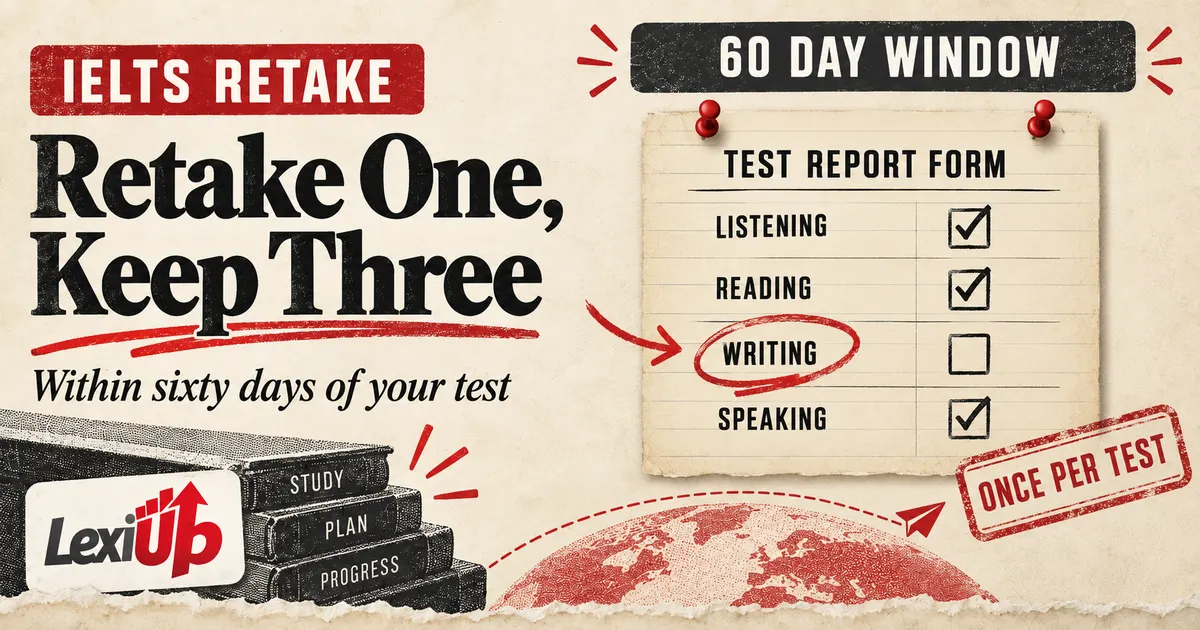
You sat the full test. Three components landed where you needed them and one did not. Under the old rules your only option was to book the whole test again, pay the whole fee, and risk the three good scores coming back lower. IELTS One Skill Retake removes that risk by letting you resit a single section.
You can retake any one of Listening, Reading, Writing or Speaking, instead of retaking all four. It is available for both IELTS Academic and General Training, and it is widely available worldwide, though availability still depends on your test centre.
That is the whole idea. The rules around it are where people get caught, and there are five of them worth knowing before you book anything, including before you book your original test.
Rule one: your original test must be on computer
The retake is only open to candidates whose original test was an IELTS on computer test. This is the rule that catches people, because it applies retrospectively to a decision you made when booking the first test, and by then it is too late to change.
It follows that the decision point is earlier than most people think. If there is any chance you will want a second attempt at one section, the delivery route you choose for the original test decides whether that option exists at all.
Rule two: the centre has to offer it, and you check first
The IELTS partners are explicit about the sequence: make sure your test centre offers IELTS One Skill Retake before booking your full test. Not every centre does, and a centre that does not offer it cannot retrospectively give you access because you did well in three sections.
This takes one email. Ask the centre directly whether they offer One Skill Retake, and keep the reply. It costs nothing and removes the worst version of this situation, which is finding out after results day.
Rule three: 60 days, and the clock starts on your original test day
You must complete the retake within 60 days of your original test day. Not 60 days from results day, and not 60 days from when you decided to try again. From the day you sat the full test.
In practice results take several days to arrive, then you need a booking slot, so the usable preparation window is meaningfully shorter than 60 days. Treat it as roughly six or seven weeks of actual study time, and plan the work backwards from the latest date a slot is available rather than forwards from today.
- Build a study routine that fits the weeks you have →
- Review mistakes so the retake changes something →
- Write your original test date on a calendar and mark day 60.
- Mark the date your results arrived; that is when your real preparation starts.
- Check available retake slots now, not later, and book one that leaves you a working margin.
- Plan the weeks between results and the booked slot around the single criterion that cost you the band.
Rule four: once per original test
You can only take One Skill Retake once per original test. If the retake does not reach your target, you cannot retake that section again against the same original sitting; the next step is a full test.
That single attempt is a reason to be honest about readiness before booking the slot. A retake booked in the first week of panic, before you have identified what actually went wrong, spends your one attempt on the same performance that produced the first score.
Rule five: you end up with two Test Report Forms and a choice
After the retake you receive a new Test Report Form. It carries your updated One Skill Retake score alongside the results for the other three skills from your original test.
You then choose which Test Report Form to use, the original or the new one. That matters more than it first appears: a retake that goes worse than the original does not damage you, because the original remains valid and remains yours to submit.
The downside of a retake is the fee and the time, not the risk of a lower score replacing a good one.
Confirm separately that your receiving organisation accepts a One Skill Retake Test Report Form. Most do, but acceptance is the organisation’s decision rather than the test partners’, and it is a cheaper question to ask before booking than after.
Deciding between a retake and a full test
Take the retake when exactly one component missed, the gap is small, and you can name the specific reason it missed.
Take a full test when two or more components missed, when the gap in the weak component is a full band or more, or when your original test was on paper and the retake is not open to you.
The one case people get wrong is a narrow miss on Speaking. It feels like the least fixable component, so candidates rebook everything.
In fact Speaking is often the fastest to move, because the marking criteria are narrow and a specific habit, such as one-word answers in Part 1 or losing fluency while searching for an impressive word, can be addressed in a fortnight.
Frequently asked questions
Can I use IELTS One Skill Retake if I sat the paper test?
No. The retake is available to candidates whose original test was an IELTS on computer test. This is decided when you book the original test, which is why the delivery route matters before you sit rather than after.
How long do I have to book the retake?
You must complete the retake within 60 days of your original test day. The clock starts on the day you sat the full test, not the day results arrived, so the usable preparation window is shorter than 60 days once results and booking time are taken out.
What happens if my retake score is lower?
Nothing is lost. You receive a new Test Report Form showing the retake score alongside the other three skills from your original test, and you choose which Test Report Form to use. The original remains valid and remains available to submit.
Can I retake two sections?
No. One Skill Retake covers exactly one section, and you can take it once per original test. If two components missed your target, a full retest is the route.
Is One Skill Retake available for General Training?
Yes. The IELTS partners confirm it is available for both IELTS Academic and General Training tests, subject to your test centre offering it.
Sources and review note
This guide was reviewed against the sources below. LexiUp remains independent of the exam owners.