For: Academic and General Training learners who have a target overall band and want to know exactly which skill bands would reach it, rather than guessing whether an average will round up or down
IELTS band score calculation starts with four separate scores
IELTS band score calculation is not one calculation. It is four, and then a fifth. Listening, Reading, Writing and Speaking are each marked on their own, each produces its own band from 0 to 9, and only once all four exist is the overall band worked out.
Learners who ask how the overall band is reached usually mean that fifth step, but the fifth step can only give back what the first four handed it. Knowing where each of the four numbers comes from is what makes the last one predictable.
Listening and Reading are objective. Forty questions, one mark for each correct answer, and nothing deducted for a wrong one, so the raw score is a whole number out of forty. That raw score is then converted to a band using a conversion table.
Academic Reading and General Training Reading use different tables, because the General Training texts are less demanding, so the same raw mark does not buy the same band in both. Listening uses one table for every candidate.
Writing and Speaking are assessed by trained examiners against published band descriptors, four criteria in each skill. There is no raw mark to convert. The examiner awards a band for each criterion, and those criterion bands become the skill band. Every figure in this guide, including the conversion numbers, is original teaching material written to show the mechanics.
These are not official conversion tables and not official examiner scores, so use the official sources listed at the end for the current published figures.
Work an original example from four skill bands to one overall band
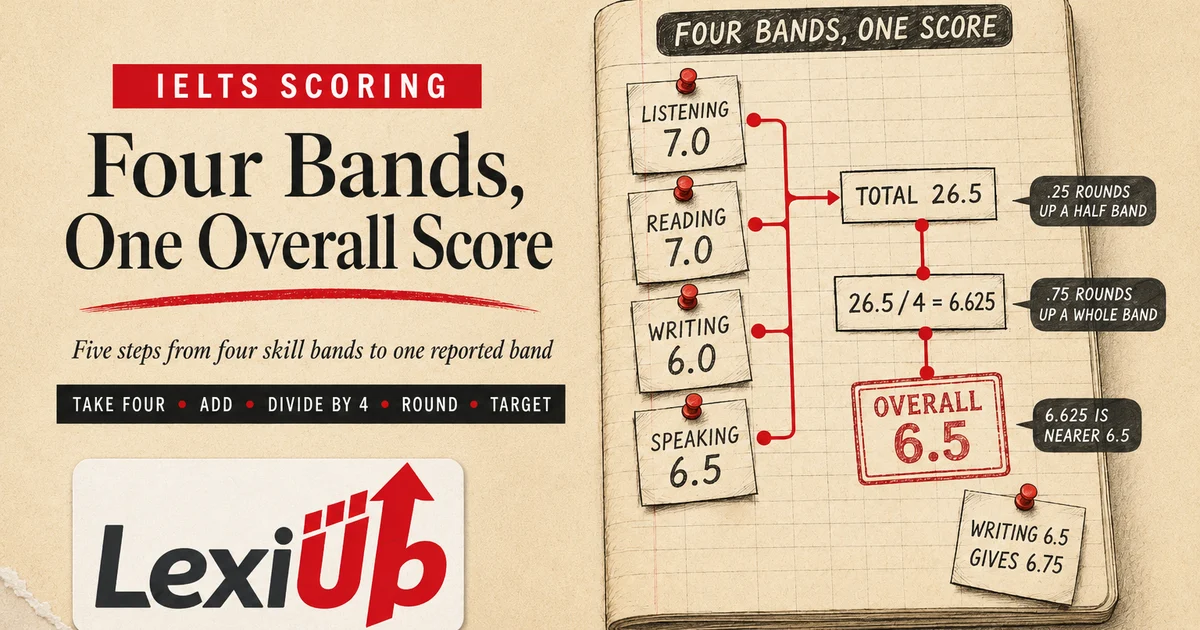
Here is an original worked example written for this article. A candidate sits Academic IELTS and finishes with thirty correct answers in Listening, thirty correct in Academic Reading, a Writing band of 6.0 and a Speaking band of 6.5.
Thirty out of forty sits at roughly band 7 in both Listening and Academic Reading on the indicative tables, so the four skill bands are 7.0, 7.0, 6.0 and 6.5. Nothing about the overall band is visible yet, and this is the point where most predictions are made and got wrong.
Add the four bands and the total is 26.5. Divide by four and the average is 6.625. That is not a reportable number, because results are issued in whole and half bands only, so it has to be rounded, and 6.625 sits nearer to 6.5 than to 7.0. The overall band on the Test Report Form reads 6.5.
The candidate finished an eighth of a band short of the 7.0 they needed, and neither Listening nor Reading was the reason.
Now change one thing. Suppose Writing had come in at 6.5 rather than 6.0. The four bands become 7.0, 7.0, 6.5 and 6.5, the total is 27, and the average is exactly 6.75. That average does not round to 6.5.
It rounds up to 7.0, so one half band in one skill lifts the overall band by a full half band. This is why the cheapest half band in your weakest skill is almost always worth more than another mark in your strongest.
- Turn a Writing shortfall into a plan with the Writing Task 2 band 7 guide →
- Protect the raw marks you already earn in the Listening answer accuracy guide →
| Skill | Evidence behind the band | Band |
|---|---|---|
| Listening | 30 correct out of 40, converted on the indicative table | 7.0 |
| Reading (Academic) | 30 correct out of 40, converted on the indicative Academic table | 7.0 |
| Writing | Examiner bands across the four Writing criteria | 6.0 |
| Speaking | Examiner bands across the four Speaking criteria | 6.5 |
| Total | 7.0 plus 7.0 plus 6.0 plus 6.5 | 26.5 |
| Overall | 26.5 divided by 4 is 6.625, rounded to the nearest half band | 6.5 |
The rounding rule is where predictions usually go wrong
Because every skill band is a whole or half number, the average of four of them always lands on a multiple of 0.125. That gives eight possible endings: .0, .125, .25, .375, .5, .625, .75 and .875.
The published rule is that an average ending in .25 rounds up to the next half band, and an average ending in .75 rounds up to the next whole band. Everything else settles on whichever whole or half band is nearest.
Two averages that sit close together are treated very differently. Bands of 6.5, 6.5, 6.0 and 6.0 average exactly 6.25, a tie between 6.0 and 6.5 that the rule resolves upward, so the overall band is 6.5. Bands of 6.5, 6.0, 6.0 and 6.0 average 6.125, which is nearer to 6.0, so the overall band is 6.0.
One half band in one skill separates those results, and the last half band is always the expensive one to find.
- Take the four reported skill bands, each a whole or half number from 0 to 9.
- Add them together to get a total somewhere between 0 and 36.
- Divide the total by four, which always gives an average ending in .0, .125, .25, .375, .5, .625, .75 or .875.
- If the average ends in .25, round up to the next half band; if it ends in .75, round up to the next whole band.
- Otherwise take the nearest whole or half band, which sends .125 down and .375, .625 and .875 to the closer neighbour.
- 7.0, 6.5, 6.5 and 6.0 average 6.5, and the overall band is 6.5.
- 7.0, 7.0, 6.5 and 6.0 average 6.625, which is nearer 6.5, so the overall band is 6.5.
- 7.0, 7.0, 6.5 and 6.5 average 6.75, which ends in .75, so the overall band rounds up to 7.0.
- 7.0, 7.0, 7.0 and 6.0 average 6.75 as well, and also round up to 7.0.
- 6.5, 6.0, 6.0 and 6.0 average 6.125, which rounds down, so the overall band is 6.0.
Writing and Speaking bands are averages before they are scores
The skill bands you feed into the overall average are themselves averages in Writing and Speaking. Writing is assessed on Task Achievement or Task Response, Coherence and Cohesion, Lexical Resource, and Grammatical Range and Accuracy. Speaking is assessed on Fluency and Coherence, Lexical Resource, Grammatical Range and Accuracy, and Pronunciation.
Each criterion carries equal weight inside its skill, so one weak criterion drags the whole skill band down through exactly the arithmetic you have just seen.
Writing adds a second layer, because the two tasks are combined with Task 2 carrying more weight than Task 1. A strong Task 1 cannot rescue an underdeveloped Task 2, which is why an unfinished second essay costs so much.
The practical consequence is that the criterion you never look at is usually the one setting your ceiling, and a named criterion is far easier to work on than a vague instruction to write better.
Read from the criterion upward and IELTS band score calculation stops being mysterious. Four criteria make a Writing band, four make a Speaking band, two conversion tables make the Listening and Reading bands, and four skill bands make the overall band.
Every one of those steps is an average or a lookup, and every one of them can be practised at deliberately rather than hoped over.
Turn the arithmetic into a study decision
Once you can run the calculation yourself, target setting changes shape. Instead of aiming vaguely at an overall 7.0, work backwards: list the four bands that would reach it, try several combinations, and notice how many succeed with one skill still at 6.5.
Most overall targets can be reached without every skill hitting the same number, and knowing which shortfalls survive the rounding tells you where the next month of study belongs.
Then find the half band closest to arriving. That is rarely the skill you enjoy most. A Reading score two marks below a band boundary is often a faster half band than a Speaking score needing a genuine fluency shift, and a Writing criterion you have never studied is often faster than either.
Diagnose first, plan second, and re-run the calculation after every practice test so the plan keeps following the evidence rather than your preferences.
LexiUp IELTS is built for that loop. It is free to start and, since version 1.0.10, entirely ad-free, and its AI feedback returns a criterion-by-criterion read on a Writing or Speaking attempt so you can see which of the four criteria is holding a skill band down.
The free tier allows five successful AI feedback results in any rolling twenty-four hours. Its band guidance is an estimate meant to steer practice, not an official IELTS examiner score, so treat it as a compass rather than a result.
Frequently asked questions
How does IELTS band score calculation treat an average like 6.625?
It takes the nearest whole or half band, so 6.625 is reported as 6.5. Only averages ending in .25 or .75 are rounded up by rule, to the next half band and the next whole band respectively. An average of 6.125 rounds down to 6.0, and an average of 6.75 rounds up to 7.0.
Do Academic and General Training Reading use the same conversion table?
No. General Training Reading generally requires more correct answers for the same band, because its texts are less demanding than the Academic ones. Listening uses a single table for every candidate. Published conversion figures are indicative and can vary between test versions, so check the official sources for the current numbers.
Is there a penalty for a wrong answer in Listening or Reading?
No. Each of the forty questions is worth one mark and nothing is deducted for an incorrect answer, so leaving a question blank can only cost you. Spelling and grammar do count, though: a correct idea written incorrectly is marked wrong, which is why answer accuracy is worth practising separately from comprehension.
Can my overall band be higher than every individual skill band?
No. The overall band is the average of the four skill bands, so it can never sit above the highest of them or below the lowest. It can, however, finish above the plain average once the rounding rule is applied, which is how an average of 6.75 is reported as an overall 7.0.
Sources and review note
This guide was reviewed against the sources below. LexiUp remains independent of the exam owners.