
For: IELTS learners who understand much of a recording but lose marks through answer format, spelling, or rushed checking
IELTS Listening answer accuracy is a separate skill
IELTS Listening answer accuracy is not only about hearing the right idea. In many practice sessions, a learner understands the conversation but writes too many words, misses a plural ending, copies a number into the wrong space, or changes a clear answer at the last moment. These are not small details to ignore.
They are part of the task. A useful Listening routine needs to protect the answer after you have heard it, not only help you find it.
Official IELTS guidance says that the Listening test has four parts and 40 questions, and that the information for questions follows the order of the recording. It also says that spelling and grammar can matter when you write answers, and that word limits must be followed for completion tasks.
This guide turns those facts into four simple checks for practice. It is not an official IELTS rulebook or a score prediction. It is a calm method for reducing avoidable errors.
What IELTS Listening answer accuracy includes
Think of an answer as having two jobs. First, it must match what the recording says. Second, it must fit the question exactly. A correct idea can still fail the second job if the answer is in the wrong form.
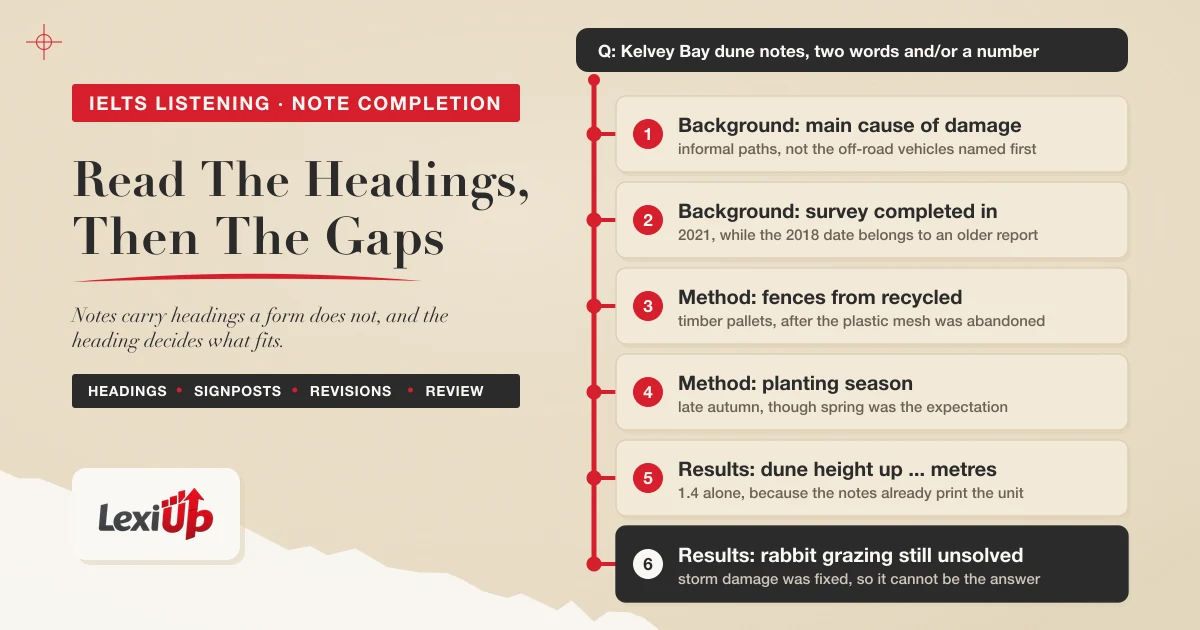
For example, a completion task may need one word, two words and a number, or a letter from a list. Your routine should keep the instruction visible while you listen, so you do not have to remember its limits when the audio is moving on.
The test format is shared by IELTS Academic and General Training for Listening. The recording is played once, and different English accents may be used. That means you cannot rely on replaying a difficult sentence.
Instead, practise the habits that help before, during, and after each part: prepare for the likely answer type, record a clear first answer, and reserve a short check for the details that often change marks. This is more useful than trying to write faster without a plan.
| Moment | Main question | Useful action |
|---|---|---|
| Before the audio | What answer form is allowed? | Circle the word limit and notice the grammar around each gap. |
| While listening | What is the speaker’s final meaning? | Write a clear first answer and keep moving with the recording. |
| At a change of idea | Did the speaker correct or qualify the first detail? | Listen for contrast words and replace an answer only with evidence. |
| At the check | Does every answer fit its task? | Check blanks, spelling, numbers, plurals, and word limits. |
Check 1: read the instruction before the recording begins
Before each part starts, use the reading time to locate the instruction and translate it into a small rule. If the task says “NO MORE THAN TWO WORDS AND/OR A NUMBER”, write a tiny “2 + number” beside the task. If you need two letters, mark that beside the answer area. This is not extra work.
It reduces the chance that you hear a useful phrase and then write more than the answer box allows.
Also look at the grammar around each blank. An article such as “a” or “an” can suggest a singular noun. A plural verb can suggest that a plural noun will fit. A price, time, date, place, or name may need a different kind of attention. You are not trying to guess the exact answer before listening.
You are preparing your eyes to recognise what kind of answer belongs there. This makes the recording feel less sudden when it starts.
- Underline the exact word or number limit.
- Notice whether the gap is likely to need a noun, number, name, or place.
- Check whether the task requires one answer or several answers.
- Keep the instruction in view while you write.
- Do not add extra helpful words that the question did not request.
Check 2: predict the answer shape, not the answer
Prediction is often misunderstood. It does not mean deciding the answer before you hear the recording. It means using the question to prepare for a category. If a form asks for a “cost”, expect a price or number. If a note says “located near the”, expect a place. If a sentence has “three”, expect a plural noun.
This light preparation helps you recognise relevant information without filling your notebook with risky guesses.
Keep predictions simple. A long list of possible answers can make you listen for your own ideas instead of the speaker’s meaning. It is better to write a small symbol such as $, P, or N for price, place, or noun. Then listen for the complete phrase, including a correction or limit.
When you know what category you need, you can pay attention to the information that decides it: the amount, direction, name, timing, or condition.
Check 3: listen for the final meaning, not the first familiar word
Many Listening errors happen because the first familiar word feels safe. A speaker may name one option, reject it, compare it with another option, and then make a final choice. Train yourself to wait for the completed meaning. Contrast words such as “but”, “however”, “instead”, “actually”, and “rather” can signal that an earlier detail is changing.
A pause, a self-correction, or another speaker’s reply can do the same thing.
You do not need to leave every answer blank until the end of the recording. Write your best first answer when you hear it, then keep listening with a light pencil mark in your mind: “final?”. If the speaker clearly changes the detail, replace it. If not, trust the evidence you heard and move on.
This middle path is calmer than either rushing to lock every early word or waiting so long that you lose your place in the next question.
- Find the part of the question that tells you what information is needed.
- Write the first answer that matches the complete phrase you hear.
- Keep listening for a correction, contrast, or final decision.
- Change the answer only when the later evidence is clear.
- Move your attention to the next question as the recording moves on.
Check 4: use a short accuracy check after each part
A review is strongest when it has a fixed order. Start with blanks. An unanswered item can be easier to repair than an answer you have already overthought. Next, check word limits. Then look at numbers, spelling, singular and plural forms, and question-number alignment. This order protects the errors that are quickest to notice.
It also stops you from spending your last seconds rereading every question without a purpose.
For paper practice, official IELTS information describes ten minutes at the end of Listening to transfer answers to the answer sheet. Use your practice format to rehearse that responsibility. For computer practice, the screen workflow differs, so use the review time available on the platform and check your entered answers carefully.
The key principle is the same: answer accuracy belongs inside the Listening task. Do not treat recording and checking as work that happens after the test is over.
Build a personal error map after practice
After you check an official or source-reviewed practice set, do more than count correct answers. Label every wrong answer with one cause. Useful labels include missed word limit, spelling, plural ending, number, distractor, lost place, unfamiliar word, and meaning error.
One answer can have more than one cause, but choose the first cause you could realistically repair next time. “I was not focused” is understandable, but it is too broad to guide a short drill.
A personal error map shows whether you need more listening practice or a more accurate answer routine. If most errors are spelling and word limits, a full new Listening test may not be the best next step. Try a short completion drill with a two-minute checking routine.
If most errors are distractors, choose a task where speakers correct a detail and practise identifying the final meaning. Small, specific repairs make your next attempt easier to plan.
| Error pattern | What it may mean | Next focused practice |
|---|---|---|
| Too many words | The instruction was not visible during listening | Complete five short gaps while marking each word limit first. |
| Plural or spelling errors | The answer was heard but not checked carefully | Copy short answer phrases, then check endings and spelling against a transcript. |
| Wrong first option | A later correction or contrast was missed | Listen to short dialogues and label the final decision. |
| Lost question number | The recording moved ahead of your answer process | Practise following ten ordered questions with minimal notes. |
| Blank answers | The answer type or location was unclear | Use reading time to predict only the answer category for each gap. |
Use transcripts after listening, not before
A transcript can be useful evidence after you complete a task. First, compare your answer with the key. Then find the part of the transcript that supports the correct answer. Read one sentence before and after it, especially if the speaker changes a plan or corrects a number.
This helps you see whether the problem was a sound you did not recognise, a word you knew but did not catch, or a change in meaning that you followed too quickly.
Avoid reading a transcript before every attempt. If you already know the wording, the next listening attempt may measure memory more than listening. A better sequence is: complete a fresh task once, review the error with the transcript, write one short lesson in your own words, and apply it to a different task.
Official IELTS sample materials include question types, answer keys, and recordings or transcripts for practice. Use them to understand the format, not to memorise one set of answers.
Make spelling and numbers part of your listening practice
Spelling is easier to check when you have a routine. During practice, notice words that are commonly difficult for you: place names, academic vocabulary, months, numbers, or words with double letters. Do not build a random giant vocabulary list. Keep a small personal list from real corrections.
Say the word, write it, compare it with the transcript or key, and return to it a few days later. The goal is accurate recall when the audio does not stop for you.
Numbers need the same care. Listen for a correction from one number to another, and notice whether the question asks for a date, time, price, distance, or quantity. Write clearly enough that you can check it later. If you are uncertain, add a small mark during practice and return in the review period.
This is not about making every response perfect on the first hearing. It is about making uncertainty visible before it becomes an unnoticed error.
A seven-day routine for more accurate Listening answers
You can train IELTS Listening answer accuracy without doing a full test every day. Start with one observation session and use the rest of the week to repair the pattern you find. Keep each session short enough to finish with a correction. If you have less time, spread the same routine across two weeks.
If you have more time, add a fresh official sample section at the end of the week. The important part is changing one habit, then checking whether it transfers.
A missed day does not erase the work you have done. Resume with the next small task. It is more helpful to return to one clear check than to try to make up several long sessions at once. A study plan should make the next action visible, especially when you are busy.
Use the routine below as a starting point, then change it to match the error map from your own practice.
| Day | Practice focus | One question to record |
|---|---|---|
| 1 | One fresh Listening section | Which answer errors were not meaning errors? |
| 2 | Word-limit and answer-shape drill | Did I read the instruction before listening? |
| 3 | Short dialogue with corrections | Which word showed the final meaning? |
| 4 | Transcript-led review | What caused each missed answer? |
| 5 | Spelling and number check practice | Which detail needs a clearer routine? |
| 6 | Fresh timed task | Did the new check help under time pressure? |
| 7 | Short reflection and review | What is the next smallest practice target? |
Connect each correction to your next practice session
A useful practice system keeps the next action close to the correction. If you missed a word limit, the next task should practise word limits. If you missed a correction in the audio, the next task should practise final meaning. This makes progress feel more concrete than simply doing more material.
It also gives you a fairer picture of what needs attention: an answer-format error is not the same as a listening-comprehension error.
LexiUp IELTS can help you keep a personal daily study plan, complete focused Listening drills, and return to recurring mistakes through Mistake Review. It is an independent IELTS preparation app, not an official IELTS service, and its guidance is for practice rather than an official score.
Use it after an accuracy check to choose one short next task, rather than leaving your corrections in a notebook with no clear follow-up.
Keep the routine calm on test day
On test day, do not try to add a new technique. Use the same small checks you have already practised: read the instruction, notice the answer shape, listen for the final meaning, and check the details in a fixed order. Familiar actions are easier to use when you feel nervous.
If a question is unclear, make the best response you can and return your attention to the next one. One uncertain item does not need to take the rest of the recording with it.
For the latest test-format information, booking details, and official preparation materials, use the official IELTS and British Council resources linked below. Your test centre can also clarify the delivery format and any access arrangements you may need. The purpose of preparation is not to create certainty about every question.
It is to help you respond steadily, record what you hear accurately, and know what to check when the recording ends.
Frequently asked questions
Does IELTS Listening have the same format for Academic and General Training?
Yes. Official IELTS guidance states that Listening is the same for Academic and General Training. Reading and Writing are the sections that differ between the two test types.
Should I write more than the word limit if it makes the answer sound clearer?
No. Follow the word or number limit printed in the question. Official IELTS guidance says that an answer over the stated limit loses the mark, even when the extra word seems helpful.
How can I avoid choosing a distractor in IELTS Listening?
Write the best answer when you hear it, then keep listening for a clear correction, contrast, or final choice. Change your answer only when the later evidence clearly replaces the earlier detail.
Can I use a transcript to practise IELTS Listening?
Yes, after a fresh attempt. Compare your answer with the key, locate the supporting part of the transcript, label the cause of the error, and apply that lesson to a different task rather than repeating the same answers from memory.
Sources and review note
This guide was reviewed against the sources below. LexiUp remains independent of the exam owners.