For: IELTS Academic and General Training learners who recognise the words in a recording but choose an early idea before the speaker reaches a final decision
Use IELTS Listening multiple choice to follow decisions
IELTS Listening multiple choice questions test more than recognition of individual words. A recording can mention every option before the speaker confirms one answer. Your task is to follow the meaning as it develops, notice when an idea changes, and select the option that answers the exact question.
The official IELTS test format includes questions with one correct answer and questions that require more than one answer. The instructions tell you how many choices to select. Listening is the same for IELTS Academic and General Training. The test has four parts and 40 questions, and the recordings are played once.
Multiple choice can test detailed information or your understanding of a main point.
This guide gives you a six-step method: read the answer count, predict the decision you need, mark the differences between options, keep listening through changes, match the final meaning, and recover quickly if one answer remains uncertain. All examples are original practice material.
Use the method with current official IELTS sample tasks to become familiar with the real question format.
See how one distractor becomes the final answer
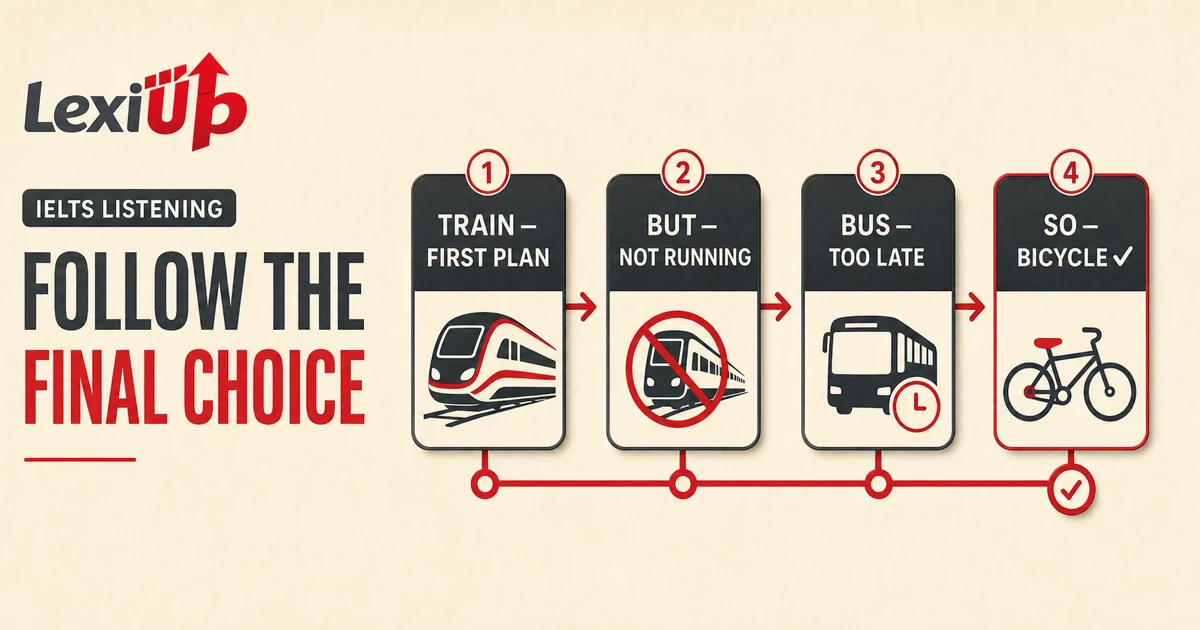
Consider this original question: “How will Maya travel to class?” The options are A train, B bus, and C bicycle. The recording says: “I was going to take the train, but engineering work means it will not run. The bus is possible, although it arrives too late. I will cycle so I can be there before nine.”
The word “train” appears first, but it describes an abandoned plan. The bus remains possible for a moment, then the late arrival removes it. The bicycle is the final decision. The answer is C because the speaker confirms that choice after explaining why the other two will not work.
This sequence is common in natural conversation. People introduce a plan, explain a problem, compare another option, and then decide. You do not need to remember every sentence. You need a small decision record: first plan, change signal, rejected reason, final choice. That record protects you from choosing an option simply because you heard its exact word.
| Recording stage | Option status | Useful note |
|---|---|---|
| “I was going to take the train” | A is the first plan | A ? |
| “but … it will not run” | A is rejected | A × |
| “The bus is possible” | B remains open | B ? |
| “although it arrives too late” | B is rejected | B × |
| “I will cycle” | C is confirmed | C ✓ |
Step 1: confirm how many answers you need
Read the instruction before you study the options. One question may ask you to choose one letter. Another may present a longer list and ask you to choose two or three answers. If you prepare for one answer when the task requires two, your listening notes will not match the task.
Circle or mentally repeat the answer count: “one answer”, “two answers”, or “three answers”. Then check whether each numbered question needs a separate choice or whether one group of questions shares a longer option list. Official IELTS guidance tells test takers to read the question carefully because the required number can change.
During practice, review answer-count errors separately from comprehension errors. If you understood the recording but selected the wrong number of options, the repair is procedural. Repeat the instruction check before the next audio. Do not respond by listening to the entire recording repeatedly without changing the step that failed.
- Read the complete instruction before looking for keywords.
- Mark the exact number of answers required.
- Check whether the option list belongs to one question or a question group.
- Leave the required number of answer spaces visible in your notes.
Step 2: predict the decision, detail, or main point
Read the question stem before comparing the options. Ask what kind of information will complete the task. You may need a final decision, a reason, an opinion, a problem, a purpose, or a general conclusion. This prediction is more useful than trying to guess the correct letter before the audio starts.
For “How will Maya travel?”, listen for a confirmed method of transport. For “Why did Maya reject the bus?”, listen for a reason. The same recording could support both questions, but each one needs different evidence. A familiar word is not enough unless it answers the stem.
Write a short prompt beside the question, such as “final choice”, “reason”, or “main view”. Keep it brief so you can still follow the recording. If you predict a noun, verb, or adjective instead of the information purpose, you may miss a paraphrase that uses a different grammatical form.
- Who or what must the answer describe?
- Does the question ask for a decision, reason, detail, or main point?
- Will the evidence probably appear as a direct statement or a paraphrase?
- What would make an option irrelevant even if its word is mentioned?
Step 3: mark only the differences between options
Options often share several words. Underlining every noun creates a page of equal-looking marks and gives you no useful comparison. Identify the one feature that separates A from B and C. It may be time, place, cause, attitude, frequency, or degree.
Imagine three options for a course meeting: A Monday morning, B Monday afternoon, and C Tuesday afternoon. The useful contrasts are day and time. You can reduce the options to “Mon AM”, “Mon PM”, and “Tue PM”. This preserves the decision without forcing you to reread long sentences while the recording continues.
Keep negative words and limits visible. “Only”, “mainly”, “first”, “least”, and “not” can change what the question requires. When two options differ by one small qualifier, that word deserves more attention than the vocabulary they share.
| Full option | Difference to mark | Fast note |
|---|---|---|
| A meeting on Monday morning | Monday + morning | Mon AM |
| A meeting on Monday afternoon | Monday + afternoon | Mon PM |
| A meeting on Tuesday afternoon | Tuesday + afternoon | Tue PM |
Step 4: keep listening when the speaker changes direction
Treat the first matching phrase as a candidate, not a confirmed answer. Continue listening for contrast and correction language. Words such as “but”, “although”, “however”, “actually”, “instead”, and “in the end” often signal that the speaker is about to qualify or replace an earlier idea.
A change is not always introduced by one obvious word. The speaker may say, “That was my original plan. The timetable has changed, so I have arranged something else.” The meaning still moves from an old option to a new one. Follow the relationship between the statements rather than waiting for a memorised signal word.
Use light status marks instead of writing full sentences. A question mark means the option is still possible. A cross means the recording rejected it. A tick means the speaker confirmed it. If a later statement changes the position again, update the mark. Your note should reflect the newest reliable evidence.
- Mark the first matching option with a question mark.
- Listen for a reason that confirms or removes it.
- Update the option when the speaker corrects or qualifies the idea.
- Choose only after the relevant decision is complete.
Step 5: match the final meaning, not the repeated word
The correct option may paraphrase the recording. An answer that repeats the speaker’s exact noun can still be wrong if that noun belongs to a rejected idea. Compare the complete meaning of the option with the evidence you heard.
Suppose an option says “The schedule was inconvenient.” The recording may say, “It would get me there after the session begins.” The words are different, but the meaning matches. Another option might include the word “schedule” directly while describing a change that the speaker welcomed. Word repetition does not decide the answer.
When two options remain possible, return to the question stem and ask which one answers it more precisely. Do not add background knowledge. If the recording says a bus is late, do not assume traffic caused the delay unless the speaker says so. Select the supported meaning and leave unsupported explanations outside the answer.
| Recording evidence | Option | Decision |
|---|---|---|
| “It arrives after the session begins” | The schedule is inconvenient | Meaning matches |
| “The timetable looked simple at first” | The simple schedule caused the decision | Word repeats, meaning does not match |
| No cause is stated | Traffic caused the delay | Unsupported detail |
Step 6: recover quickly and follow the next question
Official IELTS guidance states that Listening questions follow the order of information in the recording. If you remain uncertain after the relevant part has passed, mark your best supported option and move to the next question. Continuing to debate an old answer can make you miss new evidence.
Use the next question as a new listening anchor. Scan its stem and option differences, then rejoin the recording. At the end of the part, review only what your notes support. Do not change an answer because one letter appears more often than another. There is no reliable answer pattern to balance.
Your practice review should identify the point where you lost the decision. Examples include “selected the first plan”, “missed the contrast after but”, “did not notice the question asked why”, or “kept reviewing question 4 and missed question 5”. Each note gives you one observable repair for the next session.
- Mark the best supported option when the relevant evidence has passed.
- Move your eyes to the next question immediately.
- Use the next stem to reconnect with the recording.
- Review the uncertain answer only after the part ends.
- Record one specific cause for the mistake.
Practise IELTS Listening multiple choice with one decision path
Use one short official sample task and focus on decision tracking rather than volume. Before listening, mark the answer count, question purpose, and option differences. During the recording, use question marks, crosses, and ticks. After checking the answer, locate the exact phrase that changed or confirmed the decision.
Repeat the task only when you have changed the practice target. On the second attempt, listen for one feature: correction language, paraphrase, or recovery timing. Then try a fresh item. A memorised transcript cannot show whether the method transfers to new listening.
LexiUp IELTS can help you keep short Listening work connected to a daily plan and later mistake review on iPhone. The app is free to start and supports independent preparation. LexiUp is not affiliated with or endorsed by IELTS, and its guidance is not an official band score.
Use current IELTS, British Council, IDP, and Cambridge materials for test format and official practice.
| Stage | Action | Evidence to keep |
|---|---|---|
| 1 | Confirm the answer count | One, two, or three choices |
| 2 | Predict the information purpose | Decision, reason, detail, or main point |
| 3 | Mark option differences | Short contrast notes |
| 4 | Track changes | Possible, rejected, or confirmed |
| 5 | Match the final meaning | One supporting phrase or paraphrase |
| 6 | Recover and review | One specific mistake cause |
Frequently asked questions
Are IELTS Listening multiple choice questions the same in Academic and General Training?
Yes. The IELTS Listening test is the same for Academic and General Training. Both can include multiple-choice questions with one answer or more than one answer.
Should I select the first option I hear?
No. Treat the first matching option as possible evidence and continue listening. A speaker may reject, qualify, or replace an early idea before confirming the final answer.
How do I know how many answers to choose?
Read the instruction for that question or question group. It states whether you need one answer or several answers. Mark the required number before the recording begins.
Do the correct options use the same words as the recording?
Sometimes, but not always. The correct option may paraphrase the recording. Compare the full meaning with the question instead of choosing an option because one word repeats.
What should I do if I miss one multiple-choice answer?
Choose the best-supported option, move to the next question, and reconnect with the recording. Listening questions follow the order of information, so staying on an old question can cost another answer.
Sources and review note
This guide was reviewed against the sources below. LexiUp remains independent of the exam owners.