For: IELTS Academic and General Training learners who understand most paragraph details but lose time or choose headings because of one repeated word instead of the complete main idea
Use IELTS Reading matching headings to find the main idea
IELTS Reading matching headings questions ask you to connect a heading with the main idea of a paragraph or section. A heading is not a label for one familiar word. It is a short summary of what the paragraph does as a whole. The useful skill is therefore not scanning for identical vocabulary.
It is separating the central message from its examples, reasons, contrasts, and other supporting details.
Official IELTS guidance explains that this task can appear in both Academic and General Training Reading. You receive a list of headings and match the appropriate heading to the marked paragraphs or sections. There are more headings than you need, so some options remain unused.
The task assesses whether you can recognise a main idea and distinguish it from supporting information.
This guide uses an original practice example and a six-step decision routine. It does not reproduce an IELTS passage, calculate a band score, or promise a particular result. Use the routine with source-reviewed practice material, then compare every decision with the answer explanation.
The aim is to make your reasoning visible enough to review, not to turn one strategy into a rigid rule for every text.
Start with one worked matching-headings example
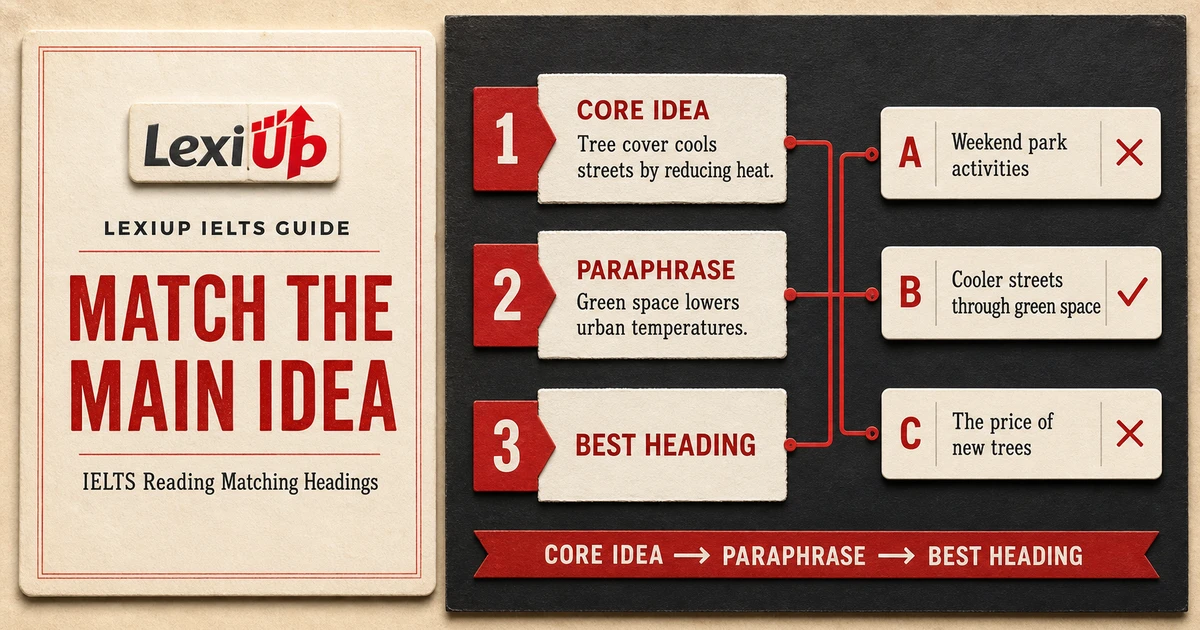
Consider this original paragraph core: “Tree cover cools streets by reducing heat.” Now compare three possible headings: “Weekend park activities”, “Cooler streets through green space”, and “The price of new trees”. The second heading is the strongest match because it paraphrases the complete relationship between green space and lower urban temperature.
The first option shares a broad setting but changes the subject to leisure activities. The third option keeps the topic of trees but introduces cost, which the paragraph core does not discuss. Both distractors feel possible if you react to one word. Neither represents the whole message. The correct decision comes from comparing meaning, not counting vocabulary matches.
Before looking at headings, reduce the paragraph to a private five-to-eight-word note. For this example, you might write “green space lowers street heat”. That note is not your answer and does not need elegant grammar. It acts as a bridge between the paragraph and the list.
Once you have the core, you can test whether each heading preserves the same topic, direction, and scope.
| Candidate heading | What it matches | Decision |
|---|---|---|
| Weekend park activities | The general outdoor setting only | Reject: it changes the paragraph’s purpose |
| Cooler streets through green space | Topic, cause, and result | Keep: it paraphrases the complete main idea |
| The price of new trees | The word “trees” only | Reject: cost is not part of the paragraph core |
Step 1: read the instructions and map the heading list
Read the task instructions before analysing the passage. Confirm which paragraphs or sections need headings, how the headings are labelled, where to write the answer, and whether an example has already been completed. Do not reuse an example heading. Follow the exact instruction in front of you rather than relying on the layout of a previous practice set.
Scan the full list of headings once. Underline the words that separate similar choices, not every large noun. If two headings both mention change, mark the direction: an early cause, a later result, resistance to change, or support for change.
These small differences are more useful than a shared topic word because the paragraph may paraphrase the topic in several ways.
Group only the headings that are easy to confuse. You might place two similar options beside one another and write a one-word contrast such as “cause/result” or “past/future”. Leave the remaining headings alone. The purpose of the first scan is to create a usable map, not to predict every answer before reading any paragraph.
- Confirm the exact paragraphs or sections included in the task.
- Notice any completed example and remove that heading from consideration.
- Mark the words that distinguish similar headings.
- Expect extra options and allow some headings to remain unused.
- Keep the instruction visible while you transfer each final answer.
Step 2: compress one paragraph into a core sentence
Read one paragraph for structure. Identify the topic, then ask what the writer says about that topic. A useful core sentence often combines those two parts: “The paragraph explains why the plan failed”, “The section describes a change in public attitudes”, or “The paragraph contrasts two ways of storing energy”.
This is more precise than a single topic noun.
The main idea often appears near the beginning, but it is not guaranteed to be the first sentence. A paragraph may open with an example, a question, or an older view before revealing its main point later. Read the first and last sentences carefully, then skim the middle for repeated meaning, contrast markers, and the role of examples.
Official preparation material recommends locating topic sentences while remembering that the main idea can appear elsewhere.
Write a short core note in your own words. Keep the paragraph’s direction: positive or negative, cause or result, problem or response, old view or new view. If your note contains only the topic, it is too broad.
If it contains a date, name, or single example that the rest of the paragraph does not develop, it is probably too narrow.
- Name the paragraph’s topic in one or two words.
- State what the writer says or does with that topic.
- Check the opening, closing, and repeated meaning.
- Separate the main claim from examples and evidence.
- Write a five-to-eight-word core note in your own words.
Step 3: paraphrase the core before choosing a heading
Turn the core note into one alternative expression before returning to the heading list. If your note says “green space lowers street heat”, a paraphrase could be “urban vegetation reduces temperature”. You are practising the relationship between ideas, not searching for a perfect synonym for every word.
Look for grammar changes as well as vocabulary changes. A heading may turn a verb into a noun, change an active clause into a compact noun phrase, or replace a specific example with a broader category. “Residents opposed the plan” could become “public resistance to the proposal”.
The surface form is different, but the participants, direction, and purpose remain connected.
Do not force a paraphrase that changes certainty or scale. “Some residents questioned the plan” is not the same as “the public rejected the plan”. Small words such as some, mainly, initially, rarely, and increasingly can change the match. Preserve the paragraph’s limits so that a dramatic heading does not appear correct only because it sounds related.
| Paragraph core | Safe paraphrase | Meaning change to reject |
|---|---|---|
| A trial produced mixed results | Uneven outcomes from an experiment | A trial proved the method successful |
| Residents gradually accepted the change | Growing public support over time | Immediate agreement from everyone |
| One example shows a wider problem | A case that illustrates a broader issue | A complete solution to the problem |
| Costs fell after a new process | A method that reduced expense | A process designed only for speed |
Step 5: reject four common heading traps
The detail trap uses a real fact from the paragraph but gives it too much importance. The broad-topic trap names the subject without saying what the paragraph contributes. The opposite-direction trap keeps the topic but reverses support and criticism, increase and decrease, cause and effect, or past and future. The familiar-word trap repeats vocabulary while changing the message.
Create a short rejection reason beside uncertain options. Use labels such as “detail only”, “too broad”, “opposite”, or “new idea”. These labels are quicker than rereading the entire paragraph without a question. They also show which thinking habit needs practice. If most errors are “detail only”, your next session should focus on separating topic sentences from examples.
Do not reject a heading only because it uses unfamiliar vocabulary. First simplify it. Break a long noun phrase into a subject and action, then compare that meaning with your core note. Likewise, do not accept a simple heading because it feels safe. The best heading must still represent the paragraph’s complete purpose.
| Trap | What it does | Review question |
|---|---|---|
| Detail only | Summarises one example | Does the rest of the paragraph develop this idea? |
| Too broad | Names only the general topic | What specific point does the writer make? |
| Opposite direction | Reverses the relationship | Is the paragraph supporting, resisting, increasing, or reducing? |
| New idea | Adds a claim not developed in the text | Where is this meaning supported? |
| Familiar word | Copies vocabulary but changes purpose | Would the heading still match if the shared word disappeared? |
Step 6: check the complete heading map and move on
After matching the clearer paragraphs, review the remaining headings as a smaller set. Confirm that every answer is entered beside the correct paragraph label. Recheck any completed example and the task instruction before transferring your answers. A correct idea in the wrong box is still a lost mark.
For each uncertain match, compare only the best two candidates. Rebuild the paragraph core, state the difference between the headings, and choose the one with stronger whole-paragraph support. If uncertainty remains, make the best evidence-based choice and continue.
IELTS Reading does not apply a penalty for an incorrect answer, so leaving a response blank does not protect your score.
Use a practical time boundary in practice. Record how long the full task takes, then identify where time was spent: reading every detail, rewriting notes, or comparing too many headings. Improve the slow stage rather than rushing every stage. A repeatable method becomes faster when each action has a clear purpose.
- Complete the clearest paragraph-heading matches first.
- Reduce the remaining choice set by removing used and rejected options.
- Compare only the two strongest candidates for an uncertain paragraph.
- Confirm paragraph labels and answer positions before moving on.
- Record one reason for each reviewed error after the task.
- Practise the slow decision stage again with a fresh paragraph.
Build a short IELTS Reading matching-headings review loop
Reviewing the answer is more useful when you keep the reasoning that produced it. For every incorrect match, save four items: your paragraph core, the heading you chose, the correct heading, and the reason the distractor attracted you. Keep the note short enough to compare at a glance.
Return the next day and cover the answer. Read the paragraph again, write a new core note, and compare the same options. Then create one original mini-paragraph and three headings of your own. Make one heading fit the whole paragraph, one fit a detail, and one introduce a new idea. Designing distractors helps you see how they work.
After several sessions, sort errors by cause rather than passage. You may find that the main issue is not vocabulary. It may be scope, direction, or trusting the first sentence too quickly. Use that pattern to choose the next practice goal. One precise review target is more actionable than repeating several full tests without knowing what changed.
- Save the paragraph core and both competing headings.
- Label the error: detail, broad topic, direction, scope, or transfer.
- Retry the paragraph without looking at the previous answer.
- Create one original distractor set to test the same distinction.
- Choose the next session from the most frequent error label.
Connect main-idea practice to LexiUp IELTS
LexiUp IELTS can help you keep Reading practice, correction, and review connected on iPhone. Use the daily plan for one clear next task, complete short skill practice, and return to saved mistakes instead of opening another unrelated resource. The app is free to start and supports independent IELTS preparation.
For a matching-headings session, use one narrow goal such as “write the paragraph core before checking options”. After the task, record whether the error came from a detail trap, an inaccurate paraphrase, or answer transfer. That evidence can guide the next review without treating one result as an official band score.
LexiUp is independent and is not affiliated with or endorsed by IELTS. Use official IELTS, British Council, IDP, and Cambridge materials for current test information and authentic practice. Use LexiUp to organise the study loop around that preparation: practise one skill, review the reason, and return with a clearer decision.
Frequently asked questions
What do IELTS Reading matching headings questions test?
They test whether you can recognise the main idea or theme of a paragraph or section and distinguish that idea from supporting details.
Are there extra headings in IELTS Reading matching headings?
Yes. Official guidance explains that the list includes more headings than the task requires, so some options will not be used. Follow the exact instructions and any completed example shown in your test.
Should I match headings by looking for the same words?
No. Shared words can appear in distractors. Compare the paragraph and heading by complete meaning, including topic, direction, scope, and degree.
Is the main idea always in the first sentence?
No. It often appears near the beginning, but a paragraph can open with an example, question, or older view. Check the opening, closing, and repeated meaning across the paragraph.
What should I do when two headings both seem possible?
Write the paragraph core in your own words, state the exact difference between the two headings, and choose the option supported by the whole paragraph rather than one detail.
Sources and review note
This guide was reviewed against the sources below. LexiUp remains independent of the exam owners.