For: Academic and General Training learners who can find the right paragraph but still hesitate between No and Not Given because the statement describes an opinion rather than a fact
IELTS Reading Yes No Not Given tests the writer’s view
IELTS Reading Yes No Not Given questions ask something narrower than most learners answer. They do not ask whether a statement is correct in the world, or whether the passage happens to mention the topic. They ask whether the writer of that passage holds the view described.
The instructions name claims or views for exactly that reason, and every label has to be traced back to a position the writer argues rather than to a subject the passage merely covers.
That is why the format sits beside True, False, Not Given rather than inside it. True, False, Not Given compares a statement with information presented as fact: dates, figures, events, measurements. Yes, No, Not Given compares a statement with a stance: what the writer believes, prefers, doubts, or recommends.
The evidence discipline is identical, but the thing you are hunting for changes. A stance is carried by a small set of signal words, not by data, so the scanning habits that work on numbers can walk straight past it.
This guide sets out six decision steps and one original worked passage. The passage, the statements, and the labels below were written as teaching material for this article. They are not real test questions and they are not official answers.
Use the official IELTS, British Council, and IDP sources listed at the end for current format and assessment information, and use the steps here to make the No against Not Given decision repeatable when the clock is running.
Label three claims against an original worked passage
Here is the original teaching passage written for this article. “Urban planners keep promising that new cycle lanes will change how a city moves. The evidence from the past decade is thinner than the enthusiasm.
Cities that painted lanes without removing parking saw almost no change in cycling numbers, and the few genuine successes shared something the reports rarely emphasise: they were built as continuous networks rather than as isolated stretches. Councils would do better to finish one connected route than to announce ten fragments.”
Read it once for stance before you read it for detail. The writer is not neutral. Thinner than the enthusiasm is a judgement. Rarely emphasise is a criticism of the reports. Would do better is a recommendation. Three opinion markers in four sentences tell you where the answers live, and none of them is a number.
A learner scanning for figures would find only the phrase past decade and would miss every claim the questions are actually about.
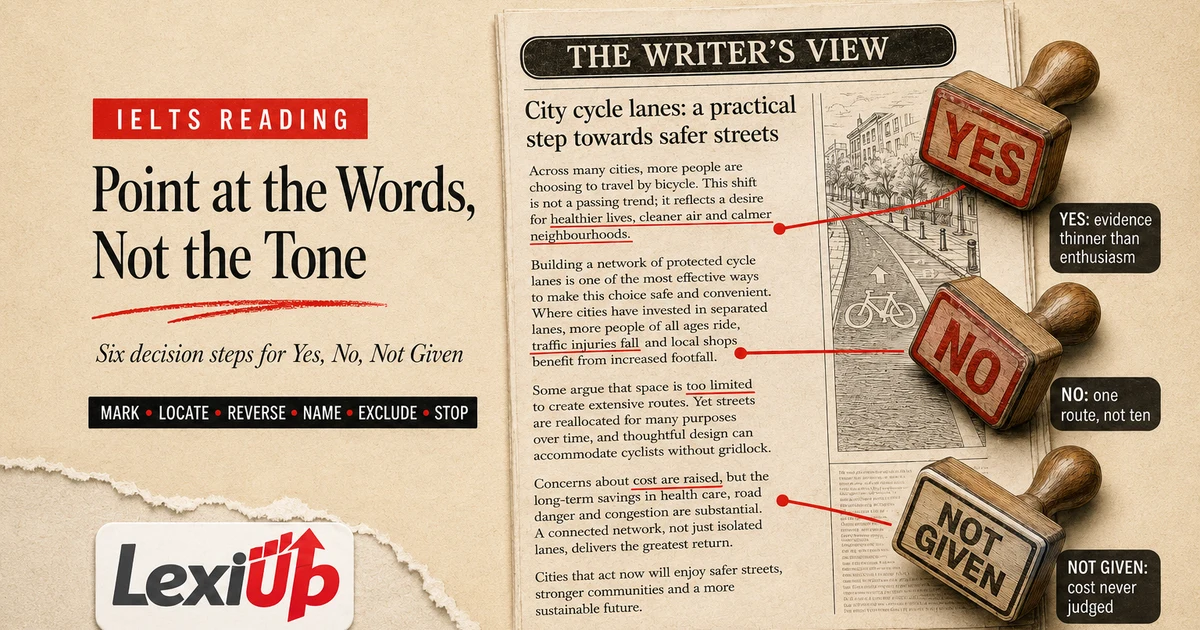
Now take four statements. The writer thinks enthusiasm for cycle lanes has outrun the evidence. The writer believes councils should build as many separate routes as possible. The writer considers cycle lanes a poor use of council money. The writer argues that removing parking is politically difficult.
Two of these are settled by the passage and two are not, and the two that are not fail for different reasons — which is precisely the distinction the format is built to test.
| Statement | Answer | What settles it |
|---|---|---|
| Enthusiasm has outrun the evidence | Yes | The evidence is thinner than the enthusiasm states the same judgement in other words. |
| Councils should build as many separate routes as possible | No | Finish one connected route rather than announce ten fragments is the stated opposite recommendation. |
| Cycle lanes are a poor use of council money | Not Given | The writer criticises fragmented building, never the spending. No view on cost appears. |
| Removing parking is politically difficult | Not Given | Parking is named as a factor, but the writer offers no opinion on the politics of removing it. |
Step 1: mark the words that carry an opinion
Before you search, decide what kind of claim the statement makes. Reduce it to a stance and a subject: who thinks what about which thing. Then mark the words that could change the stance rather than the subject. Should, must, ought, better, worse, fails, overstates, underestimates, unnecessary, and essential all carry weight.
So do hedges such as may, tends to, and in some cases, which can soften a position enough to change your answer.
The same discipline applies to the passage. A writer signals a position through evaluative adjectives, modal verbs, comparatives, and reporting verbs that carry doubt. Claims, insists, assumes, and concedes all report someone else while leaking the writer’s attitude towards them. Neutral reporting verbs such as states and notes do not.
Learning to notice this handful of signals is most of the work, because it converts a vague instruction about views into something you can physically underline.
- Underline the stance verb in the statement before you look at the passage.
- Circle modals and comparatives: should, must, better, more effective, less useful.
- Watch hedges, which weaken a claim without reversing it.
- Note reporting verbs that carry attitude, such as claims, assumes, or concedes.
- Ignore the topic nouns for now; they locate the paragraph but never decide the label.
Step 2: locate the writer’s voice, not only the topic
Answers usually follow the order of the passage, so the surrounding questions give you a search boundary. Inside that boundary, look for the sentence where the writer stops describing and starts judging. Descriptive sentences supply context; evaluative sentences supply answers.
In the worked passage, the sentence about cities that painted lanes is description, while the sentence about what councils would do better is the writer speaking directly.
A common failure is answering from a view the writer is reporting rather than holding. Passages frequently summarise a position in order to disagree with it, and a statement matching that summary can look supported when the writer has just spent the next sentence rejecting it.
Read one sentence past any reported view and check for a contrast marker. However, yet, in practice, and the evidence suggests often mark the turn from someone else’s claim to the writer’s own.
- Use the neighbouring questions to bound the search area, then verify from meaning.
- Separate description from evaluation inside that area.
- Read one sentence beyond any reported opinion before deciding.
- Treat however, yet, and in practice as signposts to the writer’s real position.
- Confirm whose voice a sentence belongs to before you use it as evidence.
Step 3: choose No only when the opposite view is stated
No is a positive finding, not a feeling of mismatch. It requires the passage to express a view that cannot sit alongside the statement. A stated opposite recommendation, a reversed comparison, a rejected proposal, or an explicit denial all qualify.
In the worked passage, the statement about building as many separate routes as possible is No because the writer recommends the opposite: one connected route in place of ten fragments.
The test that keeps this honest is simple. Point at the words. If you can put your finger on the phrase that contradicts the stance, the answer is No.
If you find yourself explaining why the writer probably would not agree, you have left the passage and are reasoning from tone, and the answer is almost certainly Not Given instead. Probably would not agree is the single most expensive thought in this question type.
- State the stance the statement is making in your own words.
- Find the sentence where the writer takes a position on that same stance.
- Point at the exact phrase that reverses it.
- If no such phrase exists, stop considering No.
- Record which kind of opposite you found: recommendation, comparison, or denial.
Step 4: name the missing element before writing Not Given
Not Given is easier to defend when you can say what is absent. Force yourself to complete one sentence: the writer never says anything about ___. If the blank fills easily, the answer is safe. If it does not, you have probably not finished searching.
Cost, comparison, cause, degree, timing, and a named group are the elements most often missing, and each one produces a different search when you go back to check.
The two Not Given statements in the worked passage fail in different ways, and noticing the difference is what makes the skill transfer. The claim about money introduces a subject the writer never evaluates at all. The claim about political difficulty takes a subject the writer does mention, parking, and attaches an opinion the writer never offers.
The second kind is far more dangerous, because the topic overlap makes the statement feel supported.
| Pattern | What the passage does | The check that catches it |
|---|---|---|
| New subject | The topic is absent from the passage entirely | Name the subject and confirm it appears nowhere in the bounded area. |
| Borrowed subject | The topic appears but carries no view from the writer | Ask which sentence evaluates it, not which sentence mentions it. |
| Attached opinion | A view is added that the writer never expresses | Underline the added stance and search for it specifically. |
| Narrowed group | A claim is limited to a group the writer never separates | Check whether the writer distinguishes that group at all. |
Step 5: keep your own opinion outside the answer
Opinion questions invite agreement in a way factual ones do not. When a passage argues something reasonable, it becomes easy to answer from what a sensible person would think rather than from what this writer wrote. Official guidance is consistent on this point: the answer comes from the passage.
A view you share, a view you find obvious, and a view you find absurd are all equally irrelevant unless the writer states it.
The same trap works in reverse when a passage argues something you disagree with. Learners reading the cycle lane passage who cycle daily tend to soften the writer’s scepticism, and learners who drive tend to sharpen it. Both drift away from the words on the page.
A useful habit is to answer aloud in the third person: the writer thinks, the writer recommends, the writer never says. The phrasing keeps the source of the opinion visible.
Step 6: stop searching on evidence, not on the clock
Not Given becomes a time sink when it is treated as a failure to find something. The stop rule has two conditions rather than one. First, you have located the area where the writer discusses this subject. Second, you have checked the sentences immediately around it for an evaluative turn.
When both are true and neither the stance nor its opposite appears, write Not Given and move on without a second sweep.
What does not qualify as a stop rule is elapsed time. Deciding after ninety seconds proves nothing about the passage, and a difficult paraphrase can hide a clear answer from a fast reader.
The two conditions above are cheap to check and they convert an uncomfortable guess into a decision you can review afterwards, which matters more than the single mark, because a decision with a reason attached is one you can correct.
Five traps that turn a settled answer into a wrong one
Most errors in this question type are not vocabulary problems. They come from a small number of repeatable mistakes, and each one has a repair that takes seconds once you recognise the pattern. The table below names the five that appear most often in practice review, in roughly the order learners meet them as their accuracy improves.
The fifth trap deserves particular attention because it survives longest. Confident readers become good at finding the writer’s position, then start using strength of language as evidence. A writer who is mildly critical is read as hostile; a writer who concedes a point is read as agreeing with it.
The label depends on what is claimed, not on how forcefully the passage says it, and calibrating that takes deliberate review rather than more reading.
| Trap | What goes wrong | Repair question |
|---|---|---|
| Topic match | Shared subject is mistaken for shared opinion | Which sentence gives a view, not a mention? |
| Reported view | Someone else’s position is read as the writer’s | Whose voice is this sentence in? |
| Tone as evidence | Disagreement is inferred from mood | Can I point at the contradicting phrase? |
| Added detail | One clause is proven and another is ignored | Is every part of the statement settled? |
| Strength drift | Mild criticism is read as outright rejection | Does the passage claim this much, or less? |
Review your IELTS Reading Yes No Not Given errors by cause
Counting how many you got wrong teaches nothing. Label each error by cause instead: wrong area, reported view mistaken for the writer’s, opinion imported from outside, opposite claimed but not stated, or missing element never named. Five categories are enough, and after two practice sets one of them will be carrying most of your losses.
That is the category worth a drill, and the others can wait.
Then repeat the same cause on fresh material within a day or two. If you treated a missing opinion as No, do three more statements where the passage mentions a subject without judging it.
Near-transfer practice is what turns a single correction into a habit, and it is far faster than re-reading whole sections hoping the decision improves on its own. Track the cause across sets rather than the score.
- Turn the labels into a repeatable routine with the IELTS mistake review guide →
- Give the drill a regular slot with the daily IELTS study plan →
- Complete a short set of statements from an official or source-reviewed passage.
- Write the evidence phrase beside every Yes and every No.
- Complete the sentence the writer never says anything about ___ for every Not Given.
- Label each error by cause rather than by question number.
- Repeat the dominant cause on a different passage within 48 hours.
Practise the decision between full Reading sections
Short, narrow repetition is what repairs this question type, and it needs somewhere to live between full timed sections. LexiUp IELTS is free to start and has been ad-free since version 1.0.10, so a ten minute set of statements runs to the end without an interruption arriving at the moment you were weighing No against Not Given.
Its AI feedback returns up to five successful results in any rolling twenty-four hours, which fits one focused set a day rather than a single long sitting.
Two limits belong in plain sight. LexiUp IELTS is an independent preparation app and not an official IELTS service, and any band estimate it produces is practice guidance rather than an examiner score.
Use it to see whether the cause you drilled last week has stopped appearing, and rely on the official sources below for anything concerning test format, question types, or how Reading is actually marked.
Keep the routine small on test day
Under time pressure the six steps compress into three questions, and they are worth rehearsing in that shorter form. Whose view is this statement about? Where does the writer take a position on it? Can I point at the words?
Yes when the words agree, No when they reverse, Not Given when the writer never takes the position at all. Nothing in that sequence requires you to recall a technique while reading.
If two labels still look possible after both conditions of the stop rule are met, choose the one your evidence note supports and leave it. An unanswered question scores nothing, and a reasoned choice on a genuinely ambiguous statement costs at most one mark.
Learners lose far more by returning three times to the same statement than by accepting a defensible answer and giving the remaining questions the attention they need.
Frequently asked questions
What is the difference between Yes, No, Not Given and True, False, Not Given?
Yes, No, Not Given compares a statement with the writer’s views or claims, while True, False, Not Given compares it with information presented as fact. The evidence logic is the same, but one asks what the writer thinks and the other asks what the passage records. Always follow the labels printed in the task.
When should I answer No instead of Not Given?
Choose No only when you can point at wording that expresses the opposite view: a reversed recommendation, a rejected proposal, an explicit denial, or an inverted comparison. If you are explaining why the writer probably would not agree, that is inference rather than evidence, and the answer is Not Given.
Do IELTS Reading Yes No Not Given answers follow the order of the passage?
They generally do, which makes the neighbouring questions a useful search boundary. Treat it as a locating aid rather than a rule, and confirm every answer from the wording itself. If a statement seems out of sequence, widen the search before settling on Not Given.
Can I use my own knowledge of the topic?
No. The answer must come from the passage. A view that is widely held, or that you personally find obvious, cannot make a statement Yes unless the writer expresses it. Outside knowledge can help you understand vocabulary, but it can never supply the evidence.
How many of these questions appear in a Reading test?
It varies by paper, and either this format or True, False, Not Given may appear. Because both are common and share one underlying skill, the safest preparation is to practise the evidence decision rather than to count on a particular question type appearing.
Sources and review note
This guide was reviewed against the sources below. LexiUp remains independent of the exam owners.