For: IELTS learners who collect many new words but find it difficult to choose, combine, and recall them accurately in Writing or Speaking practice
IELTS vocabulary in context turns a word into usable language
IELTS vocabulary in context is more useful than a long list of isolated words. A word becomes usable when you know what it means in one real situation, which words normally sit beside it, what grammar follows it, and whether it suits the tone.
That information helps you recognise the word in Reading or Listening and use it more accurately in Writing or Speaking.
Official IELTS Writing guidance explains that Lexical Resource considers vocabulary range, accuracy, appropriacy, precision, spelling, word formation, and collocation. This means that an unusual word is not automatically a strong choice. A familiar word used precisely in a natural phrase can communicate more clearly than a difficult synonym placed in the wrong sentence.
This guide turns that principle into a seven-step study routine. It is independent preparation guidance, not an official score method or a list of predicted test words.
What learning a word in context actually includes
Context is the information around a word. It includes the sentence, the wider paragraph or conversation, the speaker or writer's purpose, and the relationship between ideas.
If you save only a translation, you may know the general meaning but still miss the difference between formal and informal use, a strong and mild claim, or a noun and verb pattern.
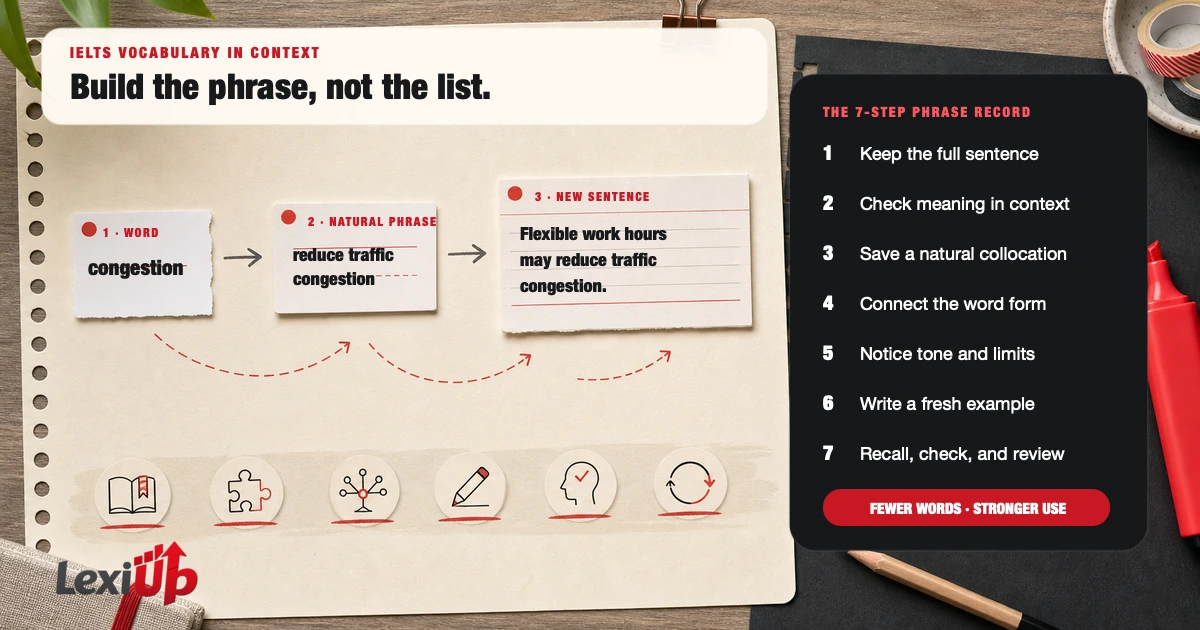
A useful vocabulary record is therefore small but complete. It keeps the original phrase, a simple meaning, the word class, one or two common partners, and a fresh example. Pronunciation and spelling may also matter. You do not need to collect every detail from a dictionary.
Keep the information that will help you understand or produce the word in a similar situation.
| Record | Question to answer | Simple example |
|---|---|---|
| Original context | Where did the word appear? | Public transport can reduce traffic congestion. |
| Meaning | What does it mean here? | Too many vehicles in one place, causing slow movement. |
| Word class | What grammar job does it perform? | Congestion is a noun. |
| Collocation | Which words naturally connect to it? | Traffic congestion; severe congestion; reduce congestion. |
| Fresh example | Can I use the phrase in a new idea? | Flexible work hours may reduce traffic congestion. |
| Review cue | What should I recall later? | reduce + traffic congestion |
Step 1: collect vocabulary from a complete sentence
Begin with language you meet in a real source: an article, podcast, conversation, official sample, or corrected practice response. Save the complete sentence or enough of it to preserve the meaning. A single word copied from a list has no evidence about how it behaves. The original sentence shows its topic, grammar, tone, and nearby partners.
Do not stop every time you meet an unfamiliar word. First ask whether it blocks the main meaning or appears several times. If the passage remains clear without it, mark it lightly and continue. After the task, choose two or three items that were important, repeated, or useful for your own communication.
A smaller set leaves enough time to understand each item properly.
For receptive practice, try to infer the meaning before opening a dictionary. Read the sentence before and after it. Notice examples, contrasts, causes, definitions, and reference words. Then check a reliable learner dictionary. The first guess trains context reading; the dictionary check prevents a mistaken meaning from entering your notes.
- Keep the sentence or phrase that first made the meaning clear.
- Choose useful items after the main Reading or Listening task, not during every line.
- Guess from nearby evidence, then confirm with a reliable dictionary.
- Record the meaning used in this source instead of copying every dictionary definition.
- Return to the source once more and confirm that your meaning still fits.
Step 2: save a word partnership, not only a definition
Collocations are words that commonly occur together. IDP IELTS gives the example of words such as “make” and “bed” working as a natural partnership. The important lesson is not that every phrase must be memorised. It is that vocabulary choice includes the words and grammar around the item.
Learners often know the meaning of two words but combine them in a way English does not normally use.
Write the smallest useful partnership. For a noun, save an adjective or verb that often connects to it. For a verb, save the object, preposition, or following form. For an adjective, save the noun it describes or the preposition it needs. “Influence” is more useful as “have a strong influence on” than as a translation on its own.
Be careful with synonym chains. Two words can share a general meaning but require different structures or carry different strength. “Help someone do something” and “assist someone in doing something” are close in meaning, but the grammar changes. Replacing one word without rebuilding the phrase can create an avoidable error.
| Isolated note | More useful phrase record | What the record protects |
|---|---|---|
| decision | make a decision about | Verb choice and preposition |
| effect | have a significant effect on | Verb, modifier, and preposition |
| increase | a gradual increase in | Noun form, degree, and preposition |
| responsible | be responsible for | Required preposition |
| access | have access to | Natural verb and preposition |
Step 3: connect the word form to the sentence grammar
A meaning can be correct while the word form is wrong. “Develop”, “development”, “developed”, and “developing” belong to one family, but they do different jobs. Save only the forms that you can use and include a short phrase for each. This makes grammar part of vocabulary learning instead of a separate correction that appears later.
Look at the space around the word. Does it follow an article, adjective, modal verb, or preposition? Is it acting as the subject, the main verb, or a modifier? These clues help you understand unfamiliar items in Reading and Listening. They also help you choose the right form when you write or speak.
Spelling belongs in this step too. A word family may change spelling when the form changes. Say the phrase, cover it, write it, and compare it with the source. If the error repeats, save the exact difficult part rather than rewriting the complete word many times without attention.
- Mark the word class in the original sentence.
- Save one other useful form from the same family.
- Write the phrase that each form needs.
- Create one sentence where the grammar makes the form necessary.
- Check spelling and any change in stress or pronunciation.
Step 4: notice meaning, strength, tone, and limits
Precise vocabulary fits the exact idea. When you study a near-synonym, ask what changes. Is it stronger, more formal, more specific, positive, negative, certain, or cautious? “Concern”, “problem”, and “crisis” do not describe the same degree. A word that is accurate in one paragraph may exaggerate another.
Tone matters because IELTS Writing tasks can require formal, neutral, semi-formal, or personal language depending on the test and task. Speaking is a conversation, so language that sounds natural aloud may differ from language used in an academic description. Save a short tone label only when it changes your choice: formal, neutral, conversational, technical, approving, or critical.
Also record a limit when it prevents misuse. For example, a phrase may describe people but not policies, or a verb may require an intentional action. One short contrast is enough. The aim is not to make every vocabulary card complex. It is to keep the detail that stops you making the same inaccurate choice again.
- What exact idea does this word express in the source?
- Is it stronger or weaker than the familiar alternative?
- Does it suit formal writing, everyday speaking, or both?
- Which noun, person, action, or situation can it describe?
- What is one nearby word that should not replace it automatically?
Step 5: write two new examples with different details
Copying the original example proves that you can copy it. A fresh example tests whether you understand the phrase. Keep the structure but change the subject, time, place, or cause. If the saved phrase is “place pressure on”, you might write one example about housing and another about public services. Both should preserve the natural partnership.
Make the first example simple enough to check. A long sentence introduces too many possible grammar problems and can hide whether the vocabulary works. After the simple version is accurate, expand it with a reason, comparison, or result. You are testing controlled use, not trying to make one sentence display every new word you learned.
Read the examples aloud. This can reveal a missing article, difficult pronunciation, or phrase that is too long to retrieve comfortably. If you would not use the item naturally in Speaking, keep it for recognition or Writing. A strong vocabulary system accepts that some words are passive before they become active.
| Stage | Example | Purpose |
|---|---|---|
| Source phrase | Rising costs place pressure on small businesses. | Observe a natural phrase in context. |
| Simple transfer | Long journeys place pressure on families. | Test meaning and grammar with a clear idea. |
| Expanded transfer | Long daily journeys can place financial pressure on families because transport costs accumulate. | Add detail after the phrase is controlled. |
| Speaking version | My commute places some pressure on my weekly budget. | Check whether the phrase is comfortable aloud. |
Step 6: use active recall across more than one IELTS skill
Recognition feels familiar because the answer is visible. Active recall asks you to produce the phrase before you see it. Cover the right side of your record and use a small cue such as the meaning, topic, or first word. Say or write the complete partnership, then compare it with the saved version. Correct the smallest missing part.
Move the same item across skills. Find it in a short Reading paragraph, notice it in audio, use it in one Writing sentence, and say it in a brief Speaking response. You do not need all four activities on one day.
Each new context strengthens the connection between meaning and use without turning the phrase into a memorised script.
Paraphrase can also support recall. If the exact word disappears during Speaking, explain the meaning with language you control. This is different from replacing every word in a Writing prompt with a synonym. Useful paraphrase preserves meaning; forced synonym replacement can change the idea or create an unnatural collocation.
- Look at the cue without the answer.
- Recall the complete phrase, including its preposition or word form.
- Use it in one short sentence.
- Compare the sentence with your record and correct only what changed the fit.
- Try the phrase in a different skill or topic on the next review.
Step 7: review fewer items at useful intervals
Review should make retrieval slightly difficult without making it impossible. Revisit a new phrase later the same day, then after one or two days, and again after about a week. Items you recall accurately can wait longer. Items with a repeated grammar, spelling, or meaning error need a shorter return and a new example.
Label the cause of an error. Did you forget the meaning, choose the wrong partner, change the word form, miss a preposition, misspell it, or use the wrong tone? The label decides the repair. Re-reading the definition will not solve a collocation error; rewriting the full phrase in a new sentence may.
Keep the weekly collection small enough to use. Ten well-understood phrases can offer more practical value than fifty items that remain translations. Remove cards that are too specialised for your needs, combine duplicates, and mark items that you only need to recognise. Your record should become clearer over time, not simply larger.
| Day | Action | Evidence to keep |
|---|---|---|
| Day 1 | Collect two or three phrases and create fresh examples. | Meaning, partnership, form, and one accurate sentence. |
| Day 2 | Recall each phrase from a meaning cue. | Mark the missing word, form, or preposition. |
| Day 3 | Use the phrases in a short Speaking or Writing response. | Keep one natural use and one correction. |
| Day 5 | Meet or create a different context. | Confirm that the meaning and tone still fit. |
| Day 7 | Complete a mixed recall check and remove weak cards. | Schedule only the items that still need attention. |
Common IELTS vocabulary habits that need a better repair
The first unhelpful habit is collecting too much. A large daily target can reward copying rather than learning. Choose items because they solve a real comprehension or communication need. The second is treating every synonym as interchangeable. Save the new phrase and its grammar before you use it as a replacement.
The third is forcing several new words into one response. This can reduce clarity and make correction difficult. Test one or two items while the rest of the task uses language you already control. The fourth is reviewing by recognition only.
If you always read the front and back together, you do not know whether the phrase will be available when you need it.
Finally, do not use one vocabulary error as an unofficial band prediction. IELTS examiners assess a complete performance against several criteria. A practice sentence is evidence for the next study decision, not a score report. Correct the specific problem and test the phrase again in a fresh context.
- Replace daily word-count goals with a small number of complete phrase records.
- Replace automatic synonym swapping with meaning and collocation checks.
- Replace crowded practice responses with one or two controlled targets.
- Replace passive rereading with recall before checking.
- Replace broad labels such as “bad vocabulary” with one observable cause.
Practise IELTS vocabulary in context with a connected routine
LexiUp IELTS includes short Vocabulary games, flashcards, examples, skill practice, and mistake review on iPhone. Use these tools as part of the same context routine: notice a useful phrase, practise its meaning or form, place it in a new sentence, and return to any error later. The app is free to start and supports independent preparation.
Keep the educational goal ahead of the collection. You are not trying to own every possible IELTS word. You are building a smaller set of accurate phrases that help you understand ideas and express your own meaning.
Begin with one sentence from today's Reading, Listening, Writing feedback, or Speaking review, then complete the seven steps before adding another item.
Frequently asked questions
Should I learn IELTS vocabulary from word lists?
A short list can help you notice useful items, but add the original sentence, meaning in that context, word class, collocation, and a fresh example before treating a word as ready to use.
How many new IELTS words should I learn each day?
There is no official daily number. Choose a small amount that you can understand, recall, use, and review accurately. Two or three complete phrase records may be more useful than a long list copied once.
Do difficult words improve an IELTS score?
Difficulty alone does not make vocabulary effective. Official criteria consider range, precision, appropriacy, accuracy, spelling, word formation, and collocation. Choose language that fits the exact meaning and context.
What is the best way to remember IELTS collocations?
Save the complete phrase in a real sentence, recall it without looking, create two accurate examples, and revisit it after one or two days and again about a week later.
Sources and review note
This guide was reviewed against the sources below. LexiUp remains independent of the exam owners.