
For: General Training candidates who have prepared for Task 2 essays and are treating the Task 1 letter as an afterthought worth half the marks it actually carries
An IELTS General Training letter is judged on purpose, not prettiness
Academic candidates describe a chart in Task 1. General Training candidates write a letter, and the marking reflects that difference precisely. The IELTS partners define Task achievement in Task 1 as how well your letter achieves its purpose.
Not how formal it sounds, not how many advanced phrases you fitted in: whether it did the job the prompt set.
That single sentence should reshape how you prepare. A letter full of impressive vocabulary that never actually requests the refund, explains the delay, or apologises for the damage has failed Task achievement, whatever the Lexical Resource score looks like.
You need at least 150 words in about 20 minutes, and you must not write your answer as notes or bullet points. Those are hard requirements rather than guidance.
Rule one: read the situation before the bullets
Every prompt opens with a situation, then gives you three bullet points. Candidates skim the situation and jump to the bullets, which is how tone goes wrong. The situation tells you who you are writing to and why, and that determines everything about register.
Read it twice. Ask one question: do I know this person, and is this a personal matter or an official one? The answer decides the tone, the greeting, and the sign-off, before you write a word.
Rule two: pick one of three tones and stay in it
Letters fall into three registers, and mixing them is a visible error that costs you across Task achievement and Lexical Resource at once.
Formal letters go to someone whose name you do not know: a manager, a company, a council. Semi-formal letters go to a named person in a professional relationship, such as a landlord or a colleague you address by name. Informal letters go to friends and family.
The most common failure is starting formally and drifting informal by the final paragraph, usually because the third bullet invites a friendly suggestion. Decide the tone at the planning stage and hold it to the sign-off.
| Register | Written to | Greeting | Sign-off |
|---|---|---|---|
| Formal | An unnamed official or organisation | Dear Sir or Madam | Yours faithfully |
| Semi-formal | A named person in a professional role | Dear Mr Chen | Yours sincerely |
| Informal | A friend or family member | Dear Sam | Best wishes |
Rule three: every bullet gets its own paragraph
Three bullets, three body paragraphs. This is the simplest structural decision available and it protects Task achievement directly, because a bullet that is only half addressed is the most common way marks disappear.
The structure that works, every time, is a short opening line stating why you are writing, then one paragraph per bullet, then a closing line. Five blocks. It is not creative, and it does not need to be: the examiner is checking that the letter achieves its purpose.
- Write one line stating your purpose. "I am writing to complain about..." is not too plain; it is clear.
- Take bullet one and give it a paragraph. Add one concrete detail the prompt did not supply.
- Take bullet two and give it a paragraph, keeping the same tone.
- Take bullet three and give it a paragraph. This is the one candidates rush; do not.
- Close with the action you want, or the warmth the relationship calls for, then sign off in register.
Rule four: invent the specifics, and keep them plausible
Unlike Academic Task 1, where all the information you need is given to you in the chart, a letter prompt deliberately leaves gaps. It will say a delivery was damaged without saying what, when or how much it cost.
You are expected to invent those details. A letter that stays vague because the candidate was afraid to make something up reads as underdeveloped, and Task achievement suffers. Give the date, the order number, the amount.
Keep them ordinary and consistent; nobody is checking whether your invented invoice number is real, but a reader will notice if the damage happened in March in one paragraph and April in the next.
Rule five: 150 words is a floor with a penalty below it
Task achievement is assessed using a minimum of 150 words. Writing fewer is penalised, and there is no upside to testing the boundary. Equally, a 300-word letter is not a better letter: it costs you the time Task 2 needs, and Task 2 carries more weight.
Aim for roughly 170 to 190 words. That is enough to develop three bullets properly with a margin above the floor, and it fits inside 20 minutes with time to reread.
Learn what your own 170 words looks like in your handwriting or at your typing speed. Counting words in the exam is wasted time; recognising the shape of a finished letter is not.
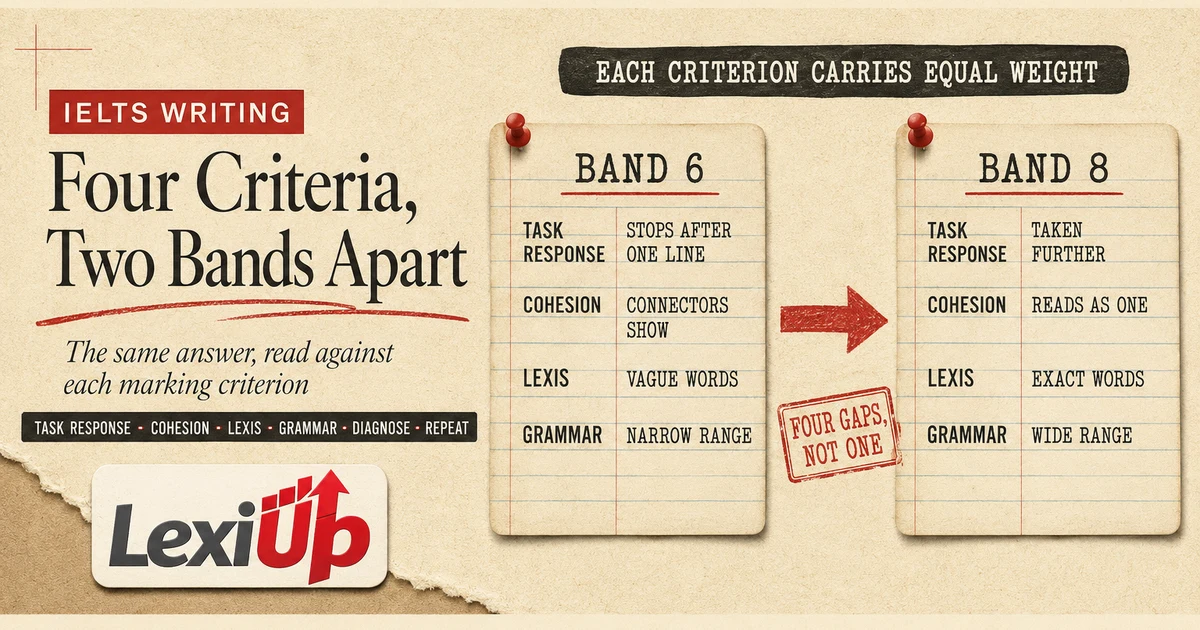
What separates a band 6 letter from a band 7 letter
At band 6 the three bullets are usually all present, but one is thin, the tone slips once or twice, and the sentences are mostly simple with a few errors that do not block meaning.
At band 7 each bullet is developed with a specific detail, the register is consistent from greeting to sign-off, and there is a mix of sentence forms with errors that are occasional rather than habitual. The letter also sounds like it was written by someone who wanted something, which is the part no template supplies.
The practical gap is smaller than it sounds. Most candidates sitting at 6 are not short of vocabulary; they are short of a third developed paragraph and a consistent tone.
Frequently asked questions
How long should an IELTS General Training letter be?
At least 150 words, written in about 20 minutes. Task achievement is assessed using that 150-word minimum, so writing fewer is penalised. Around 170 to 190 words gives you a safe margin without stealing time from Task 2, which carries more weight.
Can I use bullet points to cover the three prompts?
No. The IELTS partners state that you must not write your answers as notes or bullet points. Each prompt bullet should become a developed paragraph in continuous prose.
Is it acceptable to invent details like dates and order numbers?
Yes, and it is usually necessary. Letter prompts leave the specifics out deliberately. Inventing plausible, consistent details is how you develop each bullet; staying vague to avoid making something up tends to read as underdeveloped.
How do I know whether to write formally or informally?
The situation line above the bullets tells you. If you are writing to an unnamed official or an organisation, write formally. If you are writing to a named person in a professional relationship, semi-formal. If it is a friend or relative, informal. Choose once and hold it to the sign-off.
Does Task 1 matter less than Task 2?
It carries less weight than Task 2, but it is not optional. Task 1 is 150 words in 20 minutes and Task 2 is 250 words in 40 minutes, and both are marked on the same four criteria. Losing a band on Task 1 through a missed bullet still moves your Writing score.
Sources and review note
This guide was reviewed against the sources below. LexiUp remains independent of the exam owners.