For: Academic and General Training learners sitting on a Writing band 6 who have been told to write better without being told which of the four criteria is actually holding the band down
IELTS band 6 vs band 8 is four differences, not one
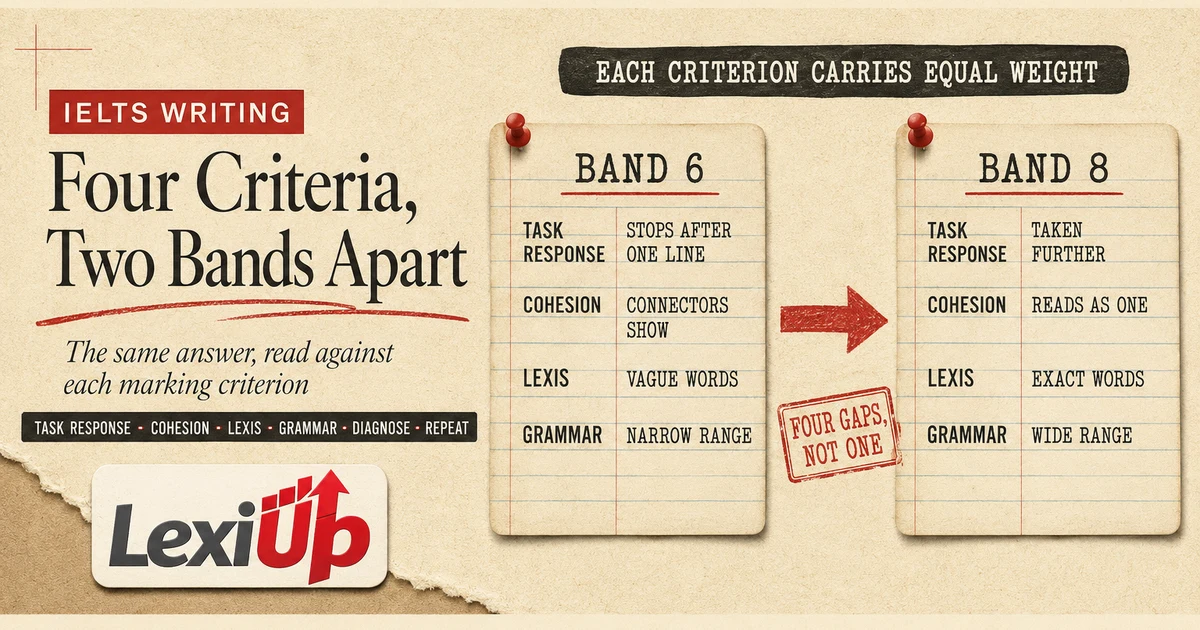
Being told to write better is useless advice, because Writing is not marked as one thing. It is marked on four criteria of equal weight: Task Response, Coherence and Cohesion, Lexical Resource, and Grammatical Range and Accuracy.
A band 6 script and a band 8 script differ on all four, in four different ways, and each gap has its own fix.
That matters because the criteria are averaged. Lifting one criterion by two bands moves the skill band by half a band on its own. So the honest question is never how to write like a band 8, it is which single criterion is furthest behind and what specifically changes when it moves.
Everything below is original teaching material written for this article. The two sample extracts were written to illustrate the published band descriptors, which IELTS makes freely available and which are linked at the end. They are not real candidate scripts, they carry no official assessment, and LexiUp does not issue examiner scores.
The same question, answered twice
Both extracts below answer the same prompt: some people think governments should spend more on public transport than on new roads. Both are on topic, both are grammatical, and both would pass a quick read. They are not equally strong, and the reasons are nameable.
Version A: I agree that governments should spend more money on public transport. Public transport is very important for people. Many people use buses and trains every day to go to work. Also, roads are expensive to build. Moreover, public transport is better for the environment because it reduces pollution.
Therefore, I think governments should spend more on public transport.
Version B: Governments should indeed prioritise public transport, though the case rests on capacity rather than cost. A single bus lane moves several times the passengers of a general traffic lane in the same space, which is why cities that widen roads tend to fill them within a decade.
Road spending is not wasted, but it buys less movement per dollar than the alternative.
Version A is not badly written. It states a position, it stays on topic, it uses connectors, and it contains no errors worth marking.
What it does not do is develop anything: every sentence adds a new generic point rather than taking one point further, the connectors label the sentences rather than joining the ideas, and the vocabulary stays at the level of very important and better for the environment.
| Criterion | What Version A does | What Version B does |
|---|---|---|
| Task Response | States a position, supports it with unextended general points | States a position and narrows it to one arguable reason |
| Coherence and Cohesion | Also, Moreover and Therefore label sentences in sequence | Each sentence follows from the previous claim without signposting |
| Lexical Resource | Common words used correctly: important, expensive, better | Precise choices: prioritise, capacity, movement per dollar |
| Grammatical Range | Short simple and compound sentences of similar shape | Subordination and a relative clause carrying real meaning |
| Length | 58 words | 61 words |
Task Response: answering is not the same as developing
The published descriptors separate addressing the task from developing a position. At band 6 the position is clear and the main ideas are relevant, but ideas tend to be insufficiently developed or unclear. At band 8 the response is sufficiently developed, with relevant and well extended ideas.
The practical difference is how many sentences one idea gets. Version A gives each idea one sentence and then moves on, which is why it reads as a list. Version B spends three sentences on a single claim about capacity, and the claim gets stronger as it goes.
Four shallow reasons are worth less than one reason carried through.
This is the criterion most learners can move fastest, because it costs nothing to know and everything to practise. Take any essay you have written, delete half the reasons, and give the survivors the space you freed. If a paragraph cannot fill four sentences, the idea was not developed enough to be there.
- Write the position in one sentence before writing anything else.
- Choose two reasons, not four.
- Give each reason a claim, a mechanism, and a consequence.
- Delete any sentence that only restates the sentence before it.
Coherence and Cohesion: connectors are not cohesion
The descriptors reward information and ideas arranged coherently with a clear progression. At band 6 cohesive devices are used, but they may be faulty, mechanical or overused. At band 8 cohesion is managed so well that it attracts no attention.
That last phrase is the whole difference. Version A uses Also, Moreover and Therefore correctly, and you still notice them, because they are doing the joining that the ideas should be doing themselves. Version B has almost no connectors and reads as more connected, because each sentence answers a question the previous one raised.
The fix is counterintuitive: use fewer linking words, not more. Write a paragraph with none at all, then add back only where the logic genuinely turns. Most of the ones you removed will turn out to have been decorating a sequence rather than creating one.
Lexical Resource: precision beats vocabulary lists
The descriptors ask for a sufficient range of vocabulary at band 6, with some flexibility and precision, and for a wide resource used fluently and flexibly with precise meanings at band 8. The word doing the work in both is precision, not rarity.
Version B is not built on impressive words. Prioritise, capacity and movement per dollar are ordinary items used exactly. Version A is not weak because its words are simple; it is weak because important and better could describe almost anything, so they carry very little.
This is why memorised advanced vocabulary so often fails to move the band. A rare word used approximately reads worse than a common word used exactly, and the descriptors mark inappropriate choices as errors regardless of how sophisticated the attempt was. Collect words with the sentences they live in, not on their own.
Grammatical Range and Accuracy: range and accuracy are two scores in one
This criterion counts both variety and correctness, which is why it moves slowly. At band 6 there is a mix of simple and complex forms with some errors, but they rarely reduce communication. At band 8 there is a wide range with the majority of sentences error free.
Version A is accurate but narrow: almost every sentence is subject, verb, object, of similar length. Version B keeps the same accuracy and adds subordination, a relative clause and a concessive turn on though, and none of those structures are decorative. Each one carries a relationship the meaning needed.
The trap is chasing range at the cost of accuracy, which loses on both halves of the criterion at once. Add one new structure at a time, use it until it is reliable under timed conditions, and only then add the next. A complex sentence you get wrong is worth less than the simple one it replaced.
What to change first, and what to leave alone
Do not work on four criteria at once. IELTS band 6 vs band 8 is decided criterion by criterion, and because the four are averaged, the fastest gain comes from whichever is furthest behind, and for most band 6 writers that is Task Response or Coherence, not vocabulary or grammar.
Those two are also the cheapest to move, because they are decisions about structure rather than knowledge you have to acquire.
Diagnose before you practise. Take one of your own essays, read it against the four criteria separately, and write one sentence per criterion saying what it does. Most people find the same thing: the grammar is fine, the words are fine, and every idea stops after one sentence. That is a Task Response problem wearing a vocabulary costume.
Then change one thing for a fortnight. Two reasons instead of four, developed properly. No connectors unless the logic turns. Nothing else. A single criterion moved two bands is worth half a band on the skill, and half a band is often the whole gap between a reported 6.5 and a 7.
- Task Response first if your ideas stop after one sentence each.
- Coherence next if your connectors are the loudest thing on the page.
- Lexical Resource if your words are correct but could describe anything.
- Grammar last unless errors are actually obscuring meaning.
- One criterion at a time, for a fortnight, then re-diagnose.
Practise the IELTS band 6 vs band 8 gap in a weekly routine
Turn the diagnosis into a week that repeats. Two sessions rewriting one old paragraph against a single named criterion, one session writing a fresh body paragraph with two reasons only, one full timed essay, and one review that names the criterion that is now furthest behind.
Then start the next week from that name rather than from the old plan.
Keep your own before and after. The clearest evidence that a criterion has moved is your own paragraph from three weeks ago beside today, read against the same descriptor. That comparison teaches more than any model answer, because the gap in it is yours and you already know what you were trying to say.
LexiUp IELTS is built for that loop. It is free to start and, since version 1.0.10, entirely ad-free, and its AI feedback returns a criterion-by-criterion read on a Writing or Speaking attempt, so the criterion holding your band down is named rather than guessed. The free tier allows five successful AI feedback results in any rolling twenty-four hours.
Its guidance is an estimate meant to aim your practice, not an official IELTS examiner score.
| Session | Focus | Finish with |
|---|---|---|
| 1 and 2 | Rewrite one old paragraph | The same idea, developed twice as far |
| 3 | Fresh body paragraph, two reasons only | Four sentences per reason, no filler |
| 4 | Full timed essay | Forty minutes, no pauses |
| 5 | Criterion review | The name of the criterion now furthest behind |
Frequently asked questions
In IELTS band 6 vs band 8 writing, what is the single biggest difference?
Development. A band 6 answer usually states relevant ideas and moves on, while a band 8 answer takes fewer ideas further. The published descriptors put this under Task Response: ideas that are insufficiently developed at band 6 are relevant and well extended at band 8. It is also the difference that costs the least to practise.
Will learning advanced vocabulary move me from band 6 to band 8?
Rarely on its own. The descriptors reward precise meaning rather than rare words, and an advanced word used approximately is marked as an error. A common word used exactly scores better than a sophisticated one used loosely, so collect vocabulary with the sentences it lives in rather than as lists.
Should I use more linking words to improve cohesion?
Usually fewer. At band 6 cohesive devices may be mechanical or overused, and at band 8 cohesion attracts no attention at all. If a reader notices your connectors, they are doing work the ideas should be doing. Try writing a paragraph with none, then add back only where the logic genuinely turns.
Can I reach band 8 in Writing if my grammar is not perfect?
Yes. The band 8 descriptor asks for a wide range of structures with the majority of sentences error free, not all of them. Occasional slips are tolerated where they do not obscure meaning. Chasing complex structures you cannot control reliably loses marks on both range and accuracy at once.
How long does it take to move from band 6 to band 8?
It varies too much for an honest single answer, and two bands across four criteria is a large jump rather than a quick one. The useful measure is criterion movement rather than elapsed weeks: pick the one furthest behind, work only on it for a fortnight, then re-diagnose and pick again.
Sources and review note
This guide was reviewed against the sources below. LexiUp remains independent of the exam owners.