For: Academic candidates who have practised line graphs and bar charts and freeze when the paper shows a manufacturing process or a natural cycle instead
An IELTS Writing Task 1 process diagram breaks the habits you built on graphs
Most preparation is built on data. You learn to spot a rising trend, compare two lines, quote a peak. Then the paper shows how cement is made, or how a butterfly develops, and every phrase you rehearsed is useless because there are no numbers to compare.
An IELTS Writing Task 1 process diagram is still Task 1: describe the visual information in your own words, at least 150 words, in about 20 minutes. All the information you require is given in the diagram, so nothing has to be researched or invented.
What changes is the shape of the description, and candidates who do not notice that write a data essay about a diagram with no data.
The five steps below are the whole method, and they work for both kinds of process you might see: a manufactured one with a beginning and an end, and a natural cycle with neither.
Step one: count the stages before you write anything
Number the stages on the paper or on your notepaper. This takes fifteen seconds and it decides your entire structure, because the number of stages tells you how to group them into two body paragraphs.
Seven stages usually splits three and four. Ten stages might split five and five, or group by phase: everything before the material enters the kiln, everything after. Grouping by phase reads better than grouping by count, when the diagram offers an obvious break.
Step two: write the overview a process actually needs
On a graph, the overview names the trend. On a process there is no trend, so candidates either skip the overview or write something empty like "the diagram shows a process". Both cost marks under Task achievement.
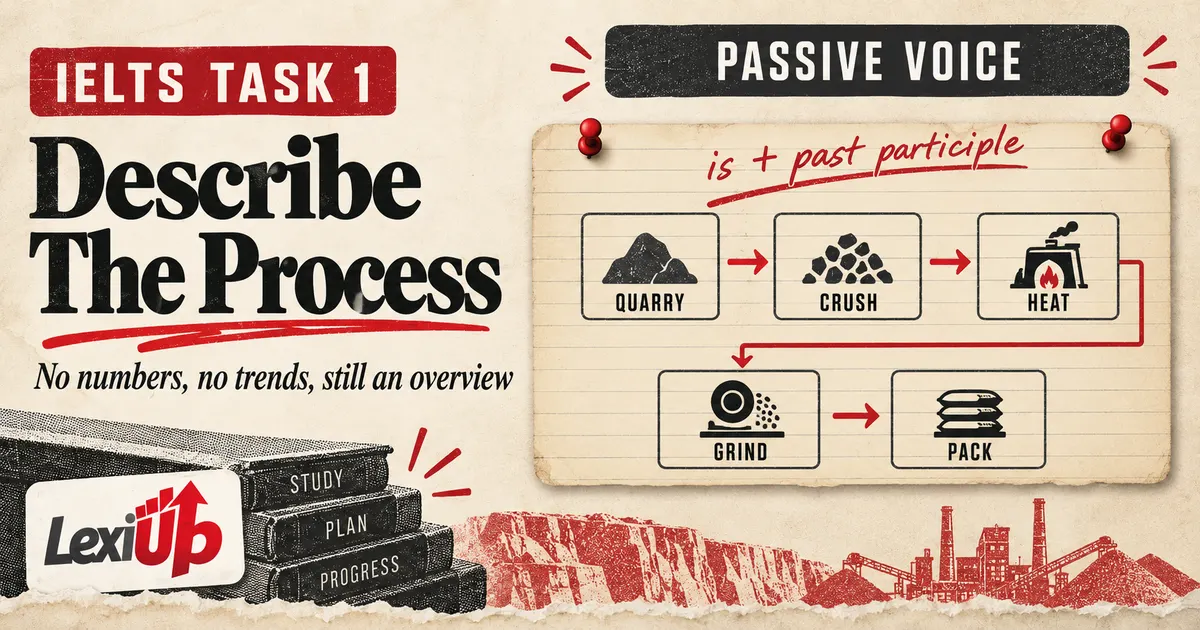
A process overview does two things: it states how many stages there are, and it names where the process begins and ends. That is genuinely the whole job. "The process comprises seven distinct stages, beginning with the quarrying of raw limestone and ending with the packaging of finished cement." One sentence, and the overview requirement is satisfied.
For a natural cycle there is no beginning or end, and saying so is the correct move: name it as a continuous cycle and state the number of stages and a conventional starting point.
Step three: use the passive, because the agent does not matter
In a manufacturing process nobody tells you who does the work, and it is not relevant. The passive voice exists for exactly this: "the limestone is crushed", not "workers crush the limestone", which invents an agent the diagram never showed.
Natural cycles are the exception. Water evaporates, it is not evaporated. A caterpillar forms a chrysalis. Use the active voice where the subject genuinely acts on its own, and the passive where a human agent is implied but unnamed.
This single distinction moves Grammatical Range and Accuracy more than any linking phrase, because it shows control of a structure the task specifically calls for rather than a formula bolted onto any answer.
- Manufactured process: the mixture is heated, the sheets are cut, the product is packaged
- Natural cycle: water evaporates, vapour condenses, the larva emerges
- Never invent a person the diagram does not show
Step four: sequence without listing
The weakest process answers are a chain of "then". Then the material is heated. Then it is cooled. Then it is packed. It covers the content and caps Coherence and Cohesion at a low band because there is no variation and no relationship between stages beyond order.
Vary how you mark sequence, and occasionally mark something other than sequence: purpose, condition, simultaneity. "Once the mixture has cooled, it is transferred to a mill, where it is ground into a fine powder before being bagged for distribution." That sentence carries three stages and reads as prose rather than a list.
| Signal | Language | Use when |
|---|---|---|
| Start | initially, in the first stage, the process begins when | Opening the first body paragraph |
| Next step | subsequently, following this, at this point | Moving between ordinary stages |
| Time relation | once, after which, having been, before being | Linking two stages in one sentence |
| Purpose | in order to, so that, for the purpose of | A stage that exists to enable another |
| End | finally, in the final stage, the completed product is | Closing the description |
Step five: check the two things examiners find missing
The first is a stage that was skipped. Working under time pressure, candidates describe stages one to four carefully, then compress five to eight into a single sentence. Every stage in the diagram is information you were asked to report.
The second is your own opinion. A process diagram invites comments about efficiency or environmental cost, and none of them belong in Task 1. All the information you require is given in the diagram; anything beyond it is outside the task.
Spend the last two minutes checking those two things specifically, rather than rereading for general quality. They are the errors that actually recur.
A worked shape you can reuse
Every IELTS Writing Task 1 process diagram fits the same four paragraphs, roughly 170 words. Paragraph one paraphrases the question in a single sentence. Paragraph two is the overview: number of stages, start point, end point. Paragraph three covers the first group of stages. Paragraph four covers the rest and closes on the finished output.
That shape is not a template to memorise word for word, and memorised sentences are visible to examiners. It is a structure to fill, which is a different thing: the sentences are yours, the architecture is decided before you arrive.
Frequently asked questions
Do I need an overview for a process diagram?
Yes. It looks different from a graph overview because there is no trend to name. State how many stages the process has and where it begins and ends. For a natural cycle, say that it is continuous and name a conventional starting point.
Should the whole answer be in the passive voice?
No. Use the passive for manufactured processes, where a human agent is implied but never shown. Use the active for natural cycles, where the subject genuinely acts: water evaporates rather than is evaporated. Mixing them correctly is what demonstrates control.
How many words should a process description be?
At least 150, written in about 20 minutes, the same requirement as any Academic Task 1. Around 170 to 190 words is a comfortable target that covers every stage without eating into the 40 minutes Task 2 needs.
Can I say whether the process seems efficient?
No. Task 1 asks you to describe the visual information, and all the information you require is given in the diagram. Evaluation, opinion and speculation about cost or environmental impact fall outside the task and do not earn credit.
Sources and review note
This guide was reviewed against the sources below. LexiUp remains independent of the exam owners.