For: IELTS Academic and General Training learners who add linking phrases to many sentences but still find that their paragraphs feel repetitive or hard to follow
Use IELTS Writing linking words to show real relationships
IELTS Writing linking words help a reader see how one idea connects to the next. They can show a reason, contrast, example, result, sequence, or reference. They do not create logic by themselves. A paragraph with many connectors can still feel disjointed when its ideas do not follow a clear order.
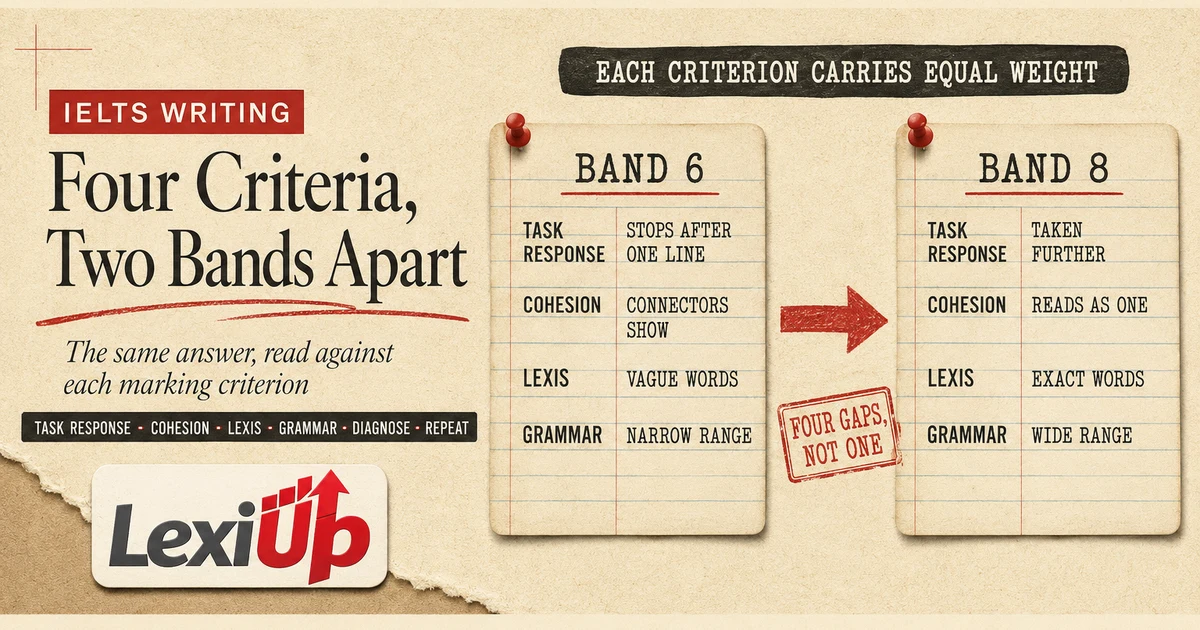
Coherence and cohesion form one of the four IELTS Writing assessment criteria. Official IELTS guidance explains that coherence concerns logical organisation and progression. Cohesion concerns the varied and appropriate use of devices such as connectors, conjunctions, pronouns, reference, and substitution.
The criterion applies to both Writing tasks, alongside task achievement or response, lexical resource, and grammatical range and accuracy.
This guide gives you six checks for a practice response: map the idea chain, name the relationship, choose a connector only when needed, use reference carefully, vary sentence connections, and read the paragraph as a complete message. The examples are original learning material. They are not official IELTS questions or model answers.
See a paragraph as an idea chain
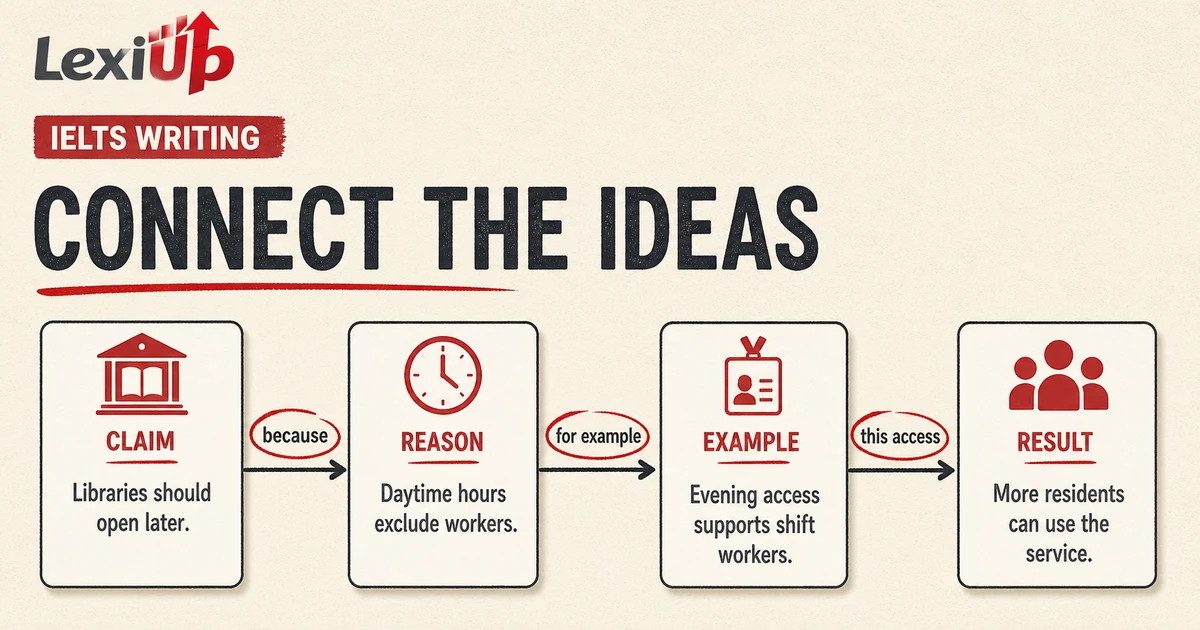
Consider this original paragraph topic: public libraries should offer more evening hours. A useful chain can move through four jobs: claim, reason, example, and result. The claim states the paragraph focus. The reason explains why it matters. The example makes the reason concrete. The result returns the support to the claim.
A clear version might read: “Public libraries should stay open later on weekdays. Many people work or study during normal opening hours, so they cannot use quiet study areas in the afternoon. For example, an evening session would give shift workers time to borrow books and use computers. This access could make the library useful to more residents.”
Only two visible connectors appear: “so” marks a result inside the reason, and “for example” introduces evidence. The final sentence uses “this access” to refer to the evening opportunity. The paragraph flows because every sentence has a clear job. Adding “firstly”, “moreover”, and “therefore” would not improve the underlying sequence.
| Sentence job | Core idea | Connection used |
|---|---|---|
| Claim | Libraries should open later | Starts the central topic |
| Reason | Daytime hours exclude some users | Cause and result with “so” |
| Example | Shift workers can visit in the evening | Example with “for example” |
| Result | More residents can use the service | Reference with “this access” |
Check 1: map the paragraph before adding connectors
Write a four- or five-word label for each sentence before you edit the language. Useful labels include claim, reason, example, contrast, limitation, and result. Read the labels in order. If they do not form a sensible path, move or replace the idea before working on linking words.
A paragraph can fail when it moves from a claim to an unrelated example, then returns to the reason. The reader must guess why the example appeared. A connector cannot repair that gap. Put the reason beside the claim, then place the example beside the reason it supports.
Keep one central topic in each paragraph. If a sentence introduces a separate issue, decide whether it belongs in another paragraph or whether it should be removed. This check supports both coherence and task response because it keeps the argument relevant to the question.
- Label each sentence by its job.
- Check that every sentence supports one central topic.
- Move the reason beside the claim it explains.
- Place each example directly after the idea it supports.
- Remove a sentence when its purpose remains unclear.
Check 2: name the exact relationship
Ask what the second idea does to the first. Does it add similar information, provide a reason, show a result, introduce an example, present a contrast, or limit the claim? Choose the relationship before you choose the word. This prevents a familiar connector from giving the reader the wrong signal.
“However” needs a genuine contrast. “Therefore” needs a result that follows from earlier evidence. “For example” needs a specific case of the previous point. If two sentences already have an obvious relationship, a connector may be unnecessary. Sentence order and repeated topic language can carry the link.
Test the meaning by replacing the connector with a plain question. For a reason, ask “why?” For a result, ask “what happened because of this?” For an example, ask “what specific case shows the point?” If the next sentence does not answer the question, revise the idea or select a more accurate relationship.
| Relationship | Question to ask | Possible language |
|---|---|---|
| Reason | Why is this true? | because, since |
| Result | What follows from this? | so, therefore, as a result |
| Contrast | What changes or differs? | but, however, although |
| Example | What specific case supports it? | for example, for instance |
| Addition | What related point comes next? | also, in addition |
Check 3: remove connectors that do no useful work
Circle every visible linking phrase in a practice response. Check whether each one marks a relationship that the reader needs. Remove a phrase when it repeats the same function, starts a sentence by habit, or announces a connection that the ideas do not support.
A sequence such as “Firstly”, “Secondly”, and “Thirdly” can be useful when order is important. It becomes mechanical when each paragraph begins that way even though the points are not stages. Official preparation guidance warns against putting a linking word in every sentence or overusing basic linkers.
Read the paragraph again after each removal. If the meaning remains clear, the connector was probably not necessary. If the relationship becomes uncertain, restore a suitable signal or improve the sentence order. The aim is not to use fewer words at any cost. The aim is to make every signal useful.
- Remove a connector that repeats the previous sentence opening.
- Remove a sequence marker when no real sequence exists.
- Keep a contrast signal when the change could be missed.
- Keep a result signal when the cause-and-effect link needs help.
- Revise the ideas when the chosen connector feels forced.
Check 4: use reference without making the reader guess
Cohesion includes more than linking phrases. Pronouns and reference expressions can connect sentences without repeating a full noun phrase. Words such as “this”, “these”, “they”, and “such measures” can help, but the reference must point to one clear idea.
Avoid a sentence such as “This is a serious problem” when several earlier facts could match “this”. Name the idea: “This lack of evening access is a serious problem for shift workers.” The extra noun keeps the connection clear and still avoids repeating the complete previous sentence.
Check number and meaning. A singular organisation takes “it”, while several residents take “they”. Do not replace a precise noun with a vague synonym only to avoid repetition. Accurate repetition is better than a varied word that changes the meaning.
| Unclear reference | Clearer reference | Reason |
|---|---|---|
| This is useful | This evening access is useful | Names the benefit |
| They should change it | Library managers should extend the schedule | Names the actor and action |
| These cause problems | These limited opening hours cause problems | Matches the plural reference |
Check 5: vary how sentences connect
Do not make every relationship depend on an adverb at the start of a sentence. You can connect ideas with conjunctions inside a sentence, relative clauses, reference, substitution, repeated key terms, or simple logical order. This variety should make the message clearer, not make the grammar more elaborate.
Compare two versions: “The library closes at five. Therefore, workers cannot visit.” and “Because the library closes at five, some workers cannot visit.” Both show cause and result. Choose the version that fits the surrounding sentences and that you can control accurately.
Use punctuation that matches the structure. A comma cannot join two complete sentences by itself. If a connector creates a long or uncertain sentence, divide the ideas and keep the relationship clear. Grammar accuracy and cohesion support each other.
- Use a conjunction when two ideas belong in one sentence.
- Use a pronoun or noun reference when the subject continues.
- Repeat a precise key term when a synonym could confuse the meaning.
- Use sentence order when the relationship is already clear.
- Split a sentence when the connection becomes hard to control.
Check 6: read the paragraph as one complete message
Read the paragraph without stopping at individual linking words. Ask whether the central topic is clear, whether each sentence develops it, and whether the final sentence completes the paragraph job. This whole-paragraph review is important because a correct connector can hide a weak idea chain during sentence-level editing.
Then cover the paragraph and write its logic in one line: “later hours → access for workers → wider community use”. Compare that line with the actual order. If the paragraph follows another path, adjust the ideas. If the line is hard to write, the central topic may be too broad.
Finish with a reader check. Circle any word that could point to two ideas. Underline any contrast without a clear difference. Box any result without a cause. These marks give you specific repair work. A general note such as “improve cohesion” does not tell you what to change next.
- State the paragraph topic in one short sentence.
- Write the idea chain with arrows.
- Check every pronoun and reference expression.
- Check that each contrast contains a real difference.
- Check that each result follows from stated evidence.
- Record one repair to practise in the next response.
Practise IELTS Writing linking words with one paragraph
Choose one paragraph from a completed practice response. Do not rewrite the whole task. Label the sentence jobs, draw the idea chain, and circle the cohesive devices. Repair one relationship at a time. Then write a fresh paragraph on a different topic and apply the same checks without copying the earlier wording.
Compare the new paragraph with the six checks rather than counting linking words. Keep evidence such as “the example now follows its reason”, “however marks a real contrast”, or “this policy names the reference”. These observations are more useful than a long list of connectors collected without context.
LexiUp IELTS can help you place short Writing practice inside a daily plan and return to saved mistakes on iPhone. The app is free to start and supports independent preparation. LexiUp is not affiliated with or endorsed by IELTS, and its feedback is not an official band score.
Use current official IELTS materials to confirm test format and assessment guidance.
| Check | Question | Evidence to keep |
|---|---|---|
| 1. Map | Do the sentence jobs form a logical chain? | Claim, reason, example, result |
| 2. Name | What exact relationship connects the ideas? | Reason, result, contrast, or example |
| 3. Remove | Does each connector do useful work? | Only necessary signals remain |
| 4. Reference | Can the reader identify every pronoun? | Clear noun reference |
| 5. Vary | Do connections use more than sentence-openers? | Controlled structures |
| 6. Read | Does the paragraph work as one message? | One specific repair note |
Frequently asked questions
How many linking words should I use in IELTS Writing?
IELTS does not set a target number. Use a linking word when it helps the reader understand a real relationship. Check logical order, paragraph focus, reference, and sentence connections instead of counting connectors.
Is it useful to start every paragraph with firstly or secondly?
Only when the paragraph order is a real sequence. Repeating these words by habit can make the response mechanical. A clear topic sentence can often introduce the next paragraph without a sequence marker.
What is the difference between coherence and cohesion?
Coherence is the logical organisation and progression of ideas. Cohesion is how language connects those ideas through devices such as conjunctions, linking phrases, pronouns, reference, and substitution.
Can I repeat a key word in IELTS Writing?
Yes. Accurate repetition can keep the topic clear. Use a pronoun, reference phrase, or suitable substitute when it remains precise, but do not force a synonym that changes the meaning.
How can I practise linking words without memorising a list?
Review one paragraph at a time. Label each sentence job, name the relationship, select only the connector you need, and then write a fresh paragraph that uses the same logic with different content.
Sources and review note
This guide was reviewed against the sources below. LexiUp remains independent of the exam owners.