For: IELTS learners who can communicate their ideas but keep repeating a small number of grammar and punctuation errors in Writing or Speaking practice
IELTS grammar correction works best as a focused routine
IELTS grammar correction becomes more useful when you stop trying to inspect every possible rule at the same time. A complete response can contain hundreds of choices. If you read it once and simply ask whether the grammar is correct, familiar errors are easy to miss.
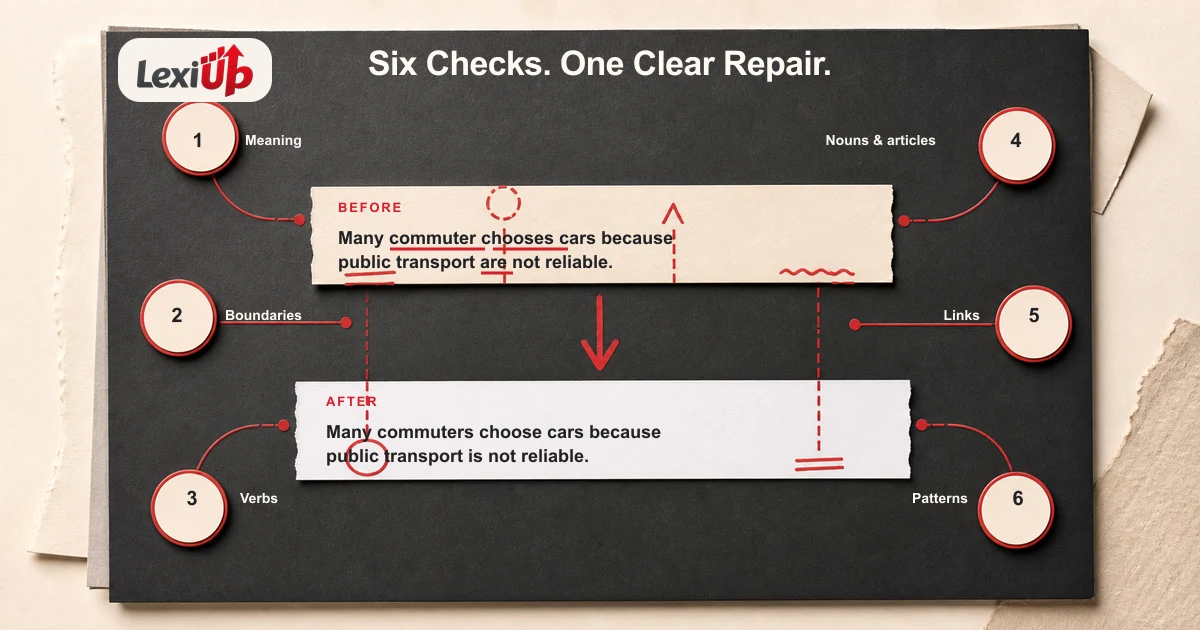
A six-check routine gives each reading one clear job: meaning, sentence boundaries, verbs, nouns and articles, connections, and repeated patterns.
Official IELTS guidance explains that Grammatical Range and Accuracy considers the range and appropriacy of grammar as well as sentence accuracy. The official Writing resources also note that examiners consider the seriousness and frequency of errors, including punctuation. This means that self-editing is not a search for one impressive structure.
It is a practical way to notice errors that interrupt meaning and patterns that keep returning.
The method below is for practice and final checking. It does not calculate a band score, replace feedback from a qualified teacher, or predict an official result. Use it to produce clear evidence: the original sentence, the exact change, the reason for the change, and a new sentence that tests the same grammar point.
Start with one worked grammar repair
A correction is easier to remember when you can see what changed. Consider this original practice sentence: “Many commuter chooses cars because public transport are not reliable.” The main idea is understandable, but three connected errors make the sentence less controlled.
“Commuter” needs a plural ending after “many”, the verb must agree with the plural subject, and “transport” takes a singular verb in this meaning.
The corrected sentence is: “Many commuters choose cars because public transport is not reliable.” Keep both versions. Underline only the parts that changed, then write a short label beside each one: noun number, subject–verb agreement, and uncountable noun agreement. The labels turn a correction into a reusable rule rather than a sentence you copy and forget.
Next, create a fresh sentence that uses the same patterns: “Many workers use buses because parking is expensive.” The topic has changed, but the grammar relationship remains visible. This transfer sentence is the real test. If you can make a new accurate example without looking at the correction, you have begun to control the pattern.
| Stage | Sentence or note | Purpose |
|---|---|---|
| Original | Many commuter chooses cars because public transport are not reliable. | Keep the evidence before changing it. |
| Correction | Many commuters choose cars because public transport is not reliable. | Show the smallest changes that restore control. |
| Labels | Noun number; subject–verb agreement; uncountable noun agreement. | Name the reusable grammar patterns. |
| Transfer | Many workers use buses because parking is expensive. | Test the same relationships in a new idea. |
Check 1: confirm that the meaning is complete
Read the sentence for meaning before changing grammar. Ask who or what the sentence is about, what happens, and how the extra detail connects. If you cannot answer those questions, the problem may be incomplete thinking rather than a missing article or comma. Clarify the idea first so that the grammar has a stable message to carry.
Mark the main subject and main verb. Then identify any reason, contrast, example, condition, or result. A long sentence often becomes confusing because two ideas are placed together without a clear relationship. You may need to separate them or choose a connector that matches the intended meaning.
Do not repair punctuation until you know whether the second part supports, contrasts with, or results from the first.
For Speaking practice, use the same check after recording a short answer. Listen once for the message only. If a listener would need to guess who performed an action or when it happened, note the missing information. Repeat the idea with a complete subject and verb, but do not stop after every small mistake while speaking.
The review happens after the response.
- Can I identify the main subject and main action?
- Does every added clause have a clear purpose?
- Is the time or condition clear enough for the verb choice?
- Would separating one long sentence make the meaning clearer?
- Can I explain the intended message before I edit the form?
Check 2: inspect sentence boundaries before small details
A sentence boundary tells the reader where one complete idea ends and another begins. Look for full stops, commas, semicolons, and connectors. A comma cannot normally join two complete sentences by itself. You may need a full stop, a semicolon, or a coordinating word such as “and”, “but”, or “so”.
The choice depends on the relationship between the ideas.
Read the response aloud at a calm pace. If you reach the end of a long line and cannot explain which clause belongs to which idea, draw a vertical line between the main units. Check whether each unit can stand alone. Then rebuild the relationship deliberately.
This method is more reliable than adding commas wherever you hear a pause, because spoken pauses do not always match written punctuation.
Also look for fragments. A fragment may begin with “because”, “although”, “which”, or an -ing form but never connect to a complete main clause. For example, “Because public transport is unreliable.” leaves the reader waiting for a result. It becomes complete when you add the related main idea: “Many commuters choose cars because public transport is unreliable.”
| Problem | Repair | Example |
|---|---|---|
| Comma splice | Use a full stop or a suitable connector. | The service was delayed, so passengers waited. |
| Fragment | Attach the dependent clause to a main clause. | Although the route is longer, it is more reliable. |
| Run-on sentence | Separate the complete ideas. | The fare increased. Some passengers changed routes. |
| Unclear list | Use consistent commas and a final conjunction. | The plan covers cost, access, and reliability. |
Check 3: build a short verb timeline
Circle the main verb in each sentence and mark its time: past, present, future, or a relationship between times. Then check whether the time matches the evidence in the sentence. Expressions such as “last year”, “currently”, “since 2024”, and “by 2030” can guide the form, but the complete meaning still decides the tense.
Check subject–verb agreement at the same time. Find the real subject rather than the nearest noun. In “The number of private vehicles has increased”, the subject is “number”, so the singular verb “has” is appropriate. In “A number of residents have changed their route”, the phrase refers to several residents, so the plural verb “have” fits.
Do not change every verb to create variety. Range means using structures that suit the task and meaning. A precise simple form is better than an unnecessary perfect or passive construction that changes the message. During review, keep one accurate version, label the reason, and create one transfer sentence with a different subject or time marker.
- Circle the finite verb in each main clause.
- Mark the intended time or time relationship.
- Connect each verb to its real subject.
- Check singular, plural, and uncountable noun agreement.
- Confirm that any passive form names the action clearly.
- Write one new sentence with the same verb pattern.
Check 4: review nouns, articles, and pronoun reference
Underline nouns and ask whether each one is countable in the meaning you intend. Countable singular nouns usually need a determiner such as “a”, “an”, “the”, “this”, or “each”. Plural and uncountable nouns follow different patterns. “Information”, “advice”, “transport”, and “research” are often uncountable in general use, so adding a plural ending can create an error.
Articles communicate whether a noun is general, newly introduced, or already identifiable. Instead of checking every “the” from memory, ask what the reader knows at that point. “A policy” introduces one policy. “The policy” refers to the specific policy already identified.
No article may be appropriate when a plural or uncountable noun expresses a general idea, as in “Public transport reduces congestion.”
Then trace pronouns. Draw a light line from “it”, “they”, “this”, “these”, or “which” to the noun or idea it represents. If two possible references remain, repeat the key noun. Clear reference supports both grammar and coherence. A short repeated noun is often safer than a pronoun that forces the reader to guess.
| Area | Question | Repair example |
|---|---|---|
| Number | Is this one countable item, several items, or an uncountable idea? | many commuters; much information |
| Article | Is the noun new, specific, or general? | a proposal; the proposal; public transport |
| Determiner | Does the noun need a quantity or reference word? | each route; several options |
| Pronoun | Can the reader identify the exact reference? | This policy may reduce fares. |
Check 5: test connectors and complex sentences for control
Complex sentences are useful when they express a real relationship, not when they simply make a sentence longer. Highlight each connector and name its job: reason, contrast, condition, result, time, or addition. If the connector does not match the logic, replace it or separate the ideas.
“Although” signals contrast, while “because” introduces a reason; they are not interchangeable decorations.
Check the grammar on both sides of the connector. A dependent clause still needs the appropriate subject and verb, and the main clause must remain complete. Avoid stacking several connectors into one sentence. One clear relationship gives you better evidence than a crowded sentence whose clauses are hard to control.
For Speaking, practise one relationship at a time. Answer a simple question with a main idea and a reason, then add a contrast or condition in a second attempt. Record both versions and compare accuracy. The goal is flexible control across several responses, not one memorised sentence that contains every structure you know.
- Reason: because, since, as
- Contrast: although, while, whereas
- Condition: if, unless, provided that
- Result: so, therefore, as a result
- Time: when, while, before, after
- Relative detail: who, which, that
Check 6: turn repeated errors into a small repair queue
The final check looks across the complete response. Count patterns, not every isolated slip. If the same article, agreement, tense, or boundary problem appears several times, place it in a small repair queue. Record one original example, one correction, one reason, and one transfer sentence.
A pattern needs repeated practice; an occasional slip may only need a brief reminder.
Use narrow labels. “Grammar is weak” does not tell you what to practise. “Plural subject with present simple verb” or “missing article before singular countable noun” gives you an action. Review one or two patterns at a time, then write or say a fresh response where those patterns appear naturally.
Check whether the error returns without forcing the structure into every sentence.
IELTS grammar correction should therefore end with a decision. Keep, shorten, separate, or repair the sentence; then schedule the underlying pattern only if it recurs. This prevents your review list from becoming a second collection of notes that you never use. The queue should become smaller as your control becomes more consistent.
| Day | Practice | Evidence |
|---|---|---|
| Day 1 | Complete the six checks on one response. | Keep two repeated patterns. |
| Day 2 | Write three short transfer sentences. | Mark accurate use without notes. |
| Day 3 | Use the patterns in a brief Speaking response. | Record one correction after speaking. |
| Day 5 | Edit a new paragraph for the same patterns. | Compare frequency with Day 1. |
| Day 7 | Complete a mixed check without labels first. | Retire controlled patterns and reschedule only recurring ones. |
Use the six checks without losing your whole response
Time the routine during practice. First give yourself enough time to learn the sequence. Later, reduce the review window and focus on the highest-value patterns. In a timed Writing response, meaning and sentence boundaries come before small stylistic changes because they protect communication. Verbs, nouns, articles, connectors, and repeated patterns follow in a consistent order.
Do not rewrite a complete response during the final check unless the message is genuinely unclear. Large late changes can introduce new errors and remove useful content. Make the smallest correction that restores the intended meaning. If a sentence remains unstable, divide it into two controlled sentences.
Sentence variety develops through practice; the final minutes are for protecting clarity.
After Speaking practice, review a recording in two passes. The first pass checks whether the answer developed clearly. The second notices one or two grammar patterns. Transcribe only the short section you need to repair.
Repeating the complete answer word for word can turn practice into memorisation and may hide whether you can use the grammar flexibly with a new topic.
- Meaning: confirm the complete idea.
- Boundaries: separate or connect clauses deliberately.
- Verbs: check time, form, and agreement.
- Nouns: check number, articles, and reference.
- Links: confirm that connectors match the logic.
- Patterns: save only recurring errors for transfer practice.
Practise IELTS grammar correction with connected review
LexiUp IELTS supports short Grammar drills, Writing practice, AI feedback, and mistake review on iPhone. Use those tools as parts of one repair loop: attempt a task, identify a specific pattern, correct it, and meet it again in a fresh sentence.
The app is free to start and supports independent preparation; its guidance is not an official IELTS examiner score.
Begin with one paragraph or one short Speaking recording today. Apply the six checks in order, keep no more than two recurring patterns, and write one transfer sentence for each. On the next practice day, test those patterns before looking at your notes. Clear, repeated evidence will tell you more than a broad instruction to improve your grammar.
Frequently asked questions
How can I correct grammar in IELTS Writing practice?
Use separate checks for meaning, sentence boundaries, verbs, nouns and articles, connectors, and repeated patterns. Keep the original sentence, the correction, a short reason, and a new transfer sentence.
Should I use more complex sentences in IELTS Writing?
Use complex sentences when they express a clear relationship such as reason, contrast, condition, or time. Accuracy and appropriacy matter alongside range, so do not make a sentence longer only to display a structure.
Can grammar mistakes still appear in a strong IELTS response?
Official descriptors consider the frequency and effect of errors as well as range and control. One practice error cannot predict a band score; review the complete performance and the patterns that recur.
How should I review grammar after IELTS Speaking practice?
Finish the response first, then listen for meaning and one or two grammar patterns. Repair a short section and repeat the pattern with a new topic instead of memorising the complete answer.
How many grammar errors should I review at one time?
Keep one or two recurring patterns from each response. Narrow labels and fresh transfer sentences are more useful than a long list of unrelated corrections.
Sources and review note
This guide was reviewed against the sources below. LexiUp remains independent of the exam owners.