For: Academic and General Training learners aiming to move from a consistent Band 6 towards Band 7 in Writing Task 2
What IELTS Writing Task 2 Band 7 actually requires
IELTS Writing Task 2 Band 7 is not a special essay template or a list of impressive words. It is a performance level across four assessment criteria: Task Response, Coherence and Cohesion, Lexical Resource, and Grammatical Range and Accuracy.
The official descriptors expect a clear position, relevant ideas that are extended and supported, logical progression, some flexibility and precision in vocabulary, and a range of complex structures used with control.
A Band 7 response can still contain errors. The important distinction is that the argument remains easy to follow, the main ideas are developed rather than merely listed, and grammar or word-choice mistakes do not prevent communication. This is why adding rare vocabulary to an underdeveloped answer rarely solves the real problem.
Treat the descriptors as a diagnostic tool. After every practice essay, ask which criterion most limited the response and choose one repair task. If the position became unclear, rewrite the thesis and topic sentences. If examples were vague, extend one body paragraph. If errors repeated, practise the specific sentence pattern before writing another full essay.
Know the task before trying to raise the band
IELTS gives you about 40 minutes for Task 2 and requires at least 250 words. Task 2 contributes twice as much as Task 1 to the Writing score, so it deserves the larger share of your one-hour Writing test. Both Academic and General Training candidates write an essay for Task 2, although the surrounding Writing test differs.
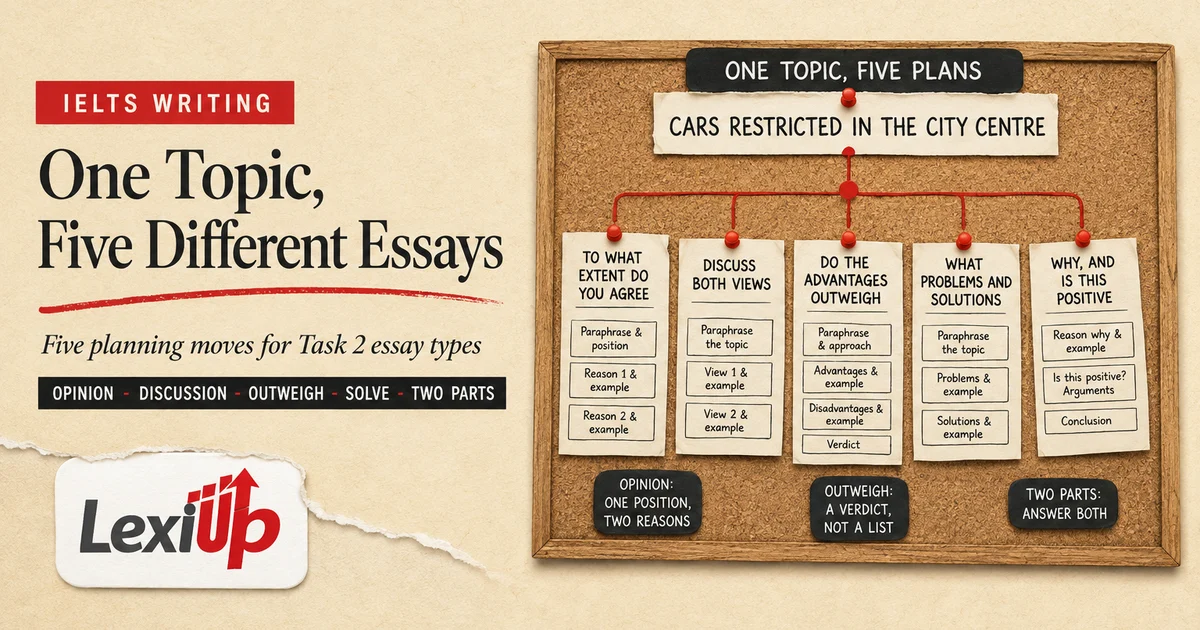
The prompt presents a point of view, argument, or problem. Depending on the wording, you may need to state and justify an opinion, discuss two views, weigh advantages and disadvantages, explain causes, propose solutions, or answer two related questions. Your first scoring decision is therefore not vocabulary; it is identifying exactly what the prompt asks you to do.
The four criteria work together. A grammatically polished essay that answers only half the question can still be limited by Task Response. A relevant essay with weak paragraph control can be limited by Coherence and Cohesion. Plan and review with all four lenses instead of assuming that “better English” automatically means a higher band.
| Criterion | Examiner looks for | Best practice question |
|---|---|---|
| Task Response | A complete answer, clear position, relevant and supported ideas | Did I answer every instruction and explain why my main ideas matter? |
| Coherence and Cohesion | Logical progression, purposeful paragraphs and natural connections | Can a reader predict the job of each paragraph and follow the argument? |
| Lexical Resource | Appropriate range, precision, collocation, spelling and word formation | Did I choose accurate words for this topic instead of forcing unusual synonyms? |
| Grammatical Range and Accuracy | Varied structures used accurately enough for effortless understanding | Did I use sentence variety I can control and leave time to correct repeated errors? |
Step 1: Decode every part of the prompt
Read the prompt twice before generating ideas. On the first read, identify the broad topic. On the second, mark the instruction words and any limits on the topic. A question about technology in primary classrooms is not an invitation to discuss technology across society. Relevance comes from respecting that scope.
Rewrite the task in plain language. For a “discuss both views and give your opinion” question, your checklist has three items: explain view A, explain view B, and make your own position clear. For a two-part question, write a short answer to each question before planning paragraphs.
This prevents the common Band 6 pattern where one part receives detailed attention and the other appears only in the conclusion.
Choose a position you can defend clearly in the available time. IELTS does not award a higher score for a fashionable opinion. A qualified position is acceptable when the task allows it, but it must remain consistent. If your introduction says the benefits clearly outweigh the drawbacks, your conclusion should not suggest that both sides are equal.
- Underline the topic and its limits.
- Circle every instruction word or question.
- Write a one-sentence position that answers the complete task.
- Check that each planned body paragraph helps prove that position.
Step 2: Build a small plan that protects Task Response
Planning is not about writing a miniature essay. It is a decision stage. Choose two strong main ideas rather than four shallow ones, then attach a reason, consequence, or example to each. This gives you enough material to extend the ideas while keeping the argument focused.
A useful body-paragraph note might be: “remote work → no commute → more usable family time → example: parent can share school pickup.” The arrows expose the logic. If you cannot connect a main idea to an explanation and a relevant example, it may be too vague for the essay.
Spend a final planning moment checking balance. In a discussion essay, both views need meaningful treatment. In a problem-and-solution essay, the solution should respond to the problem you described. In an advantages-and-disadvantages essay, the comparison should support the final judgement rather than reading like two unrelated lists.
- Thesis: your direct answer to the whole prompt.
- Body 1: one main claim, why it is true, and one specific illustration.
- Body 2: a second claim or required contrasting view, developed to a similar depth.
- Conclusion: the same position, summarised without introducing a new argument.
Step 3: Write a direct introduction, not a memorised performance
A reliable introduction usually needs two jobs: introduce the exact issue and state the answer or position. It does not need a sweeping claim about modern society, a dictionary definition, or a memorised sentence about a “controversial topic.” Those openings consume time and can make the response sound less precise.
Paraphrase carefully. You do not need to replace every word from the prompt. Keep technical terms when an invented synonym would change the meaning. Change the sentence structure, combine ideas, or use a natural equivalent where one exists. Accuracy is more valuable than visible synonym hunting.
Make the thesis specific enough to guide the essay. “This essay will discuss both sides” describes the task but does not give your position. “Although working from home can reduce informal collaboration, its time and flexibility benefits are greater for most office roles” gives the reader a clear direction that the body paragraphs can support.
Step 4: Develop body paragraphs beyond one example
Band 7 development comes from the relationship between a claim, its explanation, and its support. Start with one central idea. Explain the mechanism: why does this happen, who is affected, or what consequence follows? Then add an example that demonstrates the logic. The example is evidence for your explanation; it should not replace it.
Consider a weak version: “Working from home is beneficial because employees save time. For example, many people do not travel to work.” The second sentence mostly repeats the first. A developed version makes the causal chain visible: “Removing a daily commute gives employees a predictable block of time that can be used for family or rest.
A parent who previously spent ninety minutes travelling, for instance, may be able to share school pickup duties and begin the next workday less fatigued.” The example now supports a clear consequence.
Use one paragraph for one central topic. A paragraph can contain nuance, but every sentence should contribute to the same job. If a paragraph begins with productivity, moves to office rent, then ends with air pollution, the reader must rebuild the organisation. Split unrelated claims or choose the one that best supports your thesis.
Do not invent precise research findings. IELTS accepts examples from your knowledge or experience when they are relevant. A realistic hypothetical example is safer than claiming that an unnamed study proved an exact percentage. Specificity should clarify your reasoning, not create false authority.
| Move | Purpose | Question to ask |
|---|---|---|
| Claim | States the paragraph’s central idea | What single point am I proving? |
| Explain | Shows the reason, mechanism or consequence | Why is this true or important? |
| Illustrate | Makes the explanation concrete | What realistic case shows this process? |
| Connect | Returns the paragraph to the task or thesis | How does this support my answer? |
Step 5: Make cohesion logical before making it visible
Cohesion is not a competition to use the most linking phrases. Words such as “however,” “therefore,” and “for example” help only when the relationship is real. Repeating a connector at the start of every sentence can make the writing mechanical and may hide gaps in reasoning.
Create progression through content first. Put information in an order where each sentence can build on the previous one. Then use a mix of reference words, pronouns, controlled repetition, substitution, and conjunctions. If a paragraph discusses public transport, repeating the core term once may be clearer than rotating through inaccurate substitutes.
Paragraphing should reveal the essay plan. Give each body paragraph a clear central topic and use the conclusion to resolve the argument. Very short paragraphs often signal undeveloped ideas; one very long paragraph can hide separate claims.
There is no magic paragraph count, but an introduction, two or three purposeful body paragraphs, and a conclusion is manageable for many Task 2 questions.
- Use a connector only when you can name the relationship: contrast, result, example, addition, or concession.
- Check every pronoun has an obvious noun to refer to.
- Repeat a key technical term when a synonym would be less accurate.
- Read only the first sentence of each paragraph; together they should show the argument’s progression.
Step 6: Choose precise vocabulary you can control
Lexical Resource rewards range, but range does not mean replacing simple words with obscure ones. Band 7 vocabulary is flexible and reasonably precise, with awareness of style and collocation. “A major obstacle,” “reduce commuting time,” and “place pressure on housing” are useful because the words naturally work together.
Build vocabulary as phrases in context. When you review an essay, save the corrected collocation and write a new sentence with it. If you wrote “do a decision,” the repair is not simply the word “make”; practise “make a decision about,” “reach a decision,” and “a difficult decision.” This makes later use more reliable.
Avoid synonym chains that distort meaning. “Children,” “young people,” and “students” are not always interchangeable. Likewise, “problem,” “challenge,” and “catastrophe” carry different strength. Precision includes knowing when the ordinary word is the correct word.
Spelling and word formation count. Reserve checking time for plural endings, adjective and noun forms, and words you know you often misspell. One correct, topic-specific phrase is more valuable than an ambitious expression that does not fit the sentence.
Step 7: Show grammatical range without sacrificing accuracy
Grammatical range means using structures that suit your meaning. A clear argument normally needs a mixture of simple, compound, and complex sentences. Complex sentences are useful for concession, condition, cause, and relative detail, but length alone does not make a sentence sophisticated.
Practise a small set of high-value relationships accurately. Concession can show nuance: “Although remote teams lose some spontaneous contact, scheduled collaboration can protect important exchanges.” Conditionals can explore consequences: “If cities improve late-night transport, more shift workers may leave their cars at home.” Relative clauses can add precise detail without starting a new sentence.
Frequent error-free sentences matter. If a long sentence contains several uncontrolled clauses, split it. A shorter accurate sentence beside a well-controlled complex one demonstrates more ability than a paragraph of tangled structures. Punctuation should help the reader see the grammar, not decorate it.
Keep a personal error list with categories such as articles, subject–verb agreement, sentence boundaries, verb forms, and countable nouns. During the final check, search for your top two patterns first. A targeted check is more effective than rereading quickly and hoping mistakes become visible.
Use a realistic 40-minute workflow
IELTS recommends spending about 40 minutes on Task 2. The split below is a practical training framework, not an official rule. Adjust it through timed practice, but protect time for understanding the prompt and checking the answer.
Use the first five minutes to decode the task, choose a position, and plan two developed body ideas. Use roughly thirty minutes to write, monitoring progress rather than chasing an exact sentence count. Keep the final five minutes for a criterion-based check.
If planning currently takes much longer, practise planning by itself until you can make clear decisions quickly.
| Time | Job | Output |
|---|---|---|
| 0–5 minutes | Decode and plan | Complete task checklist, thesis, two developed ideas |
| 5–35 minutes | Write the response | Introduction, purposeful body paragraphs, conclusion |
| 35–40 minutes | Check by criterion | Missing task part, paragraph logic, repeated vocabulary and personal grammar errors |
Diagnose the move from Band 6 towards Band 7
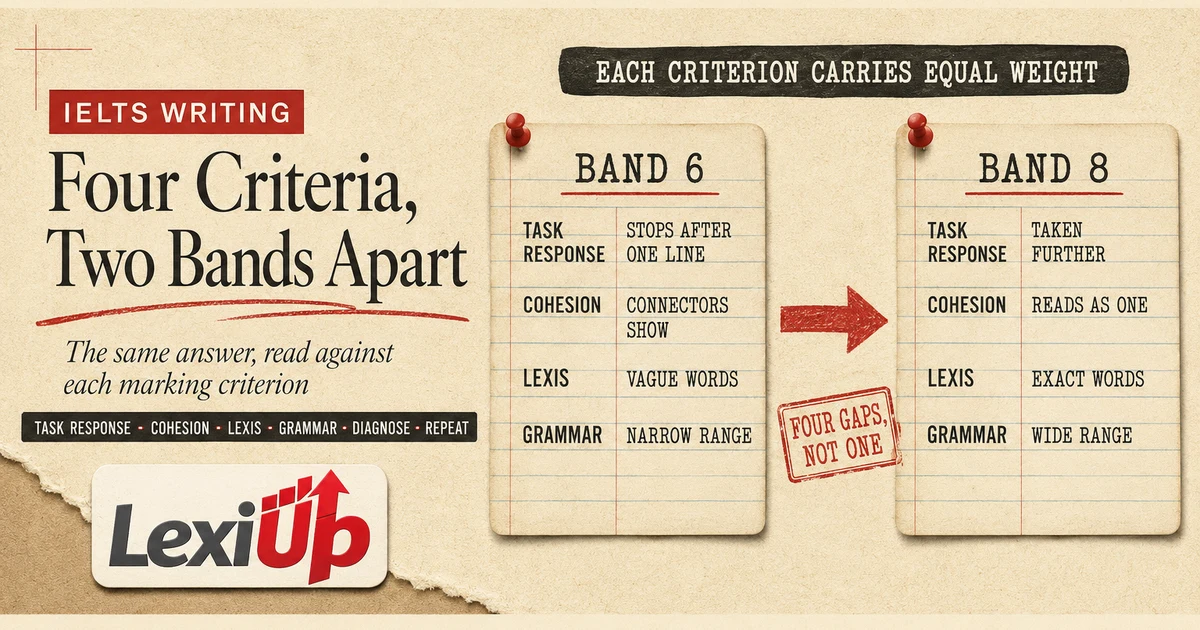
The difference is rarely one dramatic trick. It is usually a collection of more consistent decisions. The official descriptors show that Band 6 may address all parts but cover some more fully than others, while Band 7 addresses all parts and maintains a clear position. Similar shifts appear in organisation, vocabulary precision, and the frequency of error-free sentences.
Use this comparison as a practice diagnosis, not a score calculator. Only certificated IELTS examiners award official bands, and a single feature cannot determine the result. Look for repeated patterns across several timed essays.
| Criterion | Common Band 6 limiter | Band 7-directed practice |
|---|---|---|
| Task Response | One task part or main idea is less fully developed | Make a task checklist and extend each main idea with an explanation and support |
| Coherence and Cohesion | Progression exists but some connections feel mechanical or unclear | Strengthen paragraph purpose and sentence order before adding connectors |
| Lexical Resource | Range is adequate but wording is sometimes imprecise or repetitive | Practise accurate topic collocations and controlled paraphrase |
| Grammar | A mix of structures appears, but errors occur in complex sentences | Use fewer uncontrolled clauses and repair two recurring error patterns |
Practise with a feedback-and-rewrite loop
Writing more essays helps only if each attempt changes the next one. Use a weekly loop that combines timed performance with focused repair. One full essay reveals how your skills interact under time pressure; short rewrites let you improve a specific weakness without spending another 40 minutes.
After a timed response, review against all four criteria. Select the weakest paragraph and name the problem in observable language: “the example repeats the claim,” “my position changes,” or “three article errors appear.” Avoid labels such as “bad grammar,” which are too broad to guide practice.
Rewrite that paragraph without looking at the original sentence by sentence. Then compare the versions and record one rule for the next essay. A day later, write a new paragraph on a similar topic using the same skill. This near-transfer step checks whether you learned the principle rather than memorised the correction.
Use official sample tasks for timed practice and official descriptors for review. A teacher or qualified tutor can help identify patterns you cannot see yourself. Automated feedback can support practice, but it should not be presented as an official examiner score and should always point back to evidence in your writing.
- Write one timed Task 2 response.
- Review it separately for Task Response, Coherence and Cohesion, Lexical Resource, and Grammar.
- Choose one high-impact weakness and rewrite the relevant paragraph.
- Practise the repaired skill on a fresh prompt within 24–48 hours.
- Track whether the same issue returns across the next three essays.
Final IELTS Writing Task 2 Band 7 checklist
Use this checklist during practice until the decisions become automatic. On test day, keep the check short and personal. You are not trying to make the essay perfect; you are protecting the features that make the response complete, clear, developed, and controlled.
- I answered every part of the prompt and kept one clear position.
- Each body paragraph has one central idea that is explained and supported.
- The paragraph order creates a logical argument without relying on excessive linkers.
- Vocabulary is accurate, topic-appropriate, and naturally combined.
- I used a range of sentence structures I can control.
- I wrote at least 250 words in connected prose, not notes or bullet points.
- I checked my most frequent grammar and spelling errors.
- My conclusion resolves the argument without adding a new main idea.
Frequently asked questions
Does an IELTS Writing Task 2 Band 7 essay need to be error-free?
No. The Band 7 descriptors allow some grammar and vocabulary errors. The response still needs clear communication, a range of structures, frequent error-free sentences, relevant development, and logical organisation.
How many words should I write for IELTS Writing Task 2?
IELTS requires at least 250 words. Writing far beyond the minimum is not automatically better and can reduce your checking time or introduce less relevant ideas. Practise producing a complete, developed response within about 40 minutes.
Do I need rare vocabulary to reach Band 7?
No. Lexical Resource rewards range, flexibility, precision, appropriate style, spelling, and word formation. Accurate collocations and well-chosen topic language are safer than unusual words used incorrectly.
Can a memorised essay template guarantee Band 7?
No. A fixed template cannot guarantee a score and may make the response less relevant to the exact prompt. A simple planning framework is useful, but the thesis, paragraph purpose, reasoning, and examples must answer the task you receive.
Is the 5–30–5 timing plan an official IELTS rule?
No. IELTS advises spending about 40 minutes on Task 2. The five-minute plan, thirty-minute draft, and five-minute check is a practical training framework that you should adjust through timed practice.
Sources and review note
This guide was reviewed against the sources below. LexiUp remains independent of the exam owners.