For: IELTS Academic and General Training learners who can give a short opinion but need a reliable way to explain, support, qualify, and extend ideas in the Part 3 discussion
Build IELTS Speaking Part 3 answers beyond one sentence
IELTS Speaking Part 3 answers need more than a quick yes or no. Part 3 is a two-way discussion in which the examiner asks broader questions connected to the Part 2 topic. The useful skill is not memorising a long speech.
It is hearing the exact question, giving a direct position, and developing that position with relevant reasoning while the discussion continues.
Official IELTS information describes Part 3 as a discussion of related issues in a more general and abstract way. It lasts about four to five minutes and gives you opportunities to explain opinions, analyse, discuss, and speculate. British Council guidance also encourages appropriately extended answers, alternative perspectives, and language for explaining, comparing, and generalising.
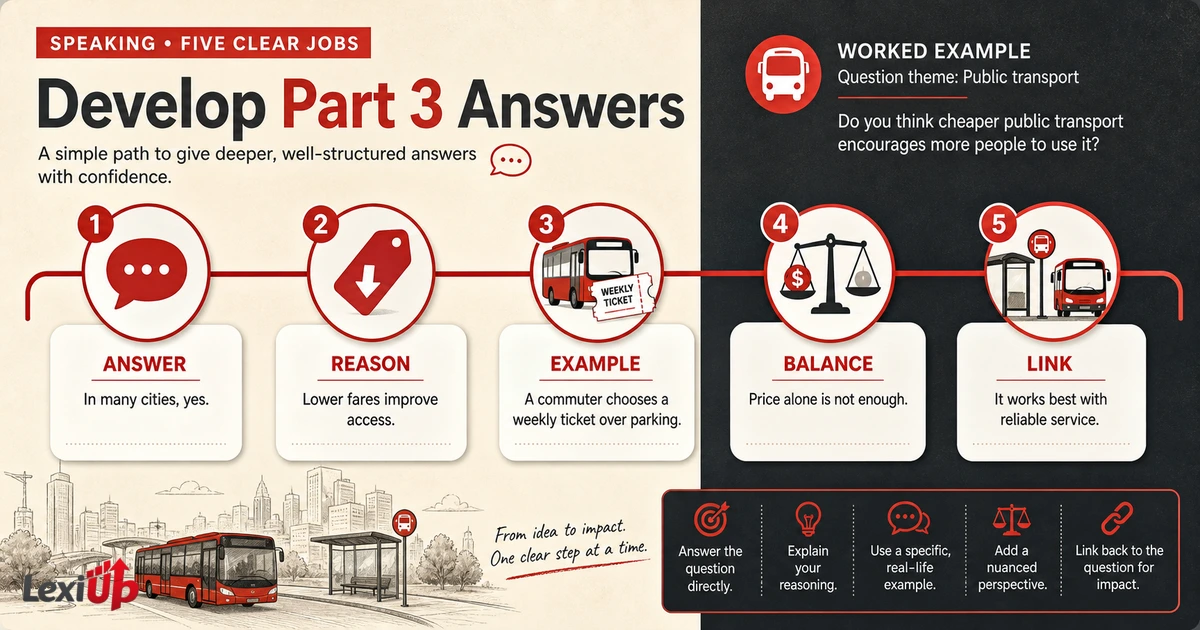
This guide uses one original public-transport example and five flexible steps: answer, reason, example, balance, and link. The example is not an IELTS test question and does not reproduce protected material. The method is a practice scaffold, not a script. In the real discussion, use only the steps that help you answer the question naturally and accurately.
See one original Part 3 answer develop clearly
Imagine this original practice question: “Should cities make public transport cheaper?” A very short answer might be: “Yes, they should.” It gives a position, but it leaves the examiner with little information about your reasoning, the conditions around the idea, or your ability to connect thoughts in spoken English.
A developed answer could be: “In many cities, yes, because lower fares can make buses and trains a realistic choice for more people. For example, a worker who travels every day may leave the car at home if the weekly ticket costs less than parking.
However, price alone is not enough; the service also needs to be frequent and reliable. So cheaper fares are most useful when they are part of a wider transport plan.”
Every sentence has a job. The first gives the position and reason. The second adds a concrete example. The third qualifies the claim instead of making it absolute. The final sentence returns to the main idea and shows the condition that makes it convincing. The answer sounds developed because the ideas connect, not because it contains unusual vocabulary.
| Answer job | Worked example | What it adds |
|---|---|---|
| Answer | In many cities, yes | A direct but carefully limited position |
| Reason | Lower fares can make public transport realistic for more people | The main explanation |
| Example | A daily worker may choose a weekly ticket over parking | A specific situation that makes the reason clear |
| Balance | Price alone is not enough; service must be reliable | A relevant condition and alternative consideration |
| Link | Cheaper fares work best inside a wider transport plan | A concise return to the complete question |
Step 1: answer the exact question directly
Begin by identifying what the examiner is asking you to do. A question may ask for an opinion, a cause, an effect, a comparison, a prediction, or an evaluation. Your first sentence should match that job. If the question asks why, give a cause. If it asks how two groups differ, establish the comparison.
If it asks about the future, make a careful prediction rather than describing only the present.
Direct does not mean rigid. Phrases such as “I think”, “In many cases”, “The main reason is”, or “One important difference is” can provide a clear starting point. Avoid spending several sentences announcing that the question is interesting or hard. A short thinking phrase is useful only when it leads quickly into a relevant answer.
Listen for limits inside the question. Words such as usually, in the future, young people, governments, and in your country define the scope. Missing one of them can produce fluent speech about a different topic. Before you continue, ask yourself: what decision have I made, and does my opening sentence answer the examiner’s actual question?
- Name the question job: opinion, cause, effect, comparison, prediction, or evaluation.
- Keep the first sentence short enough to control.
- Match the time reference and subject in the question.
- Use careful limits when the claim is not true in every situation.
- Do not replace an answer with a memorised introduction.
Step 2: add one reason that explains your position
A reason should explain the position you just gave. It should not introduce an unrelated advantage because you remember vocabulary for it. For the transport example, the reason is access: lower fares make regular travel realistic for more residents. That reason directly supports the view that cities should reduce fares.
Use one clear relationship at a time. Cause language can include “because”, “this is mainly due to”, or “one reason is that”. Effect language can include “so”, “which means that”, or “as a result”. The linking phrase matters less than the logical connection.
If removing the connector makes the two ideas unrelated, revise the content rather than adding a more formal phrase.
You do not need three reasons for every answer. One reason developed well is often more useful than a list of undeveloped points. The examiner may ask a follow-up question or interrupt to explore the issue further.
That is a normal part of a two-way discussion, so keep enough flexibility to respond instead of trying to deliver a prepared monologue.
- State the position in one sentence.
- Ask yourself why that position is reasonable.
- Choose the strongest relevant reason, not the first memorised topic.
- Connect the reason with clear cause or effect language.
- Stop the reason before it turns into a second unrelated idea.
Step 3: make the reason concrete with an example
An example helps the listener see how the reason works. It does not need to be a statistic, a famous event, or a personal story presented as universal proof.
You can create a realistic situation: a commuter choosing between a weekly ticket and parking, a family living far from a school, or a small business adjusting to a new rule.
Keep the example narrow. In the worked answer, one daily worker makes the cost comparison visible. The answer does not invent a percentage or claim that every driver will change. A specific situation can be persuasive without becoming a false fact. Use phrases such as “For example”, “A simple case would be”, or “This can happen when”.
Examples are optional when the reason is already clear and the examiner moves on. They are especially helpful when your answer sounds abstract, when you need to explain a consequence, or when you want to distinguish two groups. After practising, check whether the example proves your reason or merely repeats the topic using different words.
| Example type | Useful form | Risk to avoid |
|---|---|---|
| Realistic situation | A commuter compares a ticket with parking | Adding unnecessary invented figures |
| Group contrast | Younger workers may adapt faster than older workers | Treating every member of a group as identical |
| Cause and result | Reliable buses reduce the need for a second car | Claiming a result that the reason cannot support |
| Personal experience | In my area, late buses make commuting uncertain | Assuming one experience proves a general rule |
| Hypothetical case | If services ran every ten minutes, more people might try them | Presenting a possibility as a certain outcome |
Step 4: add balance only when it improves the answer
Part 3 often invites analysis rather than absolute statements. A useful balance sentence can show a condition, exception, or alternative perspective: “However, price alone is not enough.” This does not mean you must contradict yourself. It means you can keep your original position while recognising the factor that limits it.
Use balance when the topic genuinely has more than one side. “This may be true in large cities, whereas rural areas face a different problem” is more precise than saying the same policy works everywhere. British Council preparation materials encourage learners to consider alternative perspectives and use appropriate language for comparing, speculating, and commenting.
Do not attach “on the other hand” to every answer. Forced balance can make a clear idea confusing or consume time without adding meaning. First establish your position and reason. Then ask whether a condition or contrast helps the listener understand the issue more accurately.
If it does not, move to a concise closing link or wait for the next question.
- Use “in many cases” or “generally” to avoid an unnecessary absolute claim.
- Add a condition when the idea depends on price, location, age, access, or time.
- Compare groups only when the question or reason makes the comparison relevant.
- Keep your main position visible after introducing another perspective.
- Remove balance phrases that add no new meaning.
Step 5: link back and leave room for discussion
A final link can return the answer to the question: “So cheaper fares are most useful when they are part of a wider transport plan.” This gives the examiner a clear endpoint and makes the development feel complete. It also shows how the reason, example, and qualification combine into one position.
The link should not repeat every sentence. One concise result, judgement, or condition is enough. If the examiner asks another question before you reach it, stop and listen. Interruption does not automatically mean the answer was poor. Part 3 is interactive, and follow-up questions allow the examiner to explore your ideas in greater depth.
Treat the five steps as a menu rather than a compulsory formula. Some questions need answer, reason, and example. Others need answer, comparison, and result. A prediction may need a present trend plus a cautious future effect. The goal is to develop a relevant idea naturally, not to force every response into exactly five sentences.
- Return to the central question in one short sentence.
- State the overall result, judgement, or condition.
- Avoid repeating the full example.
- Stop when the idea is complete and listen for the next question.
- Adapt the framework to the question instead of reciting it.
Use language that supports meaning, not a memorised performance
Natural development depends on clear relationships between ideas. Practise small sets of language by function: “because” for a reason, “for instance” for an example, “whereas” for a comparison, “might” for a cautious prediction, and “overall” for a final judgement. Choose the simplest form that expresses the relationship accurately.
Do not memorise complete answers for possible topics. A fixed answer can become irrelevant when one word in the question changes. It can also make follow-up questions harder because you are listening for the next prepared line instead of the examiner’s meaning. Practise flexible building blocks and new questions so the method survives outside one familiar topic.
Record short discussions rather than isolated perfect sentences. After each answer, check four things: Did I answer the exact question? Did each added sentence support the position? Was my qualification accurate? Could I respond to a natural follow-up? Review one repeated issue at a time, such as vague reasons, missing examples, over-generalisation, or excessive linking phrases.
Practise the five-step map in a short weekly loop
Start with two original Part 3-style questions on one broad topic. Give yourself no written script. Record an answer of about twenty to forty seconds, then label each sentence by job: answer, reason, example, balance, or link. A sentence with no clear job may be filler, repetition, or an idea that belongs in another answer.
On the second attempt, change only the weakest part. If the reason was vague, make the cause more specific. If the example became a long story, reduce it to one situation. If the answer sounded absolute, add a precise limit. Re-record the complete response so the repair becomes part of connected speech rather than an isolated correction.
Later in the week, return to the same reasoning skill with a different topic. You might compare remote and office work, explain why public spaces matter, or predict how shopping may change. Topic rotation prevents you from memorising content and reveals whether the five-step map is genuinely available when the language and ideas change.
| Session | Main job | Review question |
|---|---|---|
| 1 | Answer and reason | Did the reason directly support the position? |
| 2 | Example and balance | Did the example clarify, and was the limit relevant? |
| 3 | Follow-up discussion | Could I listen, adapt, and extend without a script? |
| 4 | New topic transfer | Did the framework work without memorised content? |
Connect Speaking Part 3 practice to LexiUp IELTS
LexiUp IELTS can help you keep speaking practice, feedback, and review connected on iPhone. Use the daily plan or Speaking Skill Builder to choose one focused task, record an answer, request guidance when it is useful, and return to the specific pattern you want to improve. The app is free to start and supports independent IELTS preparation.
For this lesson, choose one narrow target such as “add one relevant reason before the example” or “qualify broad claims”. Keep the target for several questions, then record the recurring issue in mistake review.
A precise target is easier to revisit than a general note such as “speak better”, and it does not treat one recording as an official band score.
LexiUp is independent and is not affiliated with or endorsed by IELTS. Use official IELTS, British Council, IDP, and Cambridge materials for current test information and authentic practice. Use LexiUp to organise the surrounding loop: practise, review feedback carefully, repair one pattern, and test the same skill on a new question.
Frequently asked questions
How long should IELTS Speaking Part 3 answers be?
There is no fixed sentence count. Give a direct answer and develop it enough to explain your meaning. The examiner may ask follow-up questions or move the discussion forward.
Do I need an example in every Part 3 answer?
No. Use an example when it makes a reason, comparison, or consequence clearer. Do not force one into an answer that is already complete.
Can I ask the examiner to repeat a Part 3 question?
If you did not hear the question clearly, asking for repetition is better than answering a different question. Listen closely when it is repeated and respond to its exact scope.
Should I give both sides of every Part 3 issue?
No. Add another perspective only when it improves the analysis. Keep your own position clear and avoid balance language that adds no relevant meaning.
Is the five-step method an official IELTS answer formula?
No. It is an original practice scaffold for developing ideas. IELTS does not require one fixed answer formula, and the method should be adapted to each question.
Sources and review note
This guide was reviewed against the sources below. LexiUp remains independent of the exam owners.