For: IELTS Academic and General Training learners who want to make their spoken English easier to follow without trying to remove their natural accent
Make IELTS Speaking pronunciation about clarity
IELTS Speaking pronunciation is not a request to copy one particular accent. The useful goal is clarity: your listener should be able to follow your ideas without unusual effort. Your own accent can remain part of your speech.
The practical work is to control the features that carry meaning, including word groups, rhythm, stress, intonation, and individual sounds that regularly cause confusion.
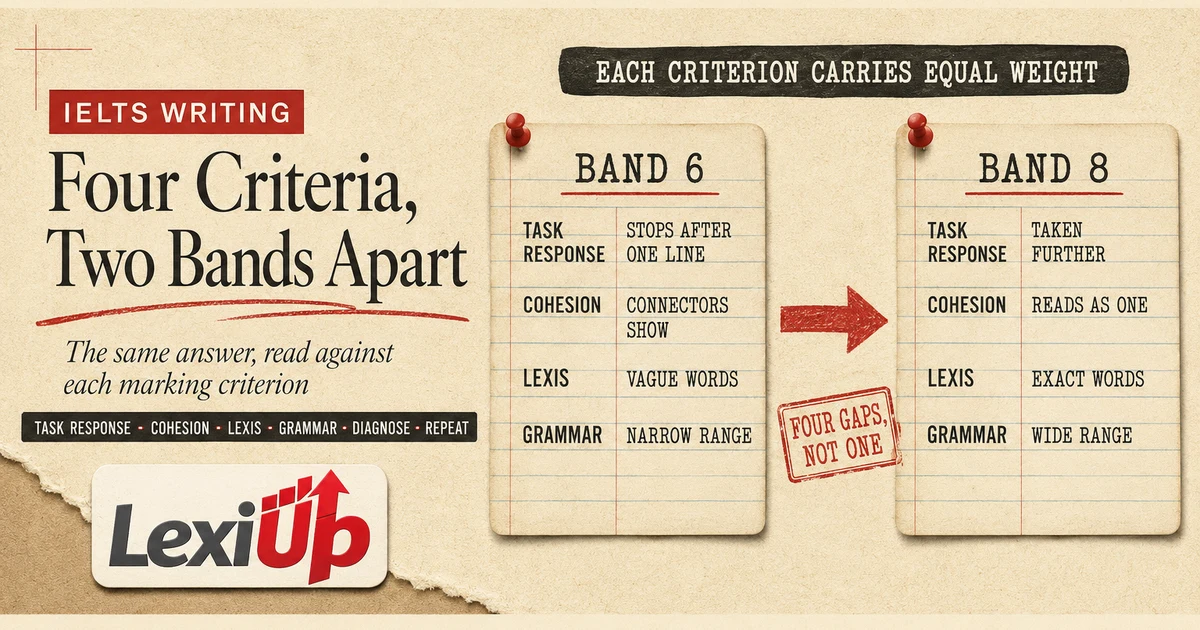
The official IELTS Speaking criteria assess four areas: fluency and coherence, lexical resource, grammatical range and accuracy, and pronunciation. Each criterion contributes equally to the Speaking result. The public pronunciation descriptors look beyond isolated sounds. They also consider how consistently a speaker uses phonological features and how understandable the speech is across the test.
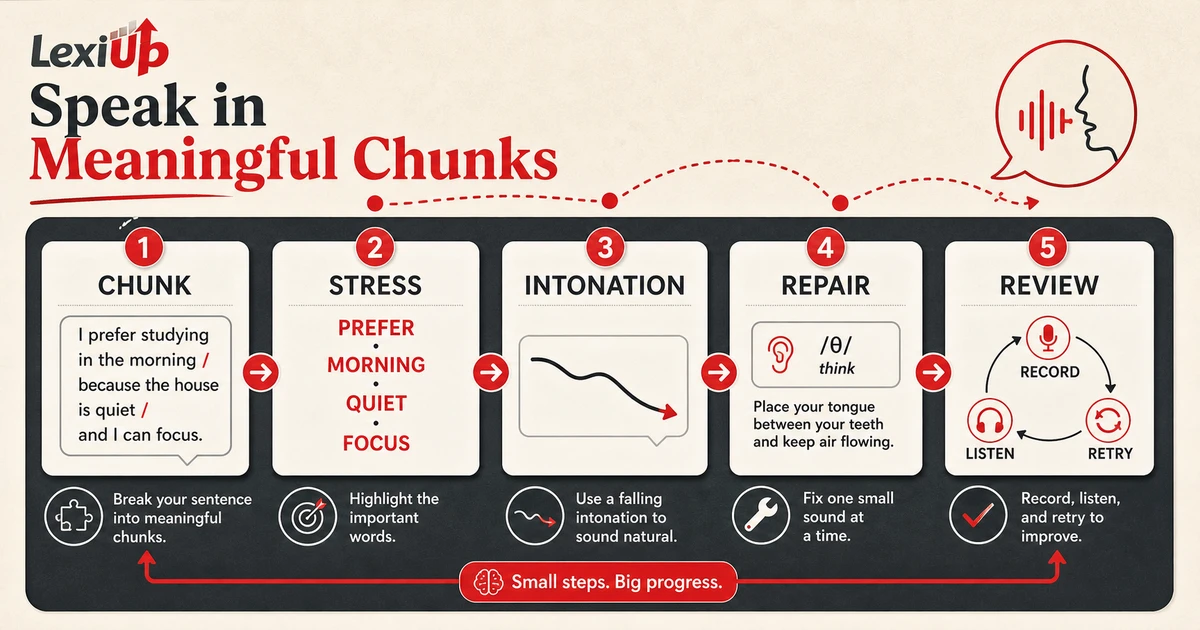
This guide turns those broad ideas into five drills: chunk the message, stress the key words, shape intonation, repair one recurring sound problem, and record a short answer for evidence. The drills are original learning activities, not official IELTS questions. Use them beside current official samples so your practice remains connected to the real format.
See one sentence as a pronunciation map
Start with this original practice sentence: “I prefer studying in the morning because the house is quiet and I can focus.” If every word receives equal weight, or if you pause after every two words, the listener has to rebuild the meaning.
A clearer delivery groups the sentence by idea: “I prefer studying in the morning / because the house is quiet / and I can focus.”
Now mark the important content words: “PREFER”, “MORNING”, “HOUSE”, “QUIET”, and “FOCUS”. These words carry the main message. Smaller grammar words still need to be spoken, but they do not all need the same force. Let the voice fall gently at the end because the sentence presents a complete statement.
This is a useful map: chunks organise the ideas, stress highlights the message, and intonation shows whether the thought is continuing or complete.
Do not perform the marks mechanically in the test. They are practice tools. Repeat the sentence slowly, then at a comfortable conversational pace. The result should sound connected rather than theatrical. If one word remains unclear, isolate only that word or sound for a brief repair, then return it to the complete sentence.
| Layer | Practice mark | Listening purpose |
|---|---|---|
| Chunks | morning / house is quiet / I can focus | Separates three connected ideas |
| Stress | PREFER, MORNING, HOUSE, QUIET, FOCUS | Makes the main message easier to catch |
| Intonation | Gentle fall at the end | Shows that the statement is complete |
| Sound repair | One unclear word only | Fixes a repeated clarity problem without breaking flow |
| Review | Record, listen, retry | Compares evidence from two attempts |
Drill 1: group words into meaningful chunks
Chunking means packaging words into short groups that express one part of an idea. Official IELTS assessment guidance identifies chunking as a pronunciation feature, and British Council teaching guidance recommends it as a way to make information easier for a listener to follow. A useful pause sits between ideas.
A pause inside a tightly connected phrase can make the message harder to process.
Take a short answer and draw a slash where one idea ends. Read each chunk in one smooth movement. For example: “The park near my home / is useful for exercise / but I usually visit in the evening.” Keep related words together.
Avoid a pause between “the” and “park”, between “useful” and “for exercise”, or between an auxiliary verb and its main verb.
After two marked readings, remove the page and say the idea again in your own words. This stops the drill becoming memorisation. During review, listen for pauses caused by searching for vocabulary. If you often stop in the middle of a phrase, simplify the wording before trying to increase speed.
- Write one original answer of two or three sentences.
- Mark a slash only where one idea naturally gives way to the next.
- Read each chunk smoothly at a comfortable pace.
- Say the answer again without reading it.
- Keep one note about any pause that interrupted meaning.
Drill 2: stress the words that carry the message
Sentence stress helps the listener identify what matters. Content words such as key nouns, main verbs, adjectives, and contrast words often carry more weight than articles, prepositions, and auxiliary verbs. The exact pattern changes with meaning. “I wanted the RED notebook” corrects the colour. “I WANTED the red notebook” contrasts wanting it with another action.
Choose one sentence and underline no more than three or four message words. Read it once with every word equal, then once with the message words slightly stronger and clearer. The second version should not become louder throughout. Stress can come from a combination of length, pitch, and emphasis.
The surrounding words can remain lighter while still being understandable.
Next, change the intended meaning and move the stress. This teaches control rather than imitation. If your review note says only “pronunciation was bad”, it will not guide the next practice. Record the exact problem instead: “I stressed every word”, “the contrast word disappeared”, or “I rushed the final key noun”.
| Meaning | Stress pattern | What the listener notices |
|---|---|---|
| Correct the time | I study in the MORNING | Morning, not evening |
| Correct the activity | I STUDY in the morning | Study, not work or exercise |
| Correct the person | I study with my SISTER | Sister, not another person |
Drill 3: use intonation to show the shape of an idea
Intonation is the movement of the voice across a phrase. It can signal that a thought is continuing, show contrast, or help a complete statement sound finished. It should support meaning rather than decorate every sentence. A flat delivery can hide the structure of an answer, while exaggerated movement can sound rehearsed and distract from the message.
Practise with a three-part response. Let the voice remain open while the explanation continues, place clear emphasis on the contrast, then allow a natural fall at the end. For example: “I used to study late, / but NOW I work in the morning, / because I can concentrate better.” The exact pitch is personal.
What matters is that the listener can hear the relationship among the three ideas.
Use a small upward arrow for a continuing phrase, a circle for the contrast word, and a downward arrow for the completed thought. Read the answer twice, then remove the marks. If the unmarked version becomes flat, keep only one visual cue next time. The goal is independent control, not dependence on a script.
- Keep intonation connected to meaning, not to a memorised melody.
- Use contrast stress when one idea changes or corrects another.
- Let complete statements finish clearly without forcing a dramatic fall.
- Check whether the listener can hear where one stage of the answer ends.
Drill 4: repair one sound problem inside real speech
Individual sounds matter when they repeatedly change a word or make the listener work harder. Do not spend the whole session trying to perfect every sound. Choose one contrast that affects your own clarity. It might be a vowel length, a final consonant, a consonant cluster, or the stress pattern of a familiar academic word.
First, confirm the target with a reliable dictionary audio model or a teacher. Listen, identify the mouth movement or word stress, and produce the sound in one or two useful words. Then place each word inside a short sentence. A sound that works in isolation may disappear when speech becomes faster, so the sentence stage is essential.
Finish by using the word in a new answer. Keep only evidence that a listener could notice. A useful note is “the final sound in ‘worked’ disappeared in both recordings”. A less useful note is “my accent is wrong”. Accent is not the repair target. Clear, repeatable communication is.
- Choose one recurring sound or word-stress problem.
- Check one reliable model and listen several times.
- Practise two words containing the target feature.
- Place each word in a short, natural sentence.
- Use one target word in a fresh answer and record it.
Drill 5: record, review, and retry with one target
Self-recording is useful when it produces a specific next action. Record a 30- to 45-second answer to an original everyday question. Listen once for meaning: can you follow the answer without the prompt? Listen again for only one target, such as chunking or sentence stress. Trying to judge every pronunciation feature at once usually produces vague notes.
Mark one moment that helped clarity and one moment to repair. Then record the answer again without reading the first version word for word. Keep the same idea but allow the language to change naturally. Compare the two attempts for the chosen target.
A second recording is useful only if it tests the repair rather than hiding the problem with a completely different answer.
If possible, ask a teacher, language partner, or trusted listener one neutral question: “Which part required extra effort to understand?” Do not ask them to rate an unofficial band score. Their job is to identify listener effort. Your job is to turn that evidence into one focused practice choice.
- Schedule short speaking reviews with the daily IELTS study plan →
- Turn repeated speaking problems into a focused IELTS mistake review →
| Pass | Question | Evidence to keep |
|---|---|---|
| Meaning | Can I follow the answer without seeing the prompt? | One unclear idea or missing link |
| Target | Did the chosen feature support clarity? | One exact timestamp or phrase |
| Repair | What will change in the second attempt? | One observable action |
| Retry | Did the same idea become easier to follow? | A short comparison, not a score |
Use a five-day IELTS Speaking pronunciation routine
Keep pronunciation practice short enough to repeat. On day one, mark and speak meaningful chunks. On day two, move sentence stress to show different meanings. On day three, shape one explanation with natural intonation. On day four, repair one recurring sound or word-stress problem. On day five, make a fresh recording and review one target.
Return to an official Speaking sample after the five drills. Answer one question without a script and notice whether the repaired feature survives when you are also choosing ideas, vocabulary, and grammar. Transfer matters more than a perfect isolated exercise. If the feature disappears, shorten the answer and repeat the same target next week.
LexiUp IELTS can help you keep short speaking work connected to a daily plan and later review on iPhone. The app is free to start and supports independent preparation. Its guidance and estimates are not official IELTS examiner scores. Use official IELTS, British Council, IDP, and Cambridge materials for current format and assessment information.
| Day | Practice focus | Finish with |
|---|---|---|
| 1 | Meaningful chunks | One answer with clear idea groups |
| 2 | Sentence stress | Two meanings created by moving stress |
| 3 | Intonation | One connected explanation with a clear finish |
| 4 | Sound repair | One target word inside fresh speech |
| 5 | Record and review | One evidence note and one retry |
Frequently asked questions
Do I need a British or Australian accent for IELTS Speaking?
No. Official and partner guidance focuses on clear, understandable speech and controlled pronunciation features. Your natural accent does not need to disappear.
What pronunciation features are assessed in IELTS Speaking?
Public IELTS materials describe features including chunking, rhythm, stress, intonation, and individual sounds, together with overall intelligibility and the effort required from the listener.
Is pronunciation one quarter of the IELTS Speaking score?
Yes. Speaking is assessed using four equally weighted criteria: fluency and coherence, lexical resource, grammatical range and accuracy, and pronunciation.
How long should I practise pronunciation each day?
A short focused session can be useful when it has one target and includes transfer into a fresh answer. Ten to fifteen minutes is enough for the drills in this guide, but your needs may differ.
Should I memorise a pronunciation script?
No. Use marks and model sentences to learn a feature, then practise the same feature in a fresh answer. Memorised delivery can become flat or inflexible when the question changes.
Sources and review note
This guide was reviewed against the sources below. LexiUp remains independent of the exam owners.