For: IELTS learners who understand a Speaking Part 2 topic but spend the preparation minute writing too much, changing ideas, or worrying about how to begin
IELTS Speaking Part 2 preparation gives one minute one clear job
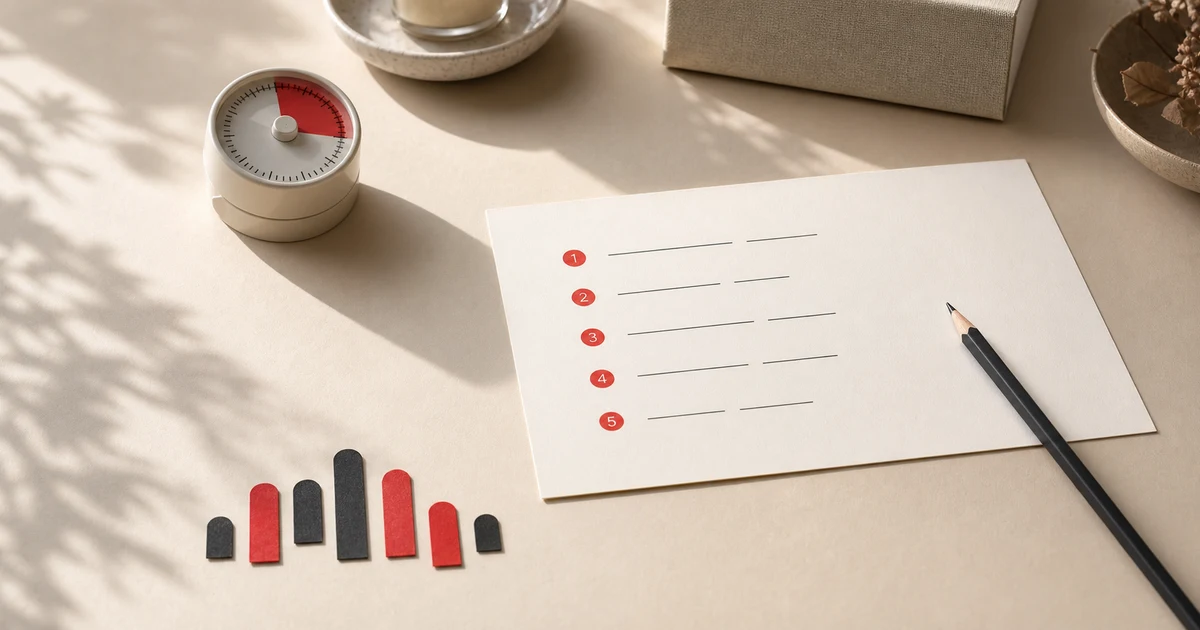
IELTS Speaking Part 2 preparation lasts for one minute. That minute is not enough to write a complete answer, and it does not need to be. Its purpose is to help you understand the task, choose a workable subject, and leave yourself a small path to follow while you speak.
A calm plan can reduce the pause between receiving the task card and beginning your long turn.
Official IELTS information says that you receive a task card, paper, and a pencil. You have one minute to prepare, then you keep talking for two minutes until the examiner stops you. The examiner may ask one or two questions about the same topic after the long turn. This guide turns that format into a five-step practice routine.
It is independent preparation guidance, not an official script or a score promise.
What the one-minute preparation time is for
The preparation minute has three useful outcomes. First, you decide what or who you will talk about. Second, you collect a few details that make the answer specific. Third, you arrange those details so that one point can lead naturally to the next. You are building a speaking route, not a written response.
Short notes should support your memory without taking your attention away from the conversation.
A task card includes a main topic and points that can guide the talk. Read the whole card before choosing your example. A quick choice based only on the first line can become difficult when you notice a later point. At the same time, do not search for a perfect or impressive story.
A familiar subject with clear details is usually easier to develop than an unusual subject that requires new facts or difficult vocabulary.
| Time | Job | What to put on the page |
|---|---|---|
| 0–10 seconds | Read the complete card | Underline the topic and notice every prompt point. |
| 10–20 seconds | Choose one subject | Write one name, place, event, object, or experience. |
| 20–40 seconds | Add useful details | Write one or two key words beside each prompt point. |
| 40–50 seconds | Choose an order | Number the notes or draw small arrows between them. |
| 50–60 seconds | Prepare the start | Add an opening phrase and one rescue detail. |
Step 1: read the complete task card before making notes
Use the first few seconds to read from the main topic to the final prompt point. You are checking the boundaries of the task. Is it asking about a person, place, object, activity, event, or experience? Does it refer to the past, present, or a possible future situation?
A small time detail can change the example you should choose, so notice it before your pencil starts moving.
Do not copy the task card into your notes. The card will remain available while you speak. Instead, mark the words that tell you what each part needs. You might notice labels such as who, where, when, what happened, or why it mattered. These are planning labels, not a memorised answer structure.
The exact card should decide which labels are useful each time.
- Read the main topic and all supporting points once.
- Notice the time reference and the type of subject required.
- Mark any point that will need a reason, feeling, or explanation.
- Keep the full card visible instead of copying it.
- If one word is unfamiliar, use the rest of the card to infer the task before choosing your example.
Step 2: choose the first clear example you can develop
Choose an example you can describe with real or plausible personal detail. It does not need to be dramatic. A local place you know well, a person you have spent time with, or an ordinary event you remember clearly can provide enough material. The useful test is not “Is this impressive?”
It is “Can I explain this clearly for up to two minutes?”
If two ideas appear, give yourself only a few seconds to compare them. Keep the one with more accessible details: a clear setting, a short sequence, a reason, and a feeling or result. Changing subjects several times can use most of the preparation minute.
Practise accepting the first workable choice so that your time is spent developing it rather than judging it.
- Write the first relevant subject that comes to mind.
- Check that it fits the complete task card.
- Ask whether you can add a setting, event, reason, and result.
- Keep it if those details are available.
- Change it only when it clearly does not fit the task.
Step 3: write key words in English, not complete sentences
Official IELTS guidance recommends making notes in English and using phrases rather than full sentences. This keeps the notes quick and easier to use while speaking. A useful note might be “quiet coastal walk”, “first visit with cousin”, or “felt more confident”.
Each phrase carries an idea, but it leaves you free to build the sentence naturally when you say it.
Complete sentences can create two problems. They take too long to write, and they can make you look down and read instead of speaking. Notes in another language can also add a translation step when you begin. Keep the language simple and familiar. Your goal is not to show advanced vocabulary on the page.
Your goal is to make the next spoken idea easy to find.
| Long thought | Short note | Why it helps |
|---|---|---|
| I went there for the first time during a school holiday | first visit — school holiday | It keeps the time and context without writing a sentence. |
| The person helped me feel less nervous | helped → less nervous | The arrow shows a simple cause and result. |
| I remember the sounds and the cool weather | sounds + cool air | Two sensory details can extend the description. |
| It changed how I think about practice | changed view of practice | The note prepares a reflective ending. |
Step 4: put the notes into a simple speaking order
A clear order reduces the need to invent a new direction while you speak. You might move from context to description, then to a short event, and finally to meaning. Another task may work better as past, present, and future. The order should fit your subject.
Add small numbers or arrows if the page looks crowded, but do not spend time making the notes neat.
The task card points can help you organise the answer, but you do not have to treat them as separate mini-questions. You can connect them. For example, the place and time can share an opening sentence, while the reason and feeling can become the ending.
This creates a connected long turn rather than four short answers placed beside one another.
- Start with one sentence that identifies the subject and context.
- Move to two or three specific details.
- Include a small event, example, or change when it fits.
- Explain why the subject matters to you.
- Finish with a result, reflection, or present view.
Step 5: add a starting phrase and one rescue detail
Use the final seconds to prepare a natural first line. You might begin with “I would like to talk about…”, “The person I have chosen is…”, or “One experience I remember clearly is…”. These phrases are simple on purpose.
They help you begin without a long silence, but they do not decide the content of the answer for you.
Then add one rescue detail that is not required by the card. A sensory detail, short comparison, reason, reaction, or later result can keep the talk moving if you reach the end of your main notes early. Write only one or two words for it.
This is a safety point, not another section that you must force into every response.
Use the notes as signs, not a script
When the examiner asks you to begin, look at the first note and speak to the person in front of you. Return to the page when you need the next sign. You do not need to reproduce the notes word for word. If a useful detail appears while you speak, you can include it.
If one note no longer fits, you can leave it out and continue.
Keep your voice connected by explaining relationships between ideas. Simple links such as “because”, “so”, “after that”, “although”, and “what I liked most was” can show how one detail leads to another. Use them only when the relationship is real.
A long list of memorised linking phrases can sound less natural than a clear sequence expressed with familiar language.
What to do if your notes run out before the examiner stops you
Running out of written points does not mean the talk must end. Return to one detail and deepen it. Explain what happened before or after, compare the subject with another example, describe a reaction, or say why your view changed. These moves extend meaning rather than repeating the same sentence with different words.
If you lose your place, pause briefly and choose the next visible note. A short pause is easier to recover from than an apology or a complete restart. Do not ask the examiner to give you a new topic because one detail feels difficult.
Use the language you have, move to another part of the card, and keep the long turn progressing.
| If you need more to say | Question to ask yourself | Useful direction |
|---|---|---|
| Add context | What happened just before this? | Give one short background detail. |
| Add description | What could I see, hear, or notice? | Use one specific sensory detail. |
| Add meaning | Why did this matter to me? | Explain a feeling, lesson, or change. |
| Add comparison | How was it different from another example? | Make one relevant, simple contrast. |
Practise the minute separately from the full long turn
You can improve preparation without recording a complete answer every time. Take three source-reviewed task cards and give yourself exactly one minute for each. Stop when the timer ends, even if the notes feel unfinished. Then check whether you chose a subject, covered the card, used short English phrases, set an order, and prepared a way to begin.
This makes the planning habit visible.
In the next round, choose one of those note pages and record the full long turn. Speak for up to two minutes without rewriting the plan. Afterwards, listen once for organisation rather than every grammar detail. Could you follow the subject from start to finish? Did one note create a useful detail? Did another note cause confusion?
Make one change to the next preparation minute.
- Round 1: prepare three cards for one minute each without speaking.
- Round 2: choose one card and record a full two-minute response.
- Round 3: listen for order, detail, and recovery points.
- Round 4: rewrite only the weakest note pattern.
- Round 5: try a fresh card with the improved routine.
Review the preparation habit, not only the finished answer
After speaking practice, learners often focus only on pronunciation or grammar. Those areas matter, but the note page can show an earlier cause. A response may have repeated one point because the plan contained four similar words. It may have stopped early because there was no event, result, or rescue detail.
It may have felt disconnected because the notes had no order.
Keep one preparation target for the next session. It could be “choose in ten seconds”, “use phrases, not sentences”, “number the notes”, or “add one meaning detail”. A small target is easier to repeat than a general instruction to speak better. Over several sessions, the page becomes simpler while the spoken answer becomes more developed.
Use IELTS Speaking Part 2 preparation inside a wider practice routine
IELTS Speaking Part 2 preparation is one part of a complete speaking practice session. After planning and recording, review whether your answer stayed on topic, developed ideas, and remained understandable. Then choose one language point to practise, such as past-tense control, clear word endings, or a small group of topic words.
Do not try to repair every feature from one recording.
LexiUp IELTS can help you keep that next step connected through a personal study path, Speaking recording and structured practice guidance, and review of recurring issues. LexiUp is an independent IELTS preparation app, so its guidance is not an official examiner score. It is available for iPhone and free to start.
Use the invitation below when you are ready to continue with a focused Speaking practice task.
Frequently asked questions
How much preparation time do I get in IELTS Speaking Part 2?
You receive one minute to prepare after the examiner gives you the task card, paper, and a pencil. You then keep talking for two minutes, and the examiner stops you when the time is up, before possibly asking one or two related questions.
Should I write full sentences during IELTS Speaking Part 2 preparation?
No. Short English key words and phrases are usually more useful because they are quicker to write and easier to scan while speaking. Use them to remember ideas rather than to create a script that you read.
Do I have to follow every task-card point in order?
The points guide what you can include, but your long turn should sound connected. You can combine related points and choose an order that fits your example, as long as your response remains relevant to the topic.
What can I do if I finish my notes too quickly?
Deepen one point with context, description, meaning, or a comparison. A short rescue detail prepared in the final seconds can help you continue without repeating the same idea.
Can LexiUp give me an official IELTS Speaking band score?
No. LexiUp is an independent preparation app. Its structured practice guidance can support reflection and further practice, but it is not an official IELTS examiner score or an official IELTS service.
Sources and review note
This guide was reviewed against the sources below. LexiUp remains independent of the exam owners.