For: Candidates who find the right sentence in the passage and still lose the mark, usually by writing one word too many
IELTS Reading sentence completion punishes the instruction, not the reading
The Academic Reading test gives you 60 minutes for three sections, 2,150 to 2,750 words of text, and 40 questions worth one mark each. Sentence completion appears in most papers, and it is the question type where candidates most often understand the passage perfectly and still score zero on the item.
The task itself is simple: fill a gap in each sentence by choosing words from the text. The trap is the instruction above it. A word limit is always given, for example NO MORE THAN TWO WORDS AND/OR A NUMBER, and you lose the mark for writing more than that limit.
A correct answer of three words, where two were allowed, is marked wrong.
So the five rules below are almost entirely about the instruction line. That is not a criticism of the task; it is where the marks actually move.
Rule one: reread the word limit for every set
The number of words you may use can change between question sets on the same paper. One set allows two words, the next allows three words and a number. Candidates read the first instruction, internalise it, and apply it to the whole test.
Read the instruction line again at the start of every set, and write the limit in the margin. It takes three seconds and it is the highest-return three seconds in the Reading paper.
Rule two: the words must come from the text
You fill the gap by choosing words from the text. Not synonyms of them, not a tidier phrasing, not your own summary. If the passage says "seasonal migration" and you write "yearly movement", the answer is wrong even though the meaning matches.
This runs against the instinct built by Writing preparation, where paraphrasing is rewarded. In Reading, copying exactly is the skill. Copy the spelling too: a misspelt word taken from a text sitting in front of you is not credited.
Rule three: know what counts as one word
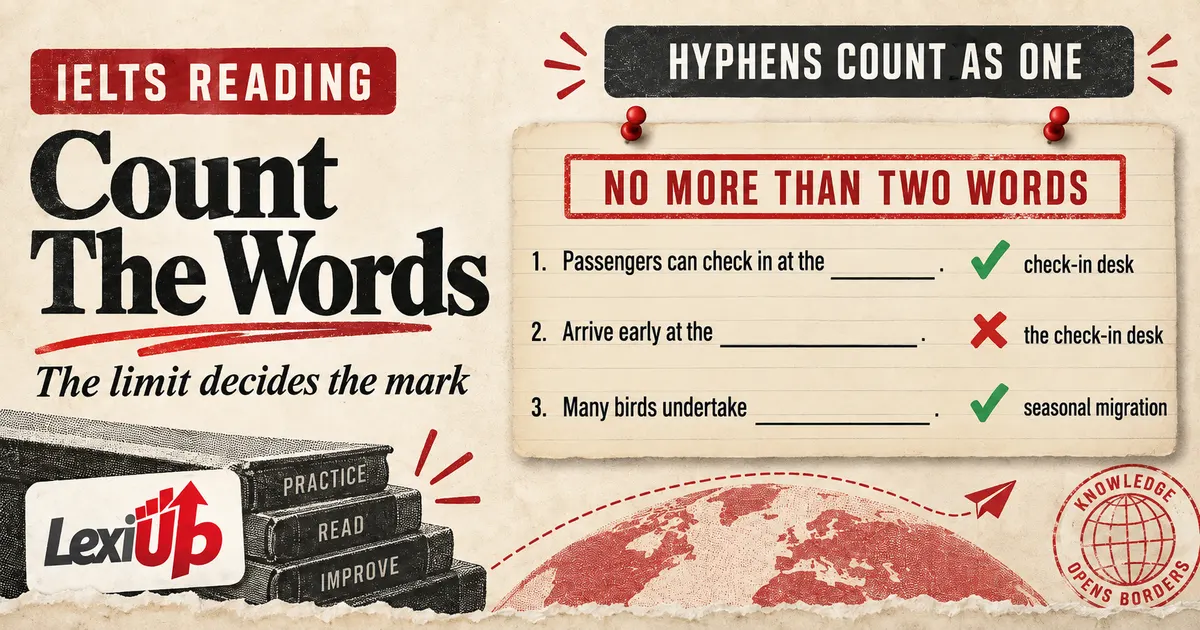
Two conventions decide borderline cases, and both are published. Hyphenated words such as check-in count as single words, so "check-in desk" is two words, not three. And contracted words such as they are will not be tested, so you never need to decide whether an apostrophe splits a word.
Numbers are usually allowed explicitly, in the AND/OR A NUMBER form. When the instruction says two words and a number, a date written as one item does not consume both word slots.
| Answer | Word count | Allowed under NO MORE THAN TWO WORDS |
|---|---|---|
| check-in | One, hyphenated words count as one | Yes |
| check-in desk | Two | Yes |
| the check-in desk | Three, articles count | No |
| seasonal migration | Two | Yes |
| annual seasonal migration | Three | No |
Rule four: use the text order to find your place
For this question type the questions are in the same order as the information in the text. That is a stronger navigational tool than most candidates use.
It means the answer to question 5 sits after the answer to question 4 and before the answer to question 6. If you have found 4 and 6, you do not reread the passage for 5; you read only the span between them. On a 900-word section that turns a three-minute hunt into a twenty-second one.
It also gives you a check. If you think you have found the answer to question 7 in a paragraph above the answer to question 6, one of the two is wrong, and you have caught the error without a mark being lost.
Rule five: read the whole sentence, not the gap
Every IELTS Reading sentence completion item is a paraphrase of something in the passage. Candidates scan for the words either side of the gap, find them, and take whatever follows. When the passage phrases the idea differently, that approach fails silently.
Read the complete sentence first and decide what it means and what grammar the gap needs. A gap after "a marked" needs a noun. A gap after "researchers were able to" needs a verb. That constraint alone eliminates most wrong candidates before you return to the text.
- Read the gapped sentence to the end and say what it claims.
- Mark the grammar the gap requires: noun, plural noun, verb, adjective, number.
- Locate the region using the answers either side of it.
- Find the phrasing in the text and copy the exact words, within the limit.
- Count the words against the limit you wrote in the margin.
What this looks like as a scoring pattern
If you are losing marks on IELTS Reading sentence completion, the pattern is usually visible in your practice papers. Answers that are semantically right but over the word limit point at rule one and rule three. Answers that are right in meaning but use different words point at rule two.
Answers scattered out of sequence point at rule four.
Diagnose which of those three shapes yours is before doing more practice. Another twenty papers will not fix an instruction-reading habit, and it is an unusually cheap habit to fix once named.
Frequently asked questions
Does a hyphenated word count as one word or two?
One. The IELTS partners state that hyphenated words such as check-in count as single words. So under a two-word limit, "check-in desk" is acceptable at two words, while "the check-in desk" is three because the article counts.
Can I use a synonym if it means the same thing?
No. Sentence completion requires you to fill the gap by choosing words from the text. A synonym that matches the meaning exactly is still marked wrong, and the spelling must match too.
What happens if I exceed the word limit?
You lose the mark. The instruction states the maximum, for example NO MORE THAN TWO WORDS AND/OR A NUMBER, and an otherwise correct answer written in three words scores zero.
Are the questions in the same order as the passage?
Yes, for sentence completion the questions follow the order of information in the text. That lets you narrow your search to the span between two answers you have already found, and it also works as an error check if an answer appears out of sequence.
Sources and review note
This guide was reviewed against the sources below. LexiUp remains independent of the exam owners.