For: IELTS candidates who hear the talk clearly but lose marks on notes because they read the gaps and skip the headings, and who want a repeatable way to keep their place across a long Part 4 monologue
What IELTS Listening note completion actually tests
You are given a set of notes with words missing and you write what the speaker says into the gaps, while the recording plays once. The notes are usually a summary of a talk, so they most often appear in the fourth part, where one speaker talks without interruption for several minutes.
Most people lose marks here for a reason that has nothing to do with their listening. They read the gaps and skip the headings. A form gives you a label beside every blank, so the label does the work of telling you what belongs there.
Notes give you something better and easier to ignore: a structure of headings, with several gaps sitting underneath each one.
That structure is the whole difference. The heading above a gap tells you the category of the answer before you hear a single word, and it also tells you where you are in the talk. Read it and you are predicting; skip it and you are guessing from the words either side of the blank.
A worked set of notes, solved gap by gap
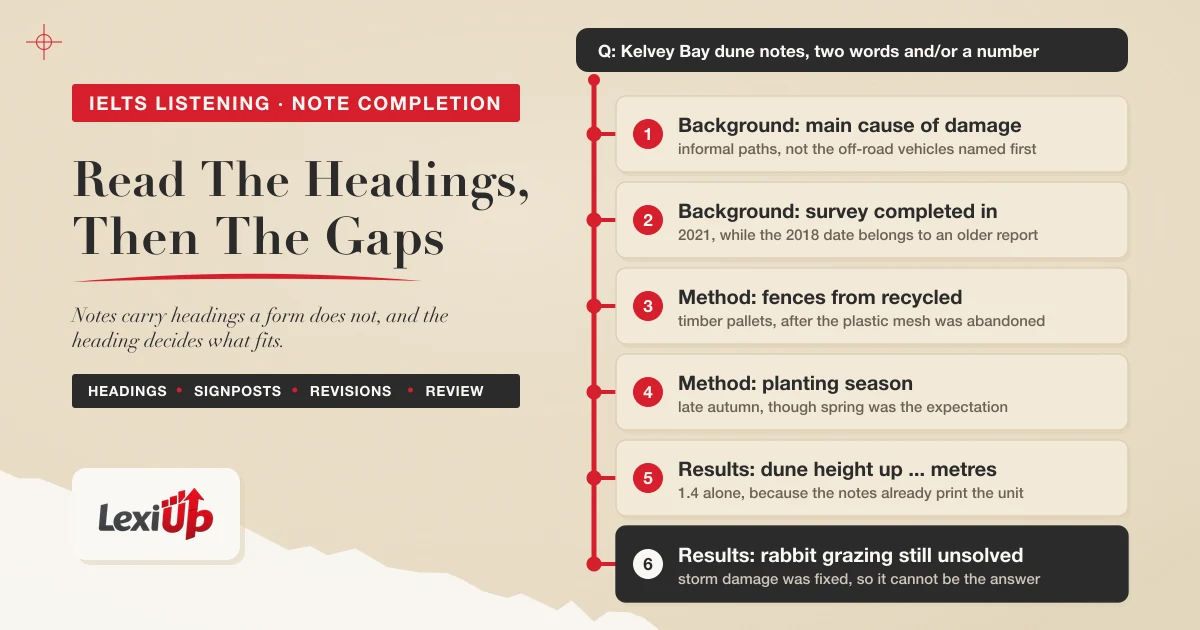
Everything below refers to one original set of notes, written for this guide rather than taken from a real test. A coastal officer is describing a dune restoration project at Kelvey Bay. The instruction is the common one: write two words and/or a number for each answer.
The notes carry three headings, and the talk moves through them in order. Read the six answers together and you can see the pattern: the wrong answer is usually said out loud first, and the heading is what rules it out.
| Heading | Gap | Answer | What catches people out |
|---|---|---|---|
| Background | Main cause of damage | informal paths | Off-road vehicles are named first, then called a smaller problem |
| Background | Survey completed in | 2021 | A 2018 date belongs to an older report mentioned in passing |
| Method | Fences built from recycled | timber pallets | Plastic mesh is described, then abandoned as too costly |
| Method | Planting season | late autumn | Spring is what the team expected before the trial changed it |
| Results | Dune height up ... metres | 1.4 | The unit is already printed, so only the number belongs |
| Results | Problem still unsolved | rabbit grazing | Storm damage is raised first, then reported as fixed |
Check one: read the heading before the gap
Take the gap under Method that reads "fences built from recycled". On its own, the blank could take almost anything the speaker mentions building with. Under the Method heading, it can only take a material the team actually used, which is what rules out the plastic mesh they costed and rejected.
The heading works as a filter you can apply before the answer arrives. Background wants circumstances and dates. Method wants what was done and what it was done with. Results wants outcomes and figures. An answer that does not belong to the category above it is wrong even when you heard it clearly.
- In the preparation time, read the headings first and the gaps second.
- Say the category of each heading to yourself: circumstances, actions, outcomes.
- For each gap, decide what kind of word could fit before you hear anything.
- When an answer arrives that does not match the category, hold it and keep listening.
Check two: let the signposts move you between sections
Losing your place is the expensive failure in notes. Miss one detail and you lose one mark. Miss the moment the talk moved from Method to Results and you can lose three, because you keep listening for the wrong category while the answers you needed go past.
Talks announce that moment out loud, and they do it with a small set of phrases. "Turning to", "the next stage", "that brings me to the results", "so much for the background". These are not decoration. They are the speaker telling you which heading you are now under.
Treat every signpost as a checkpoint. When you hear one, glance back at the section you are leaving, fill any blank there with the best answer of the right category, and move on with the speaker. The cost of an imperfect guess is one mark. The cost of staying behind is the rest of the section.
- Turning to, moving on to, now for: a new heading is starting.
- The next stage, after that, once this was done: still inside Method.
- That brings me to, as a result, the outcome was: Results has begun.
- Finally, one problem remains, looking ahead: the last gaps are close.
Check three: take the second answer when the speaker revises
Four of the six Kelvey Bay answers are the second thing the speaker says. Off-road vehicles, the 2018 report, plastic mesh and spring are each named first, plausibly, and then set aside out loud. Nothing is hidden. This is deliberate, and it is the most reliable pattern in the whole task.
The signal is almost always a small contrast word: actually, in fact, although, in the end, as it turned out, we had expected. When you hear one, whatever follows it is more likely to be the answer than whatever came before.
The trap is that the first option is usually easier to hear. It is said plainly, and the correction arrives inside a longer clause. Writing the first thing you recognise is what turns a talk you understood into a set of wrong answers.
Check four: obey the word limit and the printed units
The instruction sets a hard maximum, and an answer over that limit is marked wrong even when the content is right. Two words and/or a number means you may write two words, or a number, or two words and a number, and never three words.
Notes hide a second version of the same trap. Look at the gap that reads "dune height up ... metres". The word metres is already printed, so the answer is 1.4 and nothing else. Writing 1.4 metres puts the unit in twice and can cost the mark.
Read the words on both sides of every blank before you write, because half the answer is often already there.
Check five: never chase a detail that has gone past
If you realise you have missed a gap, the instinct is to keep reaching for it while the recording continues. That instinct costs more than the mark it is trying to save.
The recording does not wait, the answers arrive in order, and every second spent behind the speaker is a second of the next answer you are not hearing.
The discipline is simple and it has to be practised, because it feels wrong. Leave the gap blank, put a small mark beside it, and rejoin the talk at the point the speaker has actually reached. One blank recovered at the end is worth more than three lost while you were looking backwards.
Check six: a fixed review order for the end of the part
You get time at the end of the section, and most people spend it rereading answers they are already confident about. Use a fixed order instead, so the time goes to the gaps most likely to be wrong rather than the ones easiest to look at.
The order below moves from the cheapest fixes to the most speculative, which means you never run out of time before doing the thing that pays most. On the answer sheet, an empty gap scores nothing and a guess of the right category sometimes scores one, so nothing should ever be left blank.
- Fill every gap you marked as missed, using the heading to choose the category.
- Count the words in every answer against the instruction and cut anything over the limit.
- Check each answer against words already printed around the gap, especially units.
- Re-read the answers where the speaker corrected themselves and confirm you took the second one.
- Check spelling and singular or plural on the answers you are keeping.
- Copy across carefully, and make sure no gap is still empty.
Turning the six checks into a practice loop
Practising IELTS Listening note completion by taking whole tests and marking them tells you the score and not the cause. The useful loop is smaller. Take one set of notes, do it once under timing, then go back and label every wrong answer with which of the six checks would have caught it.
After a handful of sets, the labels stop being spread evenly. Almost everybody has one dominant cause, and it is usually either the heading or the revision. Once you know which one is yours, you are practising a specific habit rather than doing more tests and hoping.
Read the notes before the audio and mark the headings, not just the blanks. That single habit is what separates a candidate who understood the talk from one who scored well on it, and it is free.
Frequently asked questions
How is IELTS Listening note completion different from form completion?
A form gives every blank its own label, so the label tells you what belongs there. Notes give you headings instead, with several gaps under each one, and the heading is what decides the category of the answer. That makes notes harder to skim and much easier to lose your place in, which is why reading the headings first matters more here than anywhere else in the paper.
What should I do if I miss a gap in IELTS Listening note completion?
Leave it, mark it, and rejoin the speaker where they actually are. The recording plays once and the answers come in order, so time spent reaching backwards is taken directly from the next answer. Fill the blank in the review time using the heading to pick a plausible category, because an empty gap scores nothing and a sensible guess sometimes scores one.
Can I write the unit if it is already printed next to the gap?
No. If the notes already print metres, kilograms or per cent beside the blank, the answer is the number alone. Repeating the unit adds a word you do not need, can push you over the word limit, and is marked wrong. Read both sides of every gap before writing, because part of the answer is frequently already on the page.
Why is the first thing the speaker says so often wrong?
Because the task is testing whether you followed the whole thought rather than caught one word. Talks routinely name an option and then replace it, signalled by actually, in fact, although or we had expected. The first option is easier to hear and the correction sits inside a longer clause, so writing what you recognised first is the most common way to lose marks you understood.
Do spelling mistakes cost marks in note completion?
Yes. Answers are marked for spelling and grammar, so a word you heard correctly but wrote incorrectly scores nothing. Names and places that matter are usually spelled out by the speaker, so copy the letters as they are given. Leave the spelling check to the review time at the end of the section rather than doing it while the recording is still playing.
Sources and review note
This guide was reviewed against the sources below. LexiUp remains independent of the exam owners.