For: IELTS Academic and General Training learners who can understand individual direction words but lose their position while following a complete route on a map or building plan
Make IELTS Listening map labelling a route task
IELTS Listening map labelling becomes more manageable when you follow the route instead of trying to remember every word. This question type asks you to connect a spoken description with a plan, map, diagram, or set of pictures.
The useful skill is staying oriented: know where the speaker starts, track each movement, notice reliable landmarks, and recover quickly if one phrase is unclear.
Official IELTS information explains that plan, map, and diagram labelling may ask you to choose letters from a list or write words from the recording. When words are required, the printed word limit must be followed.
The task tests whether you can understand a description of a place and relate that description to the visual, including explanations of where things are and how to follow directions.
This guide uses a six-step method: anchor, track, turn, recover, answer, and check. The worked example is an original fictional community-centre plan created for teaching. It is not an IELTS question and does not reproduce protected test material.
Use the method with current official samples so that you practise both the listening skill and the delivery format you expect to take.
See one original route from entrance to answer
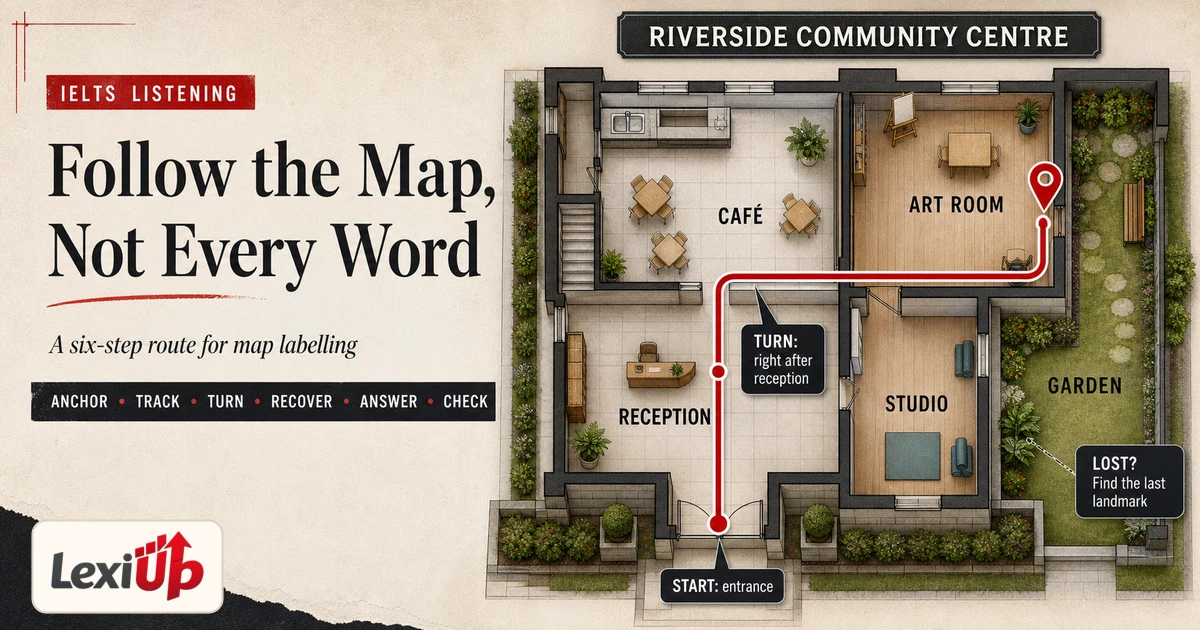
Imagine a plan titled “Riverside Community Centre”. The entrance is at the bottom. Reception is directly ahead, the café is beyond it on the left, and the art room is at the end of the corridor on the right.
The plan also contains a studio and a garden, but those places do not belong to the route in this example.
Now listen to this original practice description: “You are standing at the main entrance. Walk straight ahead to reception. Continue past the desk and take the corridor on your right. The café will be on your left. The art room is at the end of the corridor.” The answer is not found by remembering a single direction word.
It comes from keeping the sequence connected from the entrance to the final landmark.
The route has four stable points: entrance, reception, café, and art room. Reception confirms that you travelled in the correct direction from the entrance. The right turn changes the route. The café confirms the new corridor. The art room is the final destination.
If you miss a small phrase between reception and the café, you can use the next named landmark to find your place again instead of abandoning the whole question.
| Route moment | What you hear | What to do on the plan |
|---|---|---|
| Anchor | You are standing at the main entrance | Place your attention at the marked entrance |
| First landmark | Walk straight ahead to reception | Trace one clear movement to reception |
| Turn | Take the corridor on your right | Change direction only at the stated point |
| Confirmation | The café will be on your left | Use the café to confirm the corridor |
| Answer | The art room is at the end | Select the location reached by the complete route |
Step 1: anchor the start before the recording moves
Use the preparation time to find the title, instructions, possible answers, known labels, compass, entrance, and any “you are here” marker. Do not study every decorative detail. Your first job is to identify the place where the speaker is likely to begin and the features that can confirm that starting position.
A plan of a building may use an entrance, reception desk, stairs, or main hall as an anchor. An outdoor map may use a gate, road junction, bridge, or compass point. The speaker may state the position directly, or the first sentence may reveal it.
Keep your eyes on the likely anchor until the recording confirms it; beginning on the wrong side of the map can shift every later answer.
Also read the task format. If the questions show numbered gaps on the visual, notice their rough order. If the map contains lettered locations and the question lists place names, do not assume alphabetical order matches the recording. Official IELTS guidance notes that map and plan tasks can be presented in different ways, so the printed layout matters.
- Read the instruction and identify whether you need letters or words.
- Find the entrance, arrow, “you are here” point, or first named landmark.
- Check whether a compass changes how direction language should be read.
- Circle two or three existing labels that could help you recover later.
- Do not predict a full route before the speaker confirms the start.
Step 2: track landmarks, not isolated direction words
Direction words are useful only when they connect known places. If you hear “turn right” but do not know where the turn happens, the phrase cannot locate an answer. Keep a light route in your mind or on the paper: start, move, confirm, then turn.
On computer, follow the same sequence with your eyes and cursor without letting either move ahead of the audio.
In the community-centre example, “reception” is more valuable than “straight ahead” by itself. Reception confirms the position reached after the first movement. Later, the café confirms the corridor after the right turn. These named places act like checkpoints.
They reduce the amount you need to hold in working memory because you can rebuild the route from the last confirmed point.
Use a simple tracing style in practice. A small line or fingertip movement is enough; do not draw so heavily that the visual becomes hard to read. If the task is on computer, practise moving your attention through the plan while keeping the options visible.
The aim is to stay with the speaker, not to create a perfect map annotation.
- Begin at the confirmed anchor.
- Trace only the movement that has been stated.
- Pause your route mentally at each named landmark.
- Check that the landmark appears on the expected side.
- Continue only when the next movement becomes clear.
Step 3: turn at the correct point and viewpoint
Left and right depend on the traveller’s viewpoint. After a turn, that viewpoint changes. Learners often keep using the original page orientation and choose a room that is visually on the right side of the paper rather than on the traveller’s right after moving along the route. Follow the person through the plan, not the page from above.
Listen for movement phrases such as “go straight ahead”, “turn left”, “take the second corridor”, “go past”, and “through the far door”. Position phrases such as “opposite”, “next to”, “between”, “at the end”, and “on the corner” describe a relationship once the route reaches the correct area.
Separate these two jobs: movement tells you how to travel; position tells you where the destination sits.
A distractor may use the correct place name with the wrong relationship. The speaker could say that a room used to be beside reception but is now beyond the café. Do not stop at the first familiar label. Keep listening until the movement and final position agree. The complete relationship is stronger evidence than one repeated word.
| Language job | Examples | Question to ask |
|---|---|---|
| Movement | go straight, turn right, pass, go through | How does the route change? |
| Order | first door, second path, just beyond | At which point does the change happen? |
| Position | opposite, beside, between, at the end | Where is the place relative to a landmark? |
| Compass | north-east, south of, western side | Does the visual provide fixed directions? |
| Correction | not the first room; the next one | Which earlier location has been replaced? |
Step 4: recover from the last confirmed landmark
Losing one phrase does not mean you have lost every later answer. Stop chasing the missed words. Look for the last landmark you confirmed and listen for the next label that is already printed on the visual. When the speaker mentions it, place your attention there and rebuild the route from that point.
This recovery habit matters because the recording is played once. Repeating the missed sentence in your head can make you miss the next two directions.
In the example, if “take the corridor on your right” is unclear but you hear “the café will be on your left”, locate the café and check which nearby corridor could support the route from reception. You may not repair the first uncertainty immediately, but you can protect the following question.
During review, identify exactly where orientation failed. Did you miss the starting point, confuse left and right, ignore a known landmark, or follow a distractor after a correction? “I got lost” is too broad for the next session. A precise note such as “I turned before reception” gives you a skill to practise on a new map.
- Release the missed phrase instead of replaying it mentally.
- Return your eyes to the last confirmed landmark.
- Listen for another printed label or a strong position phrase.
- Resume from the new confirmed point and protect later answers.
- Review the cause of the lost position after the task, not during it.
Step 5: answer in the exact form the task requires
Map and plan questions do not always use the same answer format. You may need to select a letter from a list or write words taken from the recording. Check the instruction before listening and keep that rule visible.
A location can be correctly identified but still recorded incorrectly if you write the room name when the task requires a letter.
When words are required, use the stated word and number limit. Official IELTS guidance explains that an answer over the limit loses the mark. Do not add an article or description because it sounds more natural. Copy the necessary words accurately, then check spelling and singular or plural form during the available review time.
If options are provided, eliminate them with route evidence rather than appearance. Two locations may both be near the café, but only one is reached after the correct turn and final position phrase. Record the answer, move with the audio, and avoid repeatedly reopening a decision unless later evidence clearly corrects it.
Step 6: check the route, not only the final label
A useful check asks whether the complete path supports the answer. Start at the anchor, replay the route visually, and confirm the turn, landmark, and final relationship. This can expose an answer chosen from one familiar word. It also helps you distinguish two nearby options without guessing from room shape or page position.
Then check the written form: question number, letter, word limit, spelling, and plural ending. Keep this check short and ordered. Do not redraw the whole plan or invent a new route after the recording. The goal is to test the answer against the evidence you already heard.
When practising with an official task, use the transcript only after your first attempt. Mark the language that established the start, movement, correction, and destination. Compare that evidence with the route you followed. Then repeat the same navigation skill on a different map so that you learn the process rather than memorising one set of answers.
| Check | Evidence question | Common repair |
|---|---|---|
| Anchor | Did I begin where the speaker began? | Move the route back to the stated starting point |
| Turn | Did I turn at the correct landmark? | Separate the movement from the destination |
| Position | Does the final relationship match? | Compare opposite, beside, beyond, and at the end |
| Answer form | Did I use the required letter or words? | Copy the required form only |
| Accuracy | Does spelling and word count fit? | Remove extra words and correct the written answer |
Practise map labelling in a four-session loop
Begin with one fresh official map, plan, or diagram task. Complete it once without a transcript. After checking the answer key, label each error by cause: wrong start, missed turn, lost landmark, distractor, answer form, or spelling. Choose one cause for the next practice session rather than repeating the complete task immediately.
In the second session, use a simple original floor plan and give or follow directions with a partner, teacher, or your own recording. Focus only on orientation language. In the third session, return to an official task and practise recovery: deliberately note the last confirmed landmark whenever the route becomes uncertain.
In the fourth session, complete a new timed task and check whether the repair transfers.
Connect this work to related LexiUp IELTS guidance. Use the Listening answer-accuracy guide when letters, spelling, or word limits are the main problem. Use the mistake-review guide to turn one lost-position pattern into a focused next task.
If concentration across the whole recording is difficult, use the daily study-plan guide to schedule shorter listening and review blocks instead of repeating full tests without correction.
| Session | Main focus | Evidence to keep |
|---|---|---|
| 1 | Fresh official task | One precise cause for each missed location |
| 2 | Direction-language drill | A route that stays connected after each turn |
| 3 | Recovery practice | The last landmark used to regain position |
| 4 | New timed task | Whether the repaired skill worked on new content |
Connect the next Listening repair to LexiUp IELTS
LexiUp IELTS can help you keep Listening practice and mistake review connected on iPhone. Use the daily plan or Listening practice to choose one focused task, then save the recurring pattern you want to repair. The app is free to start and supports independent IELTS preparation; its guidance is not an official score or examiner decision.
For this lesson, choose one target such as “confirm the starting point before tracing”, “turn only at a named landmark”, or “recover from the last printed label”. Keep the target narrow for several short attempts. A specific repair is easier to recognise and revisit than a broad note such as “improve Listening”.
LexiUp is independent and is not affiliated with or endorsed by IELTS. Use official IELTS, British Council, IDP, and Cambridge materials for current format information and authentic practice. Use LexiUp to organise the surrounding loop: attempt, check the route, record the cause, repair one navigation skill, and return to a new task.
Frequently asked questions
What is IELTS Listening map labelling?
It is a Listening question type in which you complete labels on a plan, map, diagram, or related visual. You may choose letters from a list or write words from the recording, depending on the instruction.
How can I stop losing my place on a Listening map?
Confirm the starting point, trace one movement at a time, and treat printed landmarks as checkpoints. If you lose one phrase, return to the last confirmed landmark and listen for the next known label.
Should I follow left and right from my view of the page?
Follow left and right from the traveller’s current viewpoint. After the route turns, the viewpoint changes, so page position alone is not reliable evidence.
Do map-labelling answers always use letters?
No. Official IELTS information says that you may select answers from a list or write words from the recording. Read the instruction carefully and follow any word or number limit.
Is the Riverside Community Centre an official IELTS task?
No. It is an original fictional example created to make the navigation method visible. Use official IELTS samples for authentic task practice.
Sources and review note
This guide was reviewed against the sources below. LexiUp remains independent of the exam owners.