For: Candidates who score well on Parts 1 to 3 and lose four or five marks in the final ten questions, usually in the second half
IELTS Listening Part 4 is the only part with nowhere to recover
The Listening test runs about 30 minutes across four parts and 40 questions, each worth one mark. Part 1 is a conversation, often about something practical like travel arrangements. Part 2 has one main speaker on a general topic such as local facilities. Part 3 is a conversation between two main speakers in an educational setting.
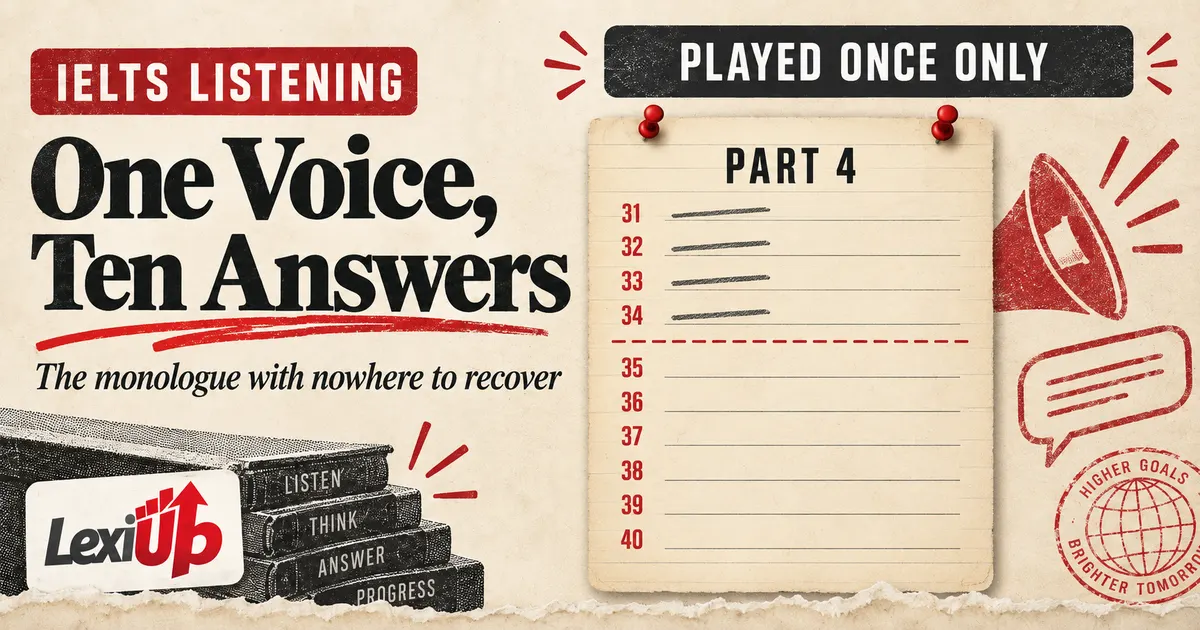
IELTS Listening Part 4 is different in a way that matters more than candidates expect: only one person speaks, on an academic subject, for the whole section. There is no second voice to reformulate an idea, no interviewer to ask the question you were about to ask, and no natural pause where a speaker changes.
You hear the recording once only. So when attention slips at question 34, there is no conversational turn to help you find your place again, and the remaining six answers can go with it. That is why a candidate can be strong across the first three parts and still lose half of Part 4.
Move one: read all ten questions in the time you are given
You get time before the section to look at the questions. Most candidates read the first three or four, feel prepared, and stop. That is the single most expensive habit in this part of the test.
Read all ten. You are not memorising them; you are building a map of where the talk is going. A lecture on urban planning that ends with questions about funding tells you the last two minutes will turn to money, and knowing that in advance is what stops you drifting when the topic shifts.
Move two: predict the grammar of every gap
Before the audio starts, mark what each gap needs. A number, a plural noun, a verb, an adjective. This takes seconds and does two things at once.
First, it narrows what you are listening for from "anything" to "a plural noun", which is far easier for attention to hold.
Second, it catches errors at the moment of writing: if you predicted a plural and wrote a singular, one of the two is wrong and you can hear the difference on the spot rather than discovering it at transfer time.
- Mark each gap with the part of speech it needs
- Note where a number or date is obviously required
- Underline the word before the gap; it is usually the signal you will hear
Move three: follow signposts, not sentences
Academic speakers signpost heavily. They say what they are about to do, they number their points, and they mark contrast before delivering it. Those signposts are your position on the map, and they matter more than any individual sentence.
Listen for the structural language rather than trying to understand every word: "there are three main reasons", "the first of these", "however, more recent work suggests", "finally". When you hear "the second factor" and you are still writing the answer to question 31, you know immediately that you have fallen behind and can jump forward instead of drifting.
| You hear | It means | Do this |
|---|---|---|
| "three main reasons" | Three answers are coming in order | Check how many gaps remain in this block |
| "however", "in contrast" | The next fact reverses the last one | Expect the answer to be the second version |
| "for example", "such as" | Illustration, often not the answer | Hold position; do not write yet |
| "finally", "to sum up" | You are near the last questions | If gaps remain unfilled, jump to them now |
Move four: abandon a lost answer immediately
This is the discipline that separates a 7 from a 6 in this section, and it is entirely psychological. When you miss an answer, the instinct is to keep reaching for it while the recording continues. That instinct costs the next two answers as well, turning one lost mark into three.
Decide in advance that a missed gap gets a dash and nothing more. Move your eyes to the next question immediately. You can guess the dashed one at the end from context, and a guess costs nothing because there is no penalty for a wrong answer.
Move five: build stamina with real academic speech
Practising with test papers alone builds familiarity but not endurance. IELTS Listening Part 4 asks you to hold concentration through several minutes of uninterrupted academic English, and that is a trainable capacity that most preparation ignores.
Listen to genuine lectures and talks with the transcript hidden. Recorded university lectures, science podcasts and documentary narration all work. Different accents are used in the test, including British, Australian, New Zealand and North American, so deliberately vary what you listen to rather than staying with the accent you find easiest.
The measure of progress is not comprehension of every word. It is whether you can still say what the speaker is arguing after four minutes without rewinding.
- Pick a five-minute academic talk in an accent you find difficult.
- Listen once, without pausing, taking notes in the gap-fill style the test uses.
- Write two sentences summarising the argument, from your notes alone.
- Only then check the transcript, and mark where your attention actually broke.
- Repeat three times a week; the break point moves later.
Frequently asked questions
Is Part 4 harder than the rest of the Listening test?
It is not harder in vocabulary so much as in structure. Only one person speaks, on an academic subject, with no second voice to restate an idea and no change of speaker to help you find your place. Combined with hearing the recording once only, that makes losing your position more costly than anywhere else.
How many questions are in Part 4?
Ten. The Listening test has 40 questions across four parts, each worth one mark, and your final score is reported as a band in whole or half bands.
Can I hear the recording again?
No. You hear the recordings once only. This is why abandoning a missed answer quickly matters: there is no second pass, and time spent reaching backwards is taken from answers still ahead of you.
Which accents should I prepare for?
A range. The test uses different accents including British, Australian, New Zealand and North American. Deliberately practise with the accent you find hardest rather than the one you are most comfortable with.
Sources and review note
This guide was reviewed against the sources below. LexiUp remains independent of the exam owners.