For: Academic and General Training learners who lose Reading marks by confusing False with Not Given
IELTS True, False, Not Given is an evidence question
IELTS True, False, Not Given questions test whether a statement matches the information in the passage. They do not test your general knowledge, your opinion, or whether the statement seems reasonable. Your only reliable question is: can the passage prove this complete statement, disprove it, or do neither?
That evidence rule matters because False and Not Given are different. False requires evidence for the opposite meaning. Not Given means the passage does not provide enough information to decide either way. A sentence can share several keywords with the passage and still be Not Given if one essential detail—such as a number, comparison, cause, or time—is missing.
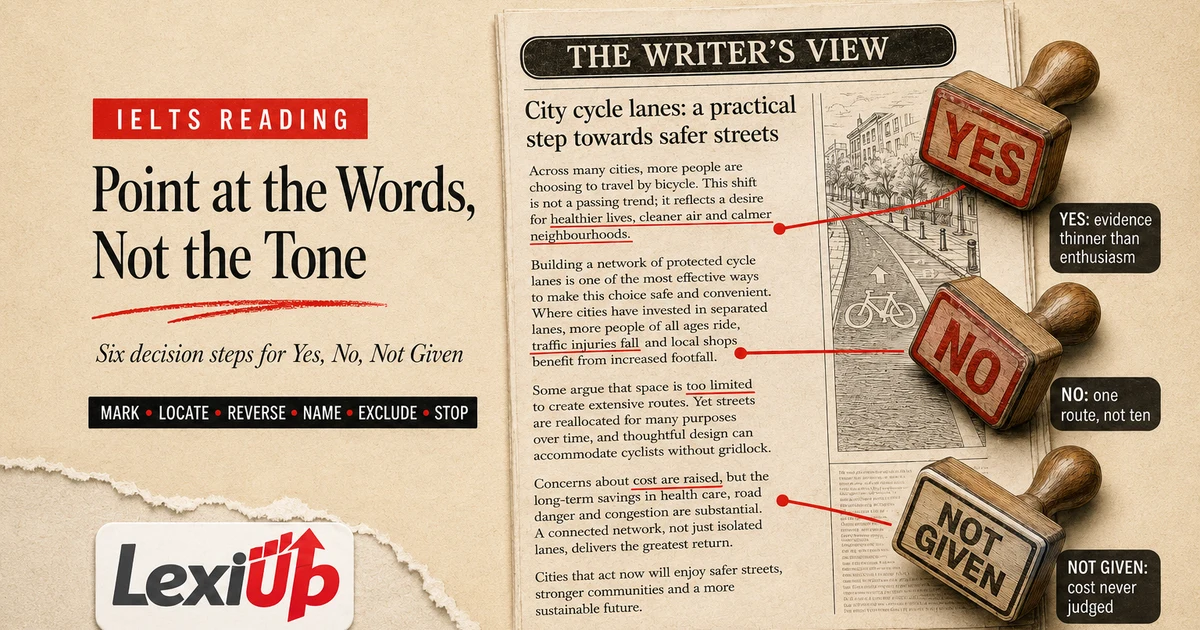
The same evidence discipline also helps with Yes, No, Not Given. True, False, Not Given normally compares statements with factual information; Yes, No, Not Given compares statements with a writer’s views or claims. Always follow the labels printed in the task instead of treating the two formats as interchangeable.
Know the three decisions before you search
A clear decision rule reduces guessing. True means the passage supports the whole meaning of the statement, even when it uses different words. False means the passage gives information that makes the statement wrong. Not Given means the passage neither supports nor contradicts the complete statement.
Do not use Not Given simply because you cannot find the answer quickly. Search carefully enough to test the key details first. Then stop: if the relevant area mentions the topic but does not settle the exact claim, the information is missing. If the passage clearly states an opposite detail, the answer is False rather than Not Given.
| Answer | What the passage does | Evidence you need |
|---|---|---|
| True | Agrees with the complete statement | A sentence or connected sentences that support every essential detail |
| False | Contradicts the statement | A stated opposite, incompatible number, reversed comparison, or denied relationship |
| Not Given | Does not settle the statement | No proof for the claim and no proof for its opposite |
Step 1: break the statement into evidence targets
Before scanning the passage, reduce the statement to its testable parts. Mark the subject, the main action or relationship, and any detail that changes the claim. High-risk details include words such as all, only, most, more, less, first, always, never, before, after, because, and mainly. A single qualifier can decide the answer.
For example, “Most participants completed the course online because it was cheaper” contains at least four targets: participants, completion, online delivery, a majority, and cost as the reason. Finding a sentence that says some participants studied online proves only part of the statement. You still need evidence about completion, proportion, and cause.
Turn the statement into a neutral question. Instead of carrying the statement’s wording into the passage, ask: “How many participants completed the course online, and why?” This makes it easier to notice both synonyms and contradictions.
- Underline the subject and main action.
- Circle quantities, comparisons, negatives, causes, and time limits.
- Rewrite the claim as a short evidence question.
- Predict what an opposite answer would look like before searching.
Step 2: locate the relevant evidence, not matching words
True, False, Not Given answers usually follow the order of the passage, so the previous and next questions can create a useful search boundary. Scan for distinctive nouns, names, dates, and paraphrases.
When you find the topic, read the sentence closely and include the sentence before or after it when a pronoun, contrast, or cause depends on nearby context.
Expect paraphrase. The statement may say “fell sharply” while the passage says “declined by almost half.” It may say “was reluctant” while the passage says “did not initially support.” Matching one repeated noun is not enough; compare the relationship between the ideas.
Avoid reading the full passage repeatedly. Use the question order to move forward, but do not make it an absolute rule. Your final decision still comes from meaning. If the task or passage structure makes the location uncertain, widen the search before choosing Not Given.
- Strong anchors: names, dates, technical terms, unusual nouns, and numbers.
- Meaning anchors: cause, comparison, change, sequence, and degree.
- Context checks: negatives, concessions such as “although,” and pronoun references.
- Weak anchors: common words that appear throughout the passage.
Step 3: test every essential detail
Once you find the relevant section, compare the complete meaning. Start with the subject and action, then test the qualifiers. If every essential part is supported, choose True. If one essential part is explicitly incompatible with the passage, choose False. If that part is never settled, choose Not Given.
Be especially careful with scope. “The trial improved sleep” does not automatically support “The trial improved sleep for every participant.” The passage confirms an improvement but may not report the result for every individual. Unless another sentence supplies that scope, the stronger statement is Not Given.
Also separate absence from opposition. If the passage says the museum opened in 1998, the statement “The museum opened in 2001” is False. If the passage describes the museum but never gives an opening year, the 2001 statement is Not Given. False must be provable.
Step 4: keep outside knowledge outside the answer
Official IELTS guidance warns against using what you already know about the topic. Even a fact that is true in the real world cannot make a Reading answer True unless the passage supports it. The same rule applies when your experience makes a statement feel unlikely.
Imagine a passage says that a city introduced electric buses in 2024. You may know that electric vehicles can reduce local air pollution, but if the passage does not discuss pollution, a statement claiming that the programme improved air quality is Not Given. Your knowledge may help you understand vocabulary; it cannot supply evidence.
Use a simple mental boundary: “In this passage, can I prove it?” This wording keeps your decision attached to the text rather than to the topic.
Step 5: use a controlled stop rule for Not Given
Not Given becomes a time trap when learners keep searching for a sentence that does not exist. Use a stop rule. Identify the relevant paragraph, check the complete local context, and ask whether the missing detail could reasonably appear elsewhere.
If the topic is finished and neither the claim nor its opposite appears, choose Not Given and move on.
Do not use time alone as the rule. “I searched for one minute” does not prove absence. The stop rule works because you first located the correct topic area and tested the statement’s essential parts. During review, record which missing detail caused the answer: proportion, reason, comparison, time, or another qualifier.
If two options still seem possible, write a tiny evidence note on your practice paper: “passage says ___; statement adds ___.” The added, unsupported detail often reveals Not Given. If the note instead shows a direct opposite, choose False.
Avoid the five traps that create preventable errors
The first trap is matching keywords instead of meaning. Test writers can repeat a topic word while changing the relationship around it. If both the passage and statement contain “migration,” for example, that tells you where to read—not which answer to choose. Rebuild the whole claim from the passage before deciding.
The second trap is treating a partial match as True. A statement may contain two or three claims joined together. If the passage supports the first clause but does not mention the second, the complete statement is not proven. This often happens with added reasons: the passage reports a change, while the statement invents why it happened.
The third trap is assuming that different means False. Paraphrases can look different while preserving meaning. “The scheme was initially unpopular” can agree with “Residents did not support the scheme at first.” Compare time, degree, and logical relationship rather than counting shared words.
The fourth trap is turning uncertainty into Not Given too early. A difficult paraphrase may hide a clear answer. Before choosing Not Given, confirm that you found the relevant topic and tested synonyms, numbers, comparisons, and negatives. Not Given is an evidence decision, not a confidence rating.
The fifth trap is refusing to choose Not Given because the topic appears. A passage can discuss a company’s new policy without explaining its cost, popularity, or long-term effect. Topic overlap does not fill those gaps. Name the exact missing detail and move on.
| Trap | What goes wrong | Repair question |
|---|---|---|
| Keyword match | Repeated words are mistaken for agreement | Does the relationship between the ideas also match? |
| Partial support | One clause is proven but another is ignored | Can I prove every essential part? |
| Paraphrase panic | Different wording is mistaken for contradiction | Is the meaning actually incompatible? |
| Early Not Given | A hidden paraphrase is not investigated | Did I test synonyms and the local context? |
| Topic overlap | A mentioned topic is treated as complete evidence | Which exact detail remains missing? |
A second example: small qualifiers change the answer
Consider another original passage: “Researchers invited 120 commuters to test the new ticketing app. Ninety-two completed both survey rounds. Most respondents said the app made ticket purchase faster, although several reported difficulty reading the smallest text. The study did not compare the app with paper tickets.”
Statement A says, “All invited commuters completed the study.” This is False because the passage gives two incompatible figures: 120 were invited and 92 completed both rounds. Statement B says, “The majority of respondents found ticket purchase quicker.” This is True: “most” and “the majority” express the same proportion relationship here.
Statement C says, “Older commuters had more difficulty reading the app.” This is Not Given. The passage mentions reading difficulty but provides no age comparison. The word “commuters” appears in both places, yet the decisive detail is age. Statement D says, “Paper tickets were slower than the app.”
This is Not Given because the study did not compare them.
Notice the difference between the two Not Given answers. In Statement C, a subgroup comparison is missing. In Statement D, the entire comparison was outside the study. Naming the missing evidence makes the decision easier to review and repeat.
Use a 15-minute evidence drill before full timed sections
A short drill can build the decision skill without the cognitive load of a full Reading section. Choose five or six True, False, Not Given statements from an official or source-reviewed passage. Give yourself two minutes to mark evidence targets, six minutes to locate and answer, and five minutes to justify each decision.
Use the final two minutes to label one recurring trap.
For every True answer, underline all information needed to support the complete statement. For every False answer, box the exact opposite or incompatible detail. For every Not Given answer, write the smallest missing element beside the question: “cause missing,” “number missing,” or “comparison missing.” These notes make an invisible decision process observable.
On the next attempt, remove the written justification but keep the mental sequence. The aim is not to create more notes for test day. It is to train a compact routine that you can execute quickly: break the claim, locate the topic, compare the meaning, decide from evidence, and stop.
Mix learning drills with timed sections. A timed section tests pace and concentration; a focused drill repairs a specific decision. If every practice session is a full test, you may measure the same False-versus-Not-Given confusion repeatedly without changing it.
| Time | Action | Output |
|---|---|---|
| 0–2 minutes | Break statements into evidence targets | Subjects, actions, and risky qualifiers marked |
| 2–8 minutes | Locate and answer | One decision per statement based on local context |
| 8–13 minutes | Prove each label | Support, contradiction, or missing detail identified |
| 13–15 minutes | Choose one repair | One trap to repeat on a fresh passage |
Worked example: compare meaning, not vocabulary
Use this original practice passage: “The Riverside Library began a weekend trial in March. During the first month, Saturday visits increased by 18 per cent. Managers extended the trial through winter, but they have not yet decided whether Sunday opening will continue next year.”
Now apply the evidence method. The passage directly supports a March start and an 18 per cent increase in Saturday visits. It directly says the Sunday decision has not been made. It says nothing about why visits increased.
| Statement | Answer | Reason |
|---|---|---|
| The weekend trial started in March. | True | The passage directly states the start month. |
| Saturday visits increased by 20 per cent. | False | The passage gives an incompatible figure: 18 per cent. |
| Longer opening hours caused the increase in visits. | Not Given | The increase is reported, but its cause is not. |
| The library will definitely open on Sundays next year. | False | The passage says the decision has not yet been made. |
Build speed through review, not shortcuts
Practise in two modes. In learning mode, write the evidence line and explain why the other two labels are wrong. In timed mode, use the five steps without writing full explanations. Afterwards, return to every error and classify it: wrong location, missed paraphrase, ignored qualifier, outside knowledge, or confusion between contradiction and missing information.
Then complete a near-transfer item with the same trap but a different topic. If you missed “most,” practise another statement with a proportion. If you treated a missing cause as False, practise another cause-and-effect claim. This turns one correction into a reusable Reading skill.
Do not turn a practice set into a band prediction. Track accuracy by question type across several passages, along with the reason for errors and whether the correction transfers. Use current official samples to learn the task format and independent practice to repeat the decision process.
- Complete a short official or source-reviewed practice set.
- Underline the exact evidence for every answer.
- Label each error by decision cause, not simply “Reading.”
- Repeat the same evidence skill on a fresh passage within 24–48 hours.
- Review whether the same trap returns after a few days.
Frequently asked questions
What is the difference between False and Not Given in IELTS Reading?
False means the passage provides evidence that contradicts the statement. Not Given means the passage does not provide enough information to prove either the statement or its opposite.
Do True, False, Not Given answers come in order?
They usually follow the order of information in the passage, which can help create a search boundary. Treat this as a locating aid, then verify every answer from the passage itself.
Can I use my own knowledge to answer?
No. Base the answer only on the passage. Outside knowledge cannot turn an unsupported statement into True or False.
Are Yes, No, Not Given questions the same?
The evidence logic is similar, but Yes, No, Not Given compares statements with the writer’s views or claims. True, False, Not Given compares statements with information presented as fact. Follow the task labels exactly.
How can I stop spending too long on Not Given?
Locate the relevant topic area, test every essential detail, read the local context, and then stop when neither the claim nor its opposite is stated. Do not keep searching only because the statement sounds plausible.
Sources and review note
This guide was reviewed against the sources below. LexiUp remains independent of the exam owners.