
For: Candidates who have not yet booked either test
PTE or IELTS: one question decides it, and it is not which is easier
Almost everyone weighing PTE or IELTS asks which is easier. That is the wrong first question, because it only matters among the tests you are actually allowed to sit.
Start at the other end. Open the page of the university, employer or immigration authority you are applying to, and read which tests they name and what score they require. Not a forum post, and not a comparison article, including this one. The official requirement page.
If only one test is listed, you are done. Book it. Everything below is for the candidates who find both.
The differences that change how you prepare
These are the practical differences, taken from each test provider. They shape how you practise far more than any claim about difficulty does.
| What you are comparing | IELTS Academic | PTE Academic |
|---|---|---|
| Score scale | A 9-band scale, reported in whole and half bands | A 10 to 90 point scale |
| Speaking | With a trained examiner: in person at a test centre, or by video call if you sit IELTS Online | Spoken into a headset microphone at a computer, in a partitioned booth, with no examiner present |
| Marking | Trained human examiners | AI scoring combined with human expertise |
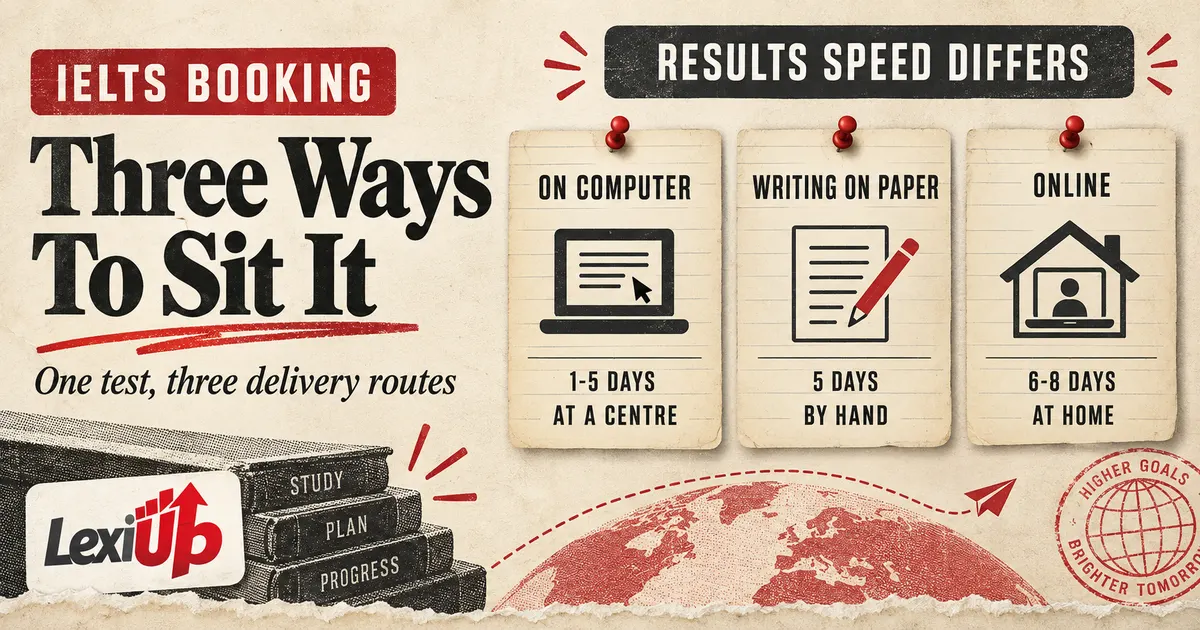
| Ways to sit it | Paper or computer at a test centre. IELTS Academic can also be sat online from home; General Training cannot | On a computer at a test centre, speaking section included |
Choose PTE Academic if these describe you
None of these is about ability. They are about the conditions you do your best work in.
- You freeze in front of an interviewer but speak fluently to a screen
- You type considerably faster than you write by hand
- You want every section delivered on a computer, speaking included
- You are comfortable being cut off by a timer rather than managing your own pace
Choose IELTS if these describe you
The same test to a different person is a different experience. Be honest about which of these is you.
- A conversation with a person helps you find your rhythm
- You want the option of paper because screens tire you, or you want to sit the Academic test from home
- You have already prepared for IELTS and your target score is close
- The institutions on your list name IELTS more often than PTE
What choosing PTE or IELTS changes in your week
The format differences matter because they change what you rehearse, not because one test is kinder than the other.
If you sit PTE, your speaking practice happens alone with a headset. You rehearse starting immediately after a tone, finishing inside a fixed window, and speaking at an even pace without a listener nodding along.
Candidates who have only ever practised conversationally often find the silence disorienting the first time, and that is a rehearsal problem rather than an ability problem.
If you sit IELTS, your speaking practice needs another person in the room, or on a call. You rehearse being interrupted, asked to expand, and steered onto a topic you did not choose. That is difficult to simulate alone, and it is the part candidates most often skip.
Writing splits the same way. A computer-delivered test rewards typing quickly and editing on screen. A paper sitting rewards planning before you commit, because reorganising a handwritten answer costs you minutes you do not have.
Set aside one week to rehearse in the real format before you decide. Not sample questions read on a phone: the actual conditions, timed, with the tools you will have on the day. Most candidates discover their preference in that week rather than from any comparison table.
- Practise speaking in the format you will actually face, not the one that is convenient
- Time every practice section from the start, because pacing is what fails first
- Write at least one full answer in the medium you will use on the day
- Get feedback on what you produced, not on how you felt about it
What matters less than the internet suggests
Both tests are hard in different places and neither has a shortcut. The candidates who improve fastest are not the ones who picked the cleverer test. They are the ones who practise the specific task types their test uses, and who get feedback on their actual writing and speaking rather than on their impression of it.
Switching tests late is usually a mistake. Three weeks before a deadline, the test you already understand beats the test that theoretically suits you better.
Decide in one sitting
This takes an afternoon and saves weeks of preparing for the wrong test.
One caution on timing. Requirements change, and the page you read in January may not say the same thing in June. If more than a few months pass between choosing your test and actually applying, open those official requirement pages again before you pay for anything.
Scores also carry a validity period, so a result you sat early can expire before the application it was meant for, which is an expensive way to learn that the rules moved.
- IELTS Academic or General Training: which one you need →
- How IELTS band scores are calculated →
- Build a daily IELTS study plan →
- Preparing for IELTS while working full time →
- What to bring and expect on IELTS test day →
- List every institution you are applying to
- Open each one official English requirement page and write down the tests and scores accepted
- Cross off any test that is not accepted everywhere on your list
- If both survive, sit a timed practice section of each and compare how you felt, not only what you scored
- Book the one you can prepare for consistently in the time you actually have
Frequently asked questions
Is PTE easier than IELTS?
Neither is easier overall. PTE suits candidates who prefer a screen and a timer, and IELTS suits candidates who do better speaking to a person. Difficulty depends far more on which skills you are weakest in than on which test you choose.
Can I switch tests after preparing for one?
You can, but close to a deadline it usually costs more than it gains. The task types differ enough that preparation does not transfer cleanly.
Does one test get accepted more widely?
Acceptance varies by institution and by country, and it changes. Check the official requirement page for every place on your list rather than relying on a general answer.
Sources and review note
This guide was reviewed against the sources below. LexiUp remains independent of the exam owners.