For: Candidates booking a test in late 2026 who last researched IELTS when the only choice was computer or paper, and who need to know which route their receiving organisation will actually accept
IELTS test delivery is now three routes, not two
If you last looked into booking a test a year ago, the question was simple: computer or paper. That framing is gone.
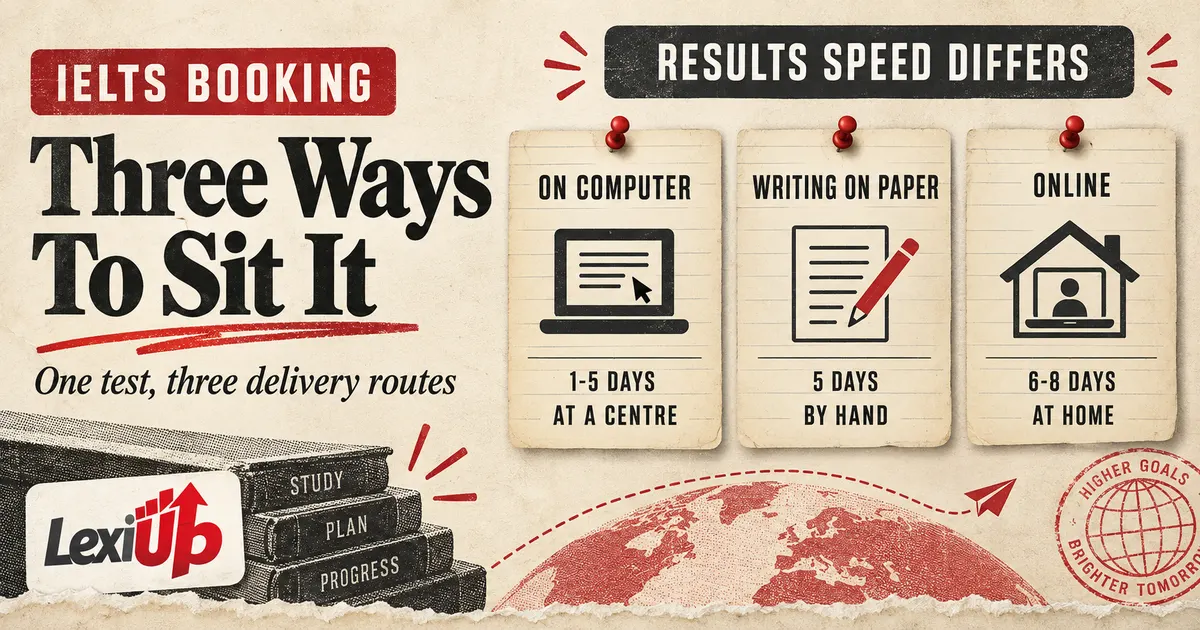
From mid-2026 the IELTS partners restructured how the test is offered, and IELTS test delivery now means choosing between sitting at a centre on a computer, sitting at a centre on a computer but writing the Writing component by hand, and in some countries sitting the Academic test remotely at home.
The three routes are not interchangeable. They differ on how fast results arrive, where the Speaking section happens, and, most importantly, on whether the organisation you are applying to will accept the result at all. Choosing on convenience alone is how people end up with a valid score that their university will not take.
This guide sets out what each route actually involves, using the IELTS partners’ own published detail rather than centre hearsay, so you can book once and not discover a constraint afterwards.
IELTS on computer at a test centre
This is the default route and the one most centres offer. You attend an official IELTS test centre and the Listening, Reading and Writing questions appear on screen, with your answers typed into the computer.
The Speaking section is not on screen: it is a face-to-face session with a trained IELTS examiner, the same as it has always been.
Results for IELTS on computer are available one to five days after you finish. That is the fastest of the three routes, and it is the reason most candidates working to an application deadline pick it.
It is also the route with the fewest acceptance questions attached. A result from a test sat at an official centre, with identity verified and every component supervised, is the form of IELTS result organisations have accepted for years.
- Listening, Reading and Writing on screen; Speaking face-to-face with an examiner
- Results in one to five days
- Required if your test is for UK Visas and Immigration
Writing on Paper keeps the pen without losing the speed
Writing on Paper is not a separate test. It is the computer test with one component changed: your Writing tasks are still shown on screen, but you complete them in pen on an IELTS Writing Answer Sheet. Everything else, including the face-to-face Speaking session, is unchanged.
It exists for a specific group. Some candidates plan essays faster by hand, some find on-screen editing slows them down, and some simply have lower digital confidence and do not want to discover that under timed conditions. Availability is limited to selected countries, so this is one to confirm with your centre before you book rather than assume.
Results arrive within five days. There is one detail worth knowing: the Test Report Form does not specify that the Writing on Paper option was chosen. To the organisation reading your result, it is an IELTS on computer score, which removes any worry about being judged for the choice.
IELTS Online is the one with a condition attached
IELTS Online lets you sit the test at home or another suitable private location with a stable internet connection. It is offered in a growing list of countries, and the IELTS partners are adding more.
The format, questions, timing and marking criteria are the same as sitting at a centre, so the test itself is not easier or harder.
Two things make it different. The Speaking section is completed in an online video call with a trained examiner rather than in person. And results take six to eight days, noticeably slower than the one to five days of the centre-based computer test.
The condition that matters most is acceptance. IELTS Online is available for the Academic test only, the Test Report Form indicates that the test was completed online, and receiving organisations decide for themselves whether they accept an online result.
If you are applying for a UK visa, this route is closed to you: tests taken to secure a UKVI visa must be sat at an official centre where identity is verified and every component is overseen.
- Academic test only, so General Training candidates cannot use it
- Speaking is an online video call, not face-to-face
- The Test Report Form shows the test was taken online
- Not permitted for UK Visas and Immigration
The three routes side by side
The table below is the whole decision in one place. Read it against your own deadline and your own receiving organisation, in that order.
| Route | Where | Speaking | Results | Main constraint |
|---|---|---|---|---|
| IELTS on computer | Official test centre | Face-to-face with an examiner | 1 to 5 days | None beyond centre availability |
| Writing on Paper | Official test centre, Writing by hand | Face-to-face with an examiner | Within 5 days | Selected countries only |
| IELTS Online | Home or private location | Online video call | 6 to 8 days | Academic only; each organisation decides |
Choosing between them without guessing
Work through it in this order, because the later questions only matter if the earlier ones leave you a choice.
- Check what your receiving organisation accepts. If it is a UKVI visa, you are sitting at a centre, and the rest of this list is decided for you.
- Check whether you need General Training. If you do, IELTS Online is not available and you are choosing between the two centre routes.
- Check your deadline against the results window. One to five days and six to eight days are very different if a university portal closes next week.
- Check whether your centre offers Writing on Paper, and whether you actually plan better by hand. Do not choose it on principle; try one timed essay each way first.
- Book the route that survives all four answers. If two survive, take the faster result.
What does not change whichever route you take
The marking criteria are identical. Writing is still assessed on Task Achievement, Coherence and Cohesion, Lexical Resource, and Grammatical Range and Accuracy, and Speaking is still assessed on Fluency and Coherence, Lexical Resource, Grammatical Range and Accuracy, and Pronunciation. No route grades more generously than another.
The question types are identical too. Nothing in your preparation needs to change because of how you sit the test, which is worth saying plainly: candidates lose weeks researching delivery routes that would have been better spent on the skill holding their band down.
IELTS is jointly owned by the British Council, IDP IELTS, and Cambridge University Press & Assessment, and the three partners publish the same specification. If a centre tells you something that contradicts the partners’ published detail, the published detail is what your Test Report Form will follow.
Frequently asked questions
Is IELTS Online easier than sitting at a test centre?
No. The IELTS partners state that IELTS Online has the same format, questions, timing and marking criteria as the centre-based test. The differences are practical rather than academic: where you sit it, how the Speaking section is conducted, how quickly results arrive, and whether your receiving organisation accepts an online result.
Will my university know which route I used?
It depends on the route. The Test Report Form indicates when a test has been completed online. It does not indicate that the Writing on Paper option was chosen, so a Writing on Paper result is presented exactly like any other IELTS on computer result.
Can I sit IELTS Online for a UK visa application?
No. Tests taken to secure a visa for UK Visas and Immigration must be taken at an official IELTS test centre, where identity is verified and all elements of the test are overseen. Book a centre-based test if a UKVI visa is your purpose.
Which route gives results fastest?
IELTS on computer at a test centre, with results available one to five days after the test. Writing on Paper results arrive within five days. IELTS Online is the slowest of the three at six to eight days.
Is General Training available online?
No. IELTS Online is available for the IELTS Academic test only. General Training candidates choose between the centre-based computer test and, where offered, the Writing on Paper option.
Sources and review note
This guide was reviewed against the sources below. LexiUp remains independent of the exam owners.